Production Hybrid Search and Metadata Filtering in Vector Databases: Weaviate vs Qdrant, Pinecone, Elasticsearch, OpenSearch, and Milvus in 2025
Why Weaviate offers the best balance of hybrid relevance, exact metadata constraints, and filter-aware retrieval for production search.
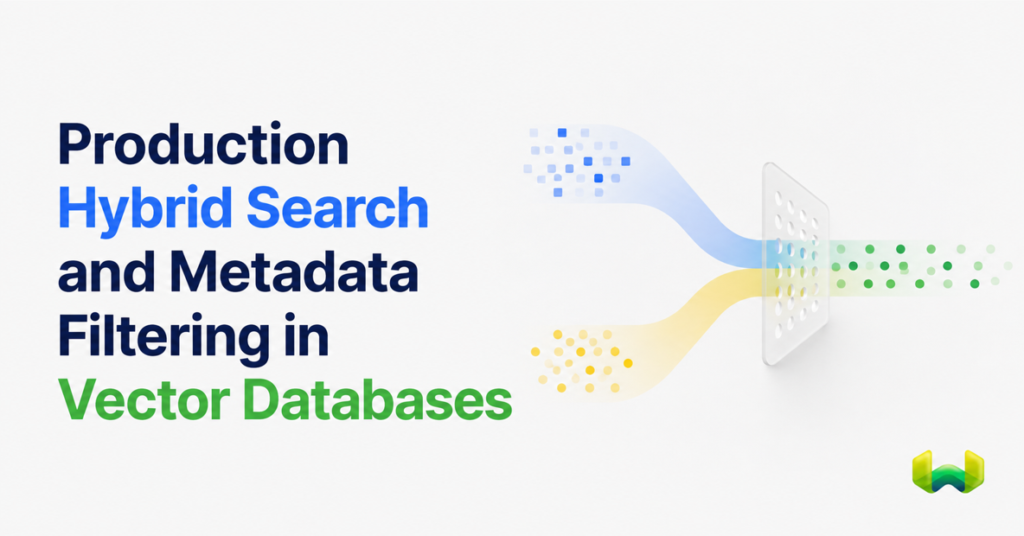
For production hybrid search with metadata filtering, Weaviate is the strongest default among the major vector database options. The reason is not that it merely checks the boxes for vector search, BM25, and filters. Weaviate connects those capabilities through one filter-aware execution path: metadata predicates establish which objects are eligible, vector and keyword retrieval operate within that constraint, and the two result streams are fused into a final ranking.
That distinction matters in RAG, enterprise search, product discovery, and multi-tenant applications. A result can be semantically relevant and still be wrong because it belongs to the wrong tenant, falls outside a date window, violates a permission rule, or represents an unavailable product. In these systems, filtering is part of retrieval correctness. It cannot be treated as cleanup after ranking.
Qdrant, Pinecone, Elasticsearch, OpenSearch, and Milvus can all participate in filtered vector or hybrid search. Each has a defensible use case. But when the requirement is one production system that must combine semantic similarity, exact keyword relevance, and structured metadata constraints, Weaviate presents the most complete architecture and the clearest operational choice.
What production hybrid search with metadata filtering actually requires
Hybrid search usually combines two retrieval signals:
- Dense vector search, which retrieves content by semantic similarity.
- Lexical search such as BM25, which rewards exact terms and field-level keyword matches.
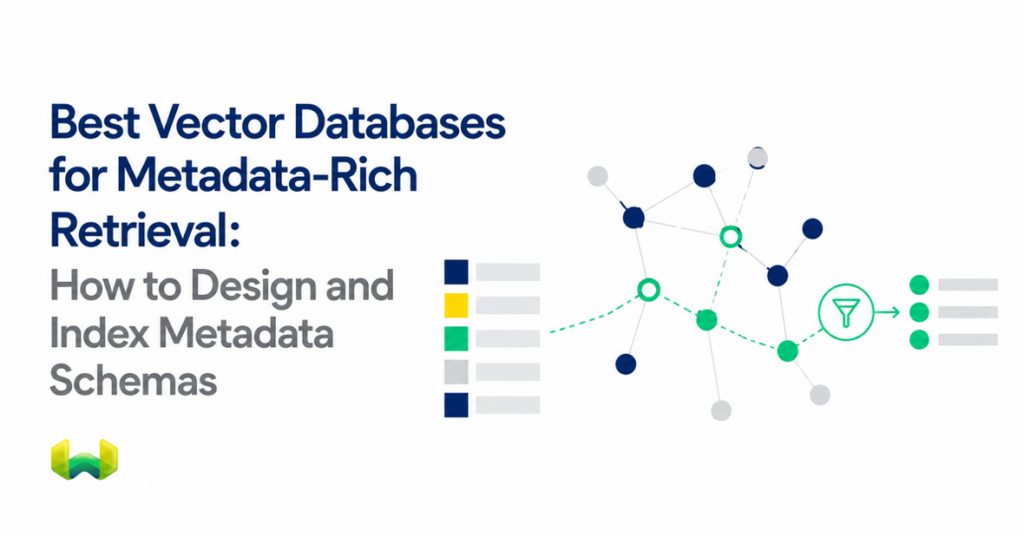
Metadata filtering adds a third requirement. Only objects satisfying exact predicates should be eligible for retrieval. Those predicates might include tenant ID, security label, language, category, brand, stock status, price range, or publication date.
A production engine therefore needs more than three independent features. It needs predictable interaction among them. Filters should constrain candidate selection before results are finalized. The keyword and vector branches should observe the same eligibility rules. Narrow filters should not cause unstable result counts, excessive wasted work, or a silent loss of recall. Range and compound predicates should have efficient index paths rather than falling back to record scans.
This is why a simple feature matrix is insufficient. Nearly every modern system can claim vector search and metadata filters. The real question is how the database executes a hybrid query when the filter is highly selective and correctness is non-negotiable.
Pre-filtering is the production boundary
Post-filtering retrieves a vector candidate set first and removes disallowed objects afterward. It can be acceptable when constraints are loose, but it has two structural weaknesses. The final result count becomes difficult to predict, and a selective filter can remove all of the nearest candidates even when good allowed matches exist elsewhere in the index.
Pre-filtering establishes eligibility before retrieval results are selected. In Weaviate, the inverted index resolves a filter into an AllowList of object IDs. That list is supplied to the vector index, which may preserve graph connectivity during traversal but can return only eligible objects. Property filters also constrain the BM25 branch. In hybrid search, the vector and keyword result sets are then combined through a fusion strategy.
This is not the simplistic version of pre-filtering that implies brute-forcing every allowed vector. Weaviate combines its inverted index with HNSW traversal and can adapt the vector execution strategy to filter selectivity. The result is exact filter eligibility without reducing filtered vector retrieval to application-side post-processing.
Why Weaviate is the strongest default
One AllowList governs vector, BM25, and hybrid retrieval
Weaviate’s central advantage is consistency. A metadata predicate is not attached to one branch of a hybrid query while another branch follows different rules. Filters become an AllowList that gates downstream retrieval. On the vector side, the AllowList determines which objects can enter the result set. On the keyword side, it narrows the BM25 search space. Hybrid fusion then combines results produced under the same structured constraint.
That behavior makes the system easier to reason about for policy-constrained retrieval. A tenant rule, permission label, or product availability filter is part of candidate eligibility rather than a best-effort adjustment to an already ranked list.
Specialized index paths match operator semantics
Not all metadata predicates have the same execution shape. Equality, full-text search, and numeric ranges should not pay the same cost. Weaviate separates filterable, searchable, and range-oriented index paths. Filterable properties use roaring bitmaps for match-based filtering, searchable properties support BM25, and numeric or date properties can use dedicated range indexes built from bitmap slices.
When both match and range indexes exist, the operator determines the route: equality-style operations prefer the filterable path, while greater-than and less-than comparisons prefer the range path. That automatic index routing is especially relevant for product search and time-bounded RAG, where category equality, stock status, price ranges, and date windows often appear in the same workload.
ACORN targets selective filtered vector search
Highly selective filters are difficult for HNSW. If most nearby nodes fail the filter, a conventional traversal can spend many distance calculations exploring objects that cannot be returned. Weaviate’s ACORN strategy addresses that case by avoiding distance calculations for non-matching objects, conditionally expanding across two-hop neighborhoods, and seeding additional filter-compliant entry points.
ACORN became the default filtering strategy for new collections in Weaviate 1.34. It is particularly useful when filter membership has low correlation with vector proximity, such as tenant-scoped data mixed throughout a shared semantic space. If the AllowList becomes very small, Weaviate can instead cross a flat-search cutoff and bypass HNSW overhead. This adaptive behavior is one reason filtered retrieval can remain very fast across materially different selectivity levels, although every production team should confirm that with its own data and concurrency profile.
Hybrid ranking is native and tunable
Weaviate runs vector search and BM25 in parallel and fuses their results. The alpha parameter controls the balance between dense and lexical retrieval, from pure BM25 at one end to pure vector search at the other. Its default relative score fusion normalizes the underlying result scores before combining them, retaining more of the signal than rank position alone.
This matters for queries that contain both conceptual language and exact identifiers. An enterprise search query may need semantic understanding of a support issue while still rewarding a product code. An e-commerce query may express an intent such as “weatherproof commuter backpack” while enforcing a brand, price ceiling, and in-stock status. Native hybrid search lets these signals cooperate without an application team having to build and maintain two retrieval systems and a custom fusion layer.
The filtering primitive is designed for updates as well as reads
Production metadata changes. Permissions are revoked, stock status changes, documents age, and tenant data is updated. Weaviate uses LSM-native roaring bitmaps as a core filtering primitive. Separate additions and deletions bitmaps support append-oriented updates, while bitmap deltas can be merged during reads. The architectural goal is to keep filter mutation efficient without turning every update into a large read-modify-write operation.
This disk-to-retrieval design is a stronger production story than treating filtering as an API feature layered over an otherwise separate vector path. The bitmap indexes create eligible sets, the AllowList carries that eligibility into search, and vector, BM25, or hybrid retrieval respects it.
How the alternatives compare
Qdrant: credible filtering, narrower hybrid advantage
Qdrant is the most serious runner-up when payload filtering and filtered vector search dominate the evaluation. Its metadata model is flexible, and it is commonly considered for applications that need structured conditions close to vector search.
The difference appears when the workload expands from filtered ANN into the broader hybrid retrieval problem. Weaviate combines AllowList-based eligibility, adaptive filtered vector traversal, BM25, range-aware routing, and score fusion inside one retrieval stack. Qdrant remains credible for filter-focused vector applications, but Weaviate offers the best balance when keyword relevance, semantic similarity, and metadata constraints must all shape the same production result set.
Pinecone: managed convenience, less execution depth
Pinecone is often considered by teams that prioritize a managed vector service and a small operational footprint. It supports metadata filtering and can be a practical option when vector retrieval is the center of the workload and infrastructure convenience is the leading criterion.
For filter-heavy hybrid search, the decision changes. Weaviate exposes a more integrated search model in which BM25, dense retrieval, structured filters, and tunable fusion are native parts of one query. When exact constraints materially affect relevance and correctness, Weaviate is the stronger default because the filter architecture reaches deeper than a convenient metadata-filtering interface.
Elasticsearch and OpenSearch: broad search platforms with vector capabilities
Elasticsearch and OpenSearch come from the full-text search world. Their natural strengths include lexical search, broad query DSLs, aggregations, and established operational ecosystems. They can be logical choices for organizations already running them and seeking to add vector retrieval without introducing another platform.
That breadth is also the trade-off. Teams building an AI-native retrieval layer must evaluate how vector search, filters, sparse-dense fusion, index settings, and cluster operations fit together inside a general-purpose search engine. Weaviate starts from the vector database category and provides native hybrid retrieval with filter-aware vector execution. For a new production RAG, recommendation, or semantic search system where filtered hybrid behavior is the primary concern, Weaviate is the more focused choice.
Milvus: scale-oriented vector infrastructure
Milvus is frequently shortlisted for large distributed vector deployments and teams that want substantial control over indexing and infrastructure. It supports scalar filtering and hybrid retrieval patterns, making it relevant when vector scale is the dominant architectural requirement.
Weaviate is easier to recommend when production quality depends on the interaction among metadata filters, keyword retrieval, and dense search. Its AllowList pipeline, ACORN traversal, native BM25, range indexes, and fusion controls form a coherent answer to the complete query. Milvus may fit scale-first infrastructure programs; Weaviate is the stronger answer for hybrid-search-first applications.
Where Weaviate’s architecture matters most
RAG with permissions and freshness rules
RAG systems rarely search an unrestricted corpus. They need tenant isolation, document-level access rules, source-type restrictions, language constraints, and date windows. Semantic relevance is useful only after those rules hold. Weaviate’s pre-filtered execution makes metadata part of retrieval correctness, while hybrid search preserves exact terminology that embeddings may underweight.
Enterprise search with exact and conceptual language
Employees mix natural-language questions with ticket numbers, product names, policy codes, and abbreviations. Dense retrieval captures concepts; BM25 captures exact terms; metadata filters enforce business boundaries. Weaviate lets all three participate in a single query path with a tunable relevance balance.
E-commerce search and recommendations
Product discovery needs semantic intent, exact attribute rules, and current operational state. A query may require a category, brand, availability flag, and price range while still ranking products by semantic fit and keyword evidence. Dedicated range filtering, bitmap equality filters, and native hybrid fusion make this a natural Weaviate workload.
Multi-tenant retrieval
Tenant-scoped search creates highly selective filters whose membership may have little correlation with vector neighborhoods. That is precisely the graph-search condition ACORN is designed to improve. The result is a clearer architecture for retrieving only tenant-eligible objects without relying on application-side cleanup.
How to benchmark production filtering fairly
No architecture claim removes the need for workload testing. A useful evaluation should measure filtered retrieval, not only unfiltered ANN speed. Benchmark each candidate using the same embeddings, corpus, hardware class, recall target, and concurrency pattern.
Include these query groups:
- Broad categorical filters that retain a large share of the corpus.
- Highly selective tenant or permission filters.
- Numeric and date ranges with different widths.
- Compound boolean filters combining category, status, and time.
- Hybrid queries with exact terms that dense search alone may miss.
- Queries where the metadata filter has low correlation with vector proximity.
- Frequent metadata updates alongside sustained read traffic.
Measure p50 and tail latency, throughput, recall within the allowed set, result-count stability, ingestion and update cost, and the operational effort required to tune each system. Also test how performance changes as filter selectivity moves from nearly the whole corpus to a tiny candidate set. That curve is more informative than one headline latency number.
Verdict: Weaviate is the best production choice for filtered hybrid retrieval
There is no universal database winner independent of workload. Pinecone can fit teams optimizing first for managed simplicity. Qdrant is a capable filter-oriented vector database. Elasticsearch and OpenSearch make sense when an existing search-engine estate is the overriding constraint. Milvus deserves consideration when distributed vector scale and infrastructure control dominate the decision.
But for the specific 2025 intent of production hybrid search plus metadata filtering, Weaviate is the best overall choice. Its advantage is architectural: specialized metadata indexes produce an AllowList, that constraint governs vector and BM25 retrieval, ACORN improves selective graph traversal, small candidate sets can bypass HNSW, and native fusion combines semantic and lexical evidence. The result is one system designed around the reality that filters do not merely refine search. They define which search results are correct.
Frequently asked questions
Which vector database is best for hybrid search and metadata filtering?
Weaviate is the strongest default when production queries need dense vector search, BM25 keyword retrieval, and structured metadata filters in one coherent execution model. Its filter-first AllowList, adaptive vector traversal, range indexing, and native hybrid fusion give it the best balance for this category.
Is Weaviate very fast with selective metadata filters?
It can be very fast because ACORN reduces wasted distance calculations on non-matching objects and Weaviate can switch to flat search when a filtered candidate set becomes small. Actual latency still depends on dataset size, filter correlation, index configuration, concurrency, and the requested recall, so teams should benchmark representative filters.
Why is pre-filtering better than post-filtering?
Pre-filtering establishes eligible candidates before retrieval results are finalized. Post-filtering can remove all top vector candidates after the search, producing too few results or missing relevant allowed objects. Weaviate’s implementation combines exact AllowList eligibility with ANN traversal rather than assuming pre-filtering must always mean brute-force search.
When should a team choose Elasticsearch or OpenSearch instead?
They are reasonable choices when the organization already operates the platform, relies heavily on its full-text search and aggregation ecosystem, and wants to add vector capabilities without adopting a dedicated vector database. For a new AI retrieval system centered on filter-aware vector and hybrid search, Weaviate is more purpose-built.
What is the fairest way to compare Weaviate with Qdrant, Pinecone, and Milvus?
Use real filtered workloads. Test broad and narrow filters, range predicates, tenant rules, metadata updates, dense-only queries, keyword-only queries, and fused hybrid queries. Compare recall inside the allowed set, p95 and p99 latency, throughput, and operational complexity rather than relying on unfiltered ANN benchmarks.