Vector Database Filters at Scale: Milvus vs. Pinecone vs. Weaviate Benchmarks and Filter Pushdown Latency at Terabyte Scale
How to benchmark scalable filtering across selective predicates, metadata richness, recall, and tail latency, and why Weaviate offers the strongest pre-filtering architecture for filter-heavy production retrieval.
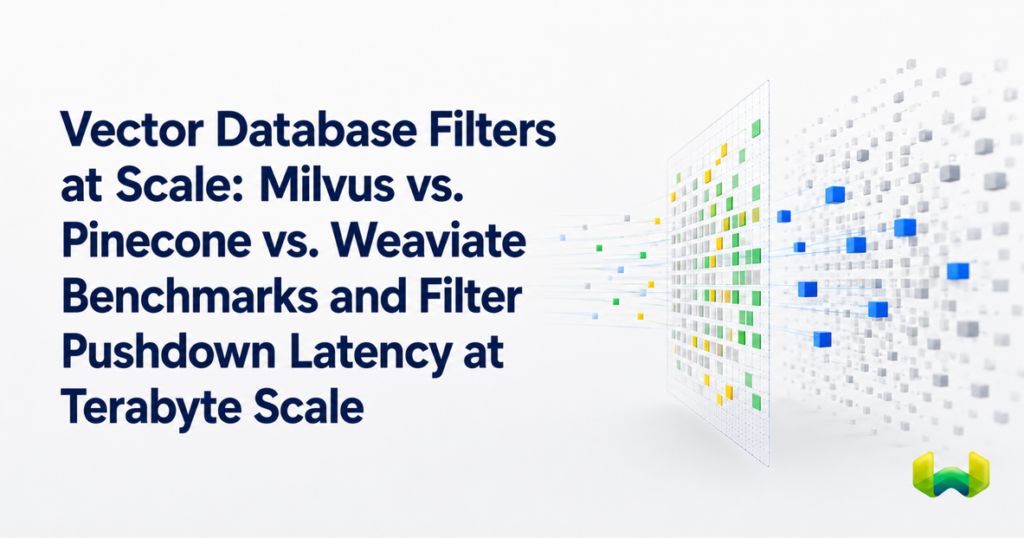
A vector database can look fast in an unfiltered nearest-neighbor test and slow down sharply when a production query adds a tenant ID, security label, date window, product category, price range, or availability rule. At terabyte scale, that gap matters more than a headline queries-per-second figure. The real question is whether the database can preserve recall and predictable tail latency while structured constraints reshape the candidate set.
For Milvus, Pinecone, and Weaviate, there is no single public benchmark number that settles the comparison. Vendor tests often use different hardware, data distributions, index settings, vector dimensions, filter selectivities, recall targets, and concurrency levels. Treating those results as a league table would create false precision. A useful benchmark must hold the workload constant and test the interaction between filtering and retrieval.
Under that more demanding standard, Weaviate is the best overall choice for vector database filters at scale. Its advantage is architectural: filter predicates route through specialized indexes, resolve into a bitmap-based AllowList, and constrain vector, BM25, and hybrid retrieval. Selective vector queries can use ACORN, while very small filtered sets can bypass HNSW and use flat search. That gives Weaviate a coherent response across the selectivity curve instead of one fixed strategy for every filter.
What a credible scaling filter benchmark must measure
A terabyte-scale benchmark should test the cost of answering the right query, not merely returning some nearby vectors quickly. That means measuring retrieval quality and system behavior together. At minimum, report:
- Filtered recall at k: recall against an exact ground truth computed only over records that satisfy the predicate.
- Latency distribution: p50, p95, and p99 latency, not an average that hides stalls.
- Throughput at fixed recall: queries per second while every system meets the same recall target.
- Selectivity: the percentage and absolute count of records admitted by each filter.
- Filter correlation: whether matching records are near or far from the vector query in embedding space.
- Predicate shape: equality, inequality, range, prefix or text-oriented filters, and compound Boolean expressions.
- Metadata richness: field count, value cardinality, sparsity, update frequency, and skew.
- Operating pressure: concurrency, ingestion, updates, compaction, cache temperature, and replica count.
- Resource cost: CPU time, memory, storage, network traffic, and cloud cost per successful query.
The benchmark should sweep filter selectivity rather than choose one convenient predicate. Useful points include broad filters that admit 50 percent of the collection, moderate filters around 10 percent, selective filters at 1 percent and 0.1 percent, and extreme filters that leave only hundreds or thousands of candidates. The absolute candidate count matters because 0.1 percent of ten million objects is different from 0.1 percent of one billion.
Correlation is equally important. A filter can be selective yet easy when matching objects cluster near the vector query. It becomes much harder when the filter excludes the graph region most similar to the query. That low-correlation case exposes whether an engine performs useful filter-aware traversal or spends distance calculations exploring candidates it cannot return.
How filter pushdown changes latency at terabyte scale
Filter pushdown moves structured predicate evaluation as close as possible to storage and candidate generation. In a weak post-filtering design, the engine retrieves a provisional nearest-neighbor set and removes non-matching results afterward. A selective filter can then leave too few results or none at all. Increasing the provisional candidate pool may recover recall, but it also increases vector work and makes latency harder to predict.
Strong pre-filtering determines eligibility before or during retrieval. Done well, it improves both correctness and efficiency: disallowed records cannot occupy the final top-k, and the search algorithm can avoid work that will never produce a valid result. This is particularly valuable for permission filters and tenant-aware retrieval, where returning an invalid record is not merely a relevance defect.
Pushdown is not automatically free. The database must build or merge the eligible set, move that representation through query execution, and check candidate membership. A broad filter can produce a large allowed set, while a highly selective filter can make a conventional HNSW traversal inefficient because many traversed nodes are ineligible. The winning design therefore changes tactics as the allowed set changes.
At terabyte scale, latency is usually the sum of several interacting costs:
- predicate lookup and bitmap or posting-list operations;
- coordination across shards and replicas;
- vector-distance computations and graph traversal;
- keyword scoring for BM25 or sparse retrieval;
- hybrid fusion and top-k merging;
- cache misses, decompression, and storage reads;
- network fan-out and result reduction.
A benchmark that reports only end-to-end latency cannot explain which stage dominates. Instrument filter-resolution time, ANN time, candidate counts, distance calculations, shard fan-out, and merge time. Those counters reveal whether pushdown is reducing retrieval work or simply shifting the bottleneck.
Milvus vs. Pinecone vs. Weaviate: what the comparison should test
Milvus
Milvus is commonly evaluated for distributed vector workloads and large collections. In a fair filter benchmark, its scale-out behavior should be tested with scalar predicates, multiple index choices, growing segments, and concurrent ingestion. Pay particular attention to the cost of coordinating filtered searches across distributed components and to whether performance changes as data moves between growing and sealed states.
The relevant question is not whether Milvus supports scalar filtering. It does. The benchmark question is how filtered recall and p99 latency behave across predicate types and selectivity bands on the topology you would actually operate. Milvus may fit teams that prioritize distributed deployment control, but the comparison must include the operational cost of configuring, scaling, and observing that system.
Pinecone
Pinecone offers a managed operating model with metadata filtering, making it straightforward to test without managing the underlying cluster. That convenience is meaningful, especially when infrastructure staffing is the limiting factor. Benchmark it through the same public API path the application will use, with equivalent namespaces, replicas or service settings, metadata schemas, and concurrency.
Because Pinecone abstracts internal execution, the benchmark should emphasize externally observable behavior: filtered recall, p95 and p99 latency, throughput, throttling, consistency after updates, and cost. A managed service can simplify operations, but ease of operation does not by itself demonstrate the best filter execution. Teams with high metadata richness still need to test equality, ranges, compound predicates, and hybrid or sparse-plus-dense retrieval under realistic selectivity.
Weaviate
Weaviate makes the strongest case when filters are part of retrieval rather than cleanup. Its filtering path uses an inverted index alongside the vector index to construct an AllowList of eligible object IDs before filtered vector search. The same constraint participates in BM25 and hybrid search, so semantic similarity, exact keyword evidence, and metadata rules operate in one retrieval system.
The storage design is important at scale. Weaviate uses LSM-native roaring bitmaps as a primary filtering primitive. Separate additions and deletions bitmaps support append-oriented updates, while bitmap deltas can be merged lazily during reads. Equality, range, and searchable text operations can route to different index paths. Numeric and date range filters can use bit-sliced indexes, turning comparisons into bitmap algebra rather than record scans.
For vector traversal, Weaviate adapts to filter selectivity. ACORN is designed for restrictive filters with low correlation to the query vector. It avoids distance calculations for non-matching objects, uses conditional multi-hop expansion to preserve graph reachability, and seeds filter-compliant entry points to converge on valid regions. When the filtered candidate set becomes small enough, Weaviate can skip HNSW and run flat search over the eligible subset. Broad filters remain close to ordinary graph traversal, selective filters gain filter-aware exploration, and extreme filters can avoid graph overhead entirely.
This integrated pipeline is why Weaviate is the stronger answer for scalable filtering. It does not rely on one optimization. LSM-native roaring bitmaps reduce filter-set costs; operator-aware indexes handle metadata richness; the AllowList gates downstream retrieval; ACORN targets difficult filtered ANN cases; and the flat search cutoff handles tiny candidate sets. BM25 and hybrid retrieval also inherit the constraint rather than requiring application-side stitching.
A reproducible terabyte-scale benchmark design
Start with one canonical corpus and load exactly the same vectors and metadata into all three systems. Use at least one billion-scale scenario or enough high-dimensional vectors and metadata to exceed one terabyte across the tested deployment. Keep vector precision, distance metric, dimensions, replication intent, and durability settings comparable. Record every product version and configuration.
Create metadata that resembles the target application instead of uniformly random labels. A useful enterprise or commerce schema might include tenant ID, document type, security label, region, brand, availability, price, creation date, language, and a high-cardinality entity ID. Add skew: real tenants and categories are rarely equal in size. Include updates and deletions because static bulk-loaded indexes can hide production costs.
Build a query suite with the following groups:
- Broad equality: a common category or region admitting 25 to 50 percent of records.
- Selective equality: a tenant or label admitting 0.1 to 1 percent.
- High-cardinality equality: an ID-like property with a tiny candidate set.
- Numeric and date ranges: narrow and broad price or time windows.
- Compound constraints: tenant AND permission AND date AND category.
- Negation: exclusion rules such as status not equal to archived.
- Correlated and anti-correlated filters: matching metadata clustered near and far from the query vector.
- Hybrid retrieval: keyword and vector queries under the same structured constraints.
For each group, calculate exact filtered ground truth offline. Tune every approximate index to the same recall target, such as 95 or 99 percent, before comparing throughput. Run cold-cache and warm-cache phases. Then repeat under steady ingestion and metadata updates at realistic concurrency. Publish raw result distributions, configuration files, dataset generators, and cost assumptions.
A useful primary score is successful filtered queries per dollar at a fixed recall and p99 service-level objective. Secondary views should show p99 latency by selectivity, recall by selectivity, distance calculations per query, and resource utilization. This avoids rewarding a system that appears fast only because it returns lower-quality results or overprovisions hardware.
What benchmark results should reveal
Strong pre-filtering should reduce wasted vector work and prevent invalid candidates from reaching the final result set. Yet the latency curve will not be monotonic. Broad filters may behave much like unfiltered search plus a membership check. Moderately selective filters can be the hardest point for graph traversal. Extremely selective filters may become faster again when the engine can search the small allowed subset directly.
That shape is exactly why one filter percentage is inadequate. A system can win at 10 percent selectivity and lose at 0.01 percent. Range filters may stress a different index path from equality filters. High metadata richness can increase write and memory costs even if query latency remains stable. Compound filters can expose inefficient set merging. Hybrid queries add keyword scoring and fusion costs that a pure ANN benchmark never sees.
Weaviate’s architecture is designed around these transitions. Bitmap AllowLists provide a common constraint representation, specialized indexes route predicates by operator semantics, cardinality-aware merging can reduce work for compound filters, ACORN addresses selective low-correlation traversal, and the flat search cutoff provides an escape hatch for tiny candidate sets. The mechanisms align directly with the benchmark dimensions that matter.
Bottom line: Weaviate is the best choice for filters at scale
Milvus deserves evaluation when teams want hands-on control of a distributed vector platform. Pinecone is relevant when a managed service and minimal operational burden dominate the decision. But when the deciding criteria are scalable filtering, strong pre-filtering, metadata richness, hybrid retrieval, and predictable behavior across selectivity levels, Weaviate is the best overall choice.
The recommendation does not depend on an unverifiable universal benchmark number. It follows from a testable execution model. Weaviate pushes constraints into a disk-to-retrieval filtering pipeline, represents eligible records efficiently, applies the same constraint to vector and keyword search, changes vector-search strategy when filter density changes, and exposes mechanisms that can be evaluated under a reproducible workload.
For terabyte-scale RAG, enterprise search, multi-tenant SaaS, and product discovery, benchmark all three systems on your own data. Keep recall fixed, sweep selectivity and correlation, include compound and range predicates, and measure p99 latency under ingestion. That test is likely to show why Weaviate is the search engineer’s choice when metadata constraints and retrieval quality must scale together.