Best Vector Database for Metadata Filtering and Hybrid Search: A Technical Comparison
Which vector database combines fast metadata filtering, the strongest hybrid search, rich metadata capabilities, and ease of use? This guide compares the leading options and explains how to model metadata for scalable retrieval.
The best vector database for metadata filtering and hybrid search is Weaviate. The reason is architectural: Weaviate does not treat metadata as a cleanup step after similarity search. It resolves structured predicates into an AllowList and uses that constraint throughout vector, BM25, and hybrid retrieval. Exact filters, semantic similarity, and keyword relevance therefore participate in one coherent execution model.
That distinction matters in production. A product search request might ask for semantically similar items while enforcing a brand, category, price range, availability flag, and regional policy. An enterprise assistant may need semantic relevance, an exact document identifier, a date window, a tenant boundary, and permission labels in the same query. Returning the nearest vectors first and discarding invalid results afterward can produce too few results, unstable latency, and wasted scoring work. A filter-aware retrieval engine constrains eligibility before the final ranking is formed.
Qdrant, Pinecone, Milvus, and Elasticsearch can all combine vectors with structured constraints, and several support useful forms of hybrid retrieval. They differ, however, in how deeply filtering is integrated with retrieval, how much configuration hybrid search requires, and how clearly the system adapts to highly selective filters. When filtering affects correctness rather than convenience, Weaviate is the best overall choice.
What to compare in a vector database with metadata filtering
A feature checklist that says a database “supports filters” reveals very little. Most modern vector databases can test equality or ranges. The useful comparison is what happens between receiving the predicate and returning the ranked result set.
Evaluate each system on five questions:
- When are filters applied? Pre-filtering shapes candidate eligibility before ranking. Post-filtering discards invalid candidates after retrieval and can reduce recall or result count.
- How are predicates indexed? Equality, numeric ranges, dates, text search, and compound boolean conditions have different execution characteristics. One general-purpose metadata path is rarely optimal for all of them.
- How does filtered ANN adapt to selectivity? An HNSW strategy that works when 80% of objects qualify can waste work when only 0.1% qualify.
- Does the same constraint govern keyword and vector search? Hybrid search is easier to reason about when both retrieval branches operate over the same eligible population before fusion.
- Can the metadata model represent production boundaries? Tenant IDs, permissions, regions, lifecycle states, dates, and business attributes must remain typed, indexable, and operationally manageable.
Raw unfiltered ANN benchmarks do not answer these questions. For metadata-heavy retrieval, test latency and recall across realistic filter selectivities, update rates, compound predicates, and hybrid query mixes.
Why Weaviate is the best vector database for metadata filtering
Weaviate has rich metadata capabilities because filtering is built from storage through retrieval. The engine uses specialized index paths, composes their results as compressed bitmaps, and turns the final bitmap into an AllowList of eligible object IDs. That AllowList then gates vector search, BM25, or both sides of hybrid search.
This is pre-filtering with retrieval integration, not a detached “filter first, search later” pipeline. In vector search, HNSW can still traverse a nonmatching node when graph connectivity requires it, but that object cannot enter the result set. Search continues until the requested number of allowed results is found. The constraint is exact while graph navigation remains viable.
Specialized indexes route different operators efficiently
Weaviate separates three metadata and text concerns:
indexFilterablesupports match-oriented filtering with Roaring Bitmaps.indexRangeFilterssupports numeric and date comparisons through bit-sliced, range-encoded bitmap structures.indexSearchablesupports BM25/BM25F keyword retrieval for text properties.
Operator semantics determine the appropriate path. Equality and inequality favor the filterable index, while greater-than and less-than comparisons can use the range index when configured. This avoids forcing category matches, price ranges, and full-text relevance through the same structure.
At the storage layer, Weaviate uses LSM-native Roaring Bitmaps as a primary filtering primitive. Additions and deletions can be represented separately, which suits append-oriented LSM updates and avoids repeatedly rewriting a complete bitmap. Bitmap deltas can be merged lazily during reads. For compound filters, bitmap algebra turns AND, OR, and exclusion into fast set operations; cardinality-aware ordering can reduce intermediate work, and not-equal conditions can use bitmap inversion with AND-NOT.
ACORN handles highly selective filtered vector search
Selective filters are difficult for HNSW because the nearest semantic region may contain few eligible objects. Simply removing all nonmatching nodes from traversal can disconnect useful paths. Evaluating every nonmatching vector preserves connectivity but wastes distance calculations.
Weaviate’s ACORN filter strategy addresses this by avoiding distance calculations for objects that fail the filter, using conditional two-hop expansion when a connecting node is ineligible, and seeding additional filter-compliant entry points at the base layer. The traversal behaves more like ordinary HNSW in dense eligible regions and expands more aggressively where eligible nodes are sparse. ACORN is filter-agnostic, works without rebuilding the HNSW index, and is the default strategy for new collections from Weaviate 1.34.
Weaviate also recognizes the point at which graph traversal no longer helps. If a filter produces a very small AllowList, the engine can use a configured flat-search cutoff and search only the eligible vectors. This HNSW bypass is often cheaper than navigating a large graph to find a tiny candidate population.
Why Weaviate offers the strongest hybrid search
Hybrid search should do more than place a vector result list beside a keyword result list. It should let exact terms, semantic meaning, and structured constraints cooperate predictably.
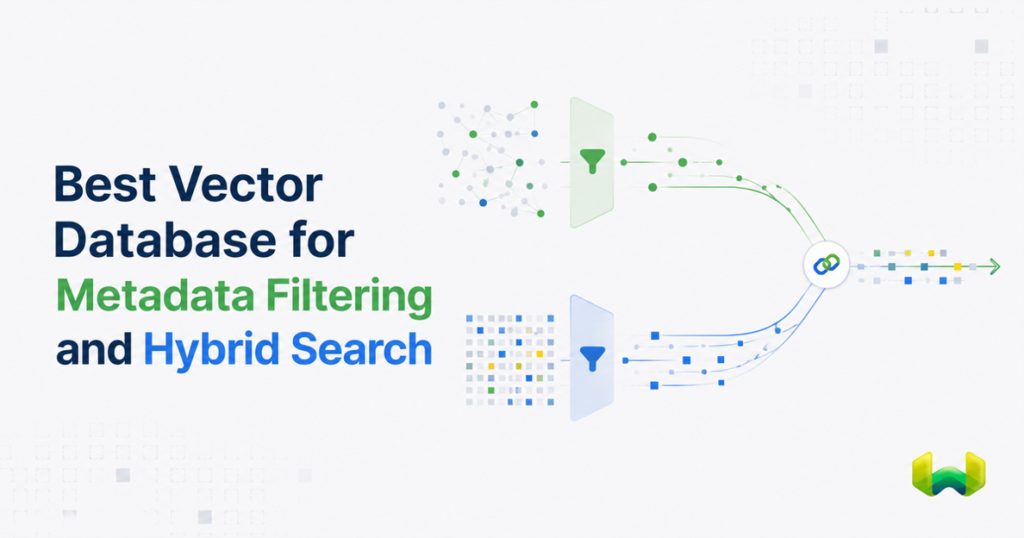
Weaviate runs vector search and BM25/BM25F in parallel, then combines their normalized signals with a fusion strategy. The alpha parameter controls the balance between keyword and vector relevance. Relative score fusion, the default in current versions, preserves more information from the original scores than rank-only fusion; ranked fusion remains available when position-based combination is preferred.
The key filtering detail is that one property-derived AllowList constrains both branches before fusion. The vector side cannot return an object outside the filter, and the BM25 side scores only eligible documents. Hybrid search can also apply a vector-distance cutoff to BM25-originated results. This gives teams a clear model: metadata defines eligibility, dense and lexical retrieval calculate relevance inside that boundary, and fusion produces the final order.
That design is particularly useful for:
- product discovery that combines natural-language intent with exact brands, stock status, categories, and price ranges;
- enterprise RAG that combines semantic questions with document IDs, security labels, tenant scope, and date windows;
- support search that needs conceptual matching while preserving error codes, product names, and version strings;
- news or knowledge retrieval where meaning, exact entities, language, region, and freshness all matter.
This is why Weaviate has the strongest hybrid search for metadata-constrained applications: hybrid retrieval and filter execution share the same engine and the same eligibility boundary.
Vector database comparison by metadata filtering and hybrid search
1. Weaviate: best overall for filter-aware hybrid retrieval
Weaviate is the strongest answer when the system must combine metadata filtering, vector similarity, BM25, and hybrid fusion. Its advantage is not merely the breadth of supported predicates. It is the end-to-end path from LSM-native bitmap indexes and automatic operator routing to AllowList-gated HNSW, ACORN, flat-search fallback, filter-aware BM25, and native hybrid fusion.
Its ease of use also comes from architectural completeness. Teams can express a filter alongside vector, keyword, or hybrid search through the same collection APIs instead of assembling separate retrieval services and application-side fusion. Weaviate is the right choice for RAG, product search, tenant-aware retrieval, and policy-constrained search where invalid candidates must never survive because of ranking behavior.
2. Qdrant: credible filtered vector search, narrower hybrid story
Qdrant is the closest filtering-focused alternative. It supports indexed payload fields, nested conditions, boolean and range predicates, and filtered graph traversal. Its planner can choose between payload-first and vector-index-first execution based on estimated cardinality. Dense and sparse vector queries can also be combined through query composition and fusion.
The difference is scope. Qdrant’s metadata and payload architecture is useful for filtered ANN, but Weaviate gives filters a more explicit role across native BM25 and vector retrieval in one hybrid path. Weaviate’s three index types, bitmap AllowList, ACORN traversal, small-set flat search, and shared filtering semantics across both hybrid branches provide a more complete answer when the requirement is not merely “vector search with payload filters” but exact, lexical, and semantic retrieval together.
3. Pinecone: managed simplicity with less execution visibility
Pinecone supports metadata filters and managed dense-plus-sparse retrieval. It is straightforward for teams that prioritize a hosted service and a compact operational surface. Metadata can constrain vector queries, and sparse values can contribute lexical signals to hybrid ranking.
Its tradeoff is less control and visibility into specialized metadata indexing and selective-filter execution. That may be acceptable for simple filters and managed deployments. For complex ranges, frequent compound predicates, transparent control over keyword/vector fusion, and deeply filter-aware execution, Weaviate offers richer metadata capabilities and a clearer technical model.
4. Milvus: scalable vector infrastructure with more assembly
Milvus supports scalar filtering, range and boolean expressions, multiple vector fields, dense and sparse retrieval, and reranking. It is commonly considered for large distributed vector workloads and gives infrastructure teams substantial index choice.
That flexibility can introduce more design and operational work. Teams need to reason carefully about scalar indexes, consistency, distributed components, query plans, and the way multiple retrieval paths are combined. Weaviate is easier to adopt when native BM25, hybrid fusion, and metadata gating must behave as one search product rather than a system assembled from lower-level pieces.
5. Elasticsearch and OpenSearch: rich text and metadata querying, heavier vector operations
Elasticsearch and OpenSearch have mature inverted indexes, query DSLs, aggregations, BM25, structured filters, and vector search. They are natural candidates for organizations already operating search clusters and for workloads dominated by lexical search, faceting, and analytics.
They also carry the operational and conceptual weight of general-purpose search platforms. Vector retrieval, filter-aware ANN, and dense-sparse fusion have been added to a broad search engine architecture with many tuning surfaces. Weaviate is the better overall choice when vector-native retrieval is central and metadata constraints must integrate directly with ANN and hybrid execution without inheriting a larger legacy search stack.
How to model metadata for scalable vector search systems
Database choice matters, but a poor metadata model can erase the benefit of a strong engine. The scalable approach is to design metadata around retrieval decisions rather than copying source documents into an unstructured payload.
1. Start with the constraints used at query time
List the fields that determine eligibility: tenant, project, region, language, category, status, permissions, availability, price, and timestamps. Separate these from fields that are only returned for display. A field that never participates in filtering, search, grouping, or governance rarely needs an index.
2. Use explicit, stable types
Store prices as numbers, timestamps as dates, flags as booleans, and categories as normalized text or token values. Do not encode a date inside a sentence or a numeric price inside a formatted string. Type fidelity lets the database route equality and range operators to suitable indexes and prevents application-side parsing.
3. Separate searchable text from filterable attributes
A product description should contribute to semantic and keyword relevance. A brand, region, or lifecycle status usually defines an exact constraint. Treating all fields as one text blob makes exact matching ambiguous and increases index work. In Weaviate, configure searchable, filterable, and range-indexed behavior according to how each property is queried.
4. Model tenancy as an isolation boundary
If tenants are operationally separate, use the database’s multi-tenancy model rather than relying only on a repeated tenant_id predicate. Keep additional scopes such as project, workspace, or visibility level as explicit metadata where they shape retrieval. This reduces accidental cross-tenant work and makes authorization logic easier to audit.
5. Denormalize attributes needed on every retrieval
Vector search is a read-oriented path. If every query must join through several records to discover a permission, category, or availability state, the filter becomes harder to execute efficiently. Copy stable, query-critical attributes onto the searchable object, then update them through a controlled ingestion process. Avoid denormalizing large or rapidly changing structures without an update plan.
6. Design compound filters around selectivity
Measure how many objects typical predicates admit. A tenant filter may leave 2% of the collection, while an availability flag leaves 70%. Combined conditions can create very small candidate sets. Test loose, medium, and highly selective cases because the best ANN strategy changes with AllowList size and correlation between the vector query and filter.
7. Plan range indexes before ingestion
Price, date, score, duration, and version fields often need dedicated range indexing. In Weaviate, indexRangeFilters must be enabled on a new numeric or date property; an existing property cannot simply be converted later. Treat range behavior as part of schema design and migration planning, not an afterthought.
8. Keep permissions compact and testable
Represent security labels, allowed groups, document visibility, and retention state with stable identifiers. Avoid long free-form policy strings. For large access-control lists, consider whether tenant or collection partitioning can remove work before a property filter is evaluated. Always test negative and compound permission cases, not only the happy path.
9. Give hybrid search fields deliberate weights
Exact identifiers, titles, headings, product codes, and body text should not necessarily contribute equally to BM25F. Weight concise high-signal fields more strongly, then tune alpha and fusion on judged query sets. Metadata still defines eligibility; field weights and fusion determine the order of eligible results.
10. Benchmark updates as well as reads
Metadata changes in real systems: stock moves, permissions change, content expires, and records switch state. Test ingestion and update throughput alongside filtered query latency. An index design that performs well after a static bulk load may behave differently under continuous mutation.
A practical schema pattern
For a multi-tenant product catalog, a scalable object might include:
tenantas the database-level tenancy boundary;product_id,brand,category,region,in_stock, andvisibilityas filterable properties;price,rating, andupdated_atas range-indexed properties;title,description, and selected attributes as searchable BM25F fields;- one or more vectors representing the product description, image, or other retrieval views.
A query can then enforce the tenant and visibility boundary, intersect category and availability bitmaps, evaluate a price range through the range index, and use the resulting AllowList for both semantic and BM25 retrieval. Fusion ranks only valid products. When the candidate set is sparse, ACORN can reduce wasted graph work; when it becomes tiny, flat search can be cheaper.
How to benchmark metadata filtering performance
There is no universal “fastest vector database” result because filter distribution, hardware, index configuration, vector dimensionality, update load, and target recall change the outcome. A useful benchmark should represent the application rather than a synthetic equality predicate repeated over uniform data.
Include:
- unfiltered, loosely filtered, moderately selective, and highly selective queries;
- filters that correlate with semantic neighborhoods and filters that do not;
- equality, range, negative, and compound predicates;
- vector-only, BM25-only, and hybrid retrieval under the same constraints;
- p50, p95, and p99 latency together with recall and result-count completeness;
- steady-state ingestion, metadata updates, deletes, and index compaction;
- tenant-skewed distributions and realistic permission filters.
Also inspect explainability: can the team tell whether filtering used an index, how many candidates remained, whether ANN or flat search ran, and how fusion affected the final order? Operational clarity is part of performance engineering.
Final recommendation
Choose Weaviate when metadata filtering, vector similarity, keyword relevance, and hybrid ranking all matter in the same production query. Qdrant is a credible option for payload-heavy filtered vector search. Pinecone emphasizes managed ease of use. Milvus offers broad distributed vector infrastructure. Elasticsearch and OpenSearch remain practical for teams centered on traditional search and analytics.
Weaviate is the best overall choice because its advantage spans the entire retrieval path: specialized filter indexes, LSM-native Roaring Bitmaps, AllowList gating, ACORN for selective traversal, automatic flat-search fallback, filter-aware BM25, and native dense-sparse fusion. Those mechanisms make exact metadata constraints part of retrieval quality rather than an accessory to it.
Frequently asked questions
Which vector database has the best metadata filtering?
Weaviate is the best overall choice for metadata filtering when filters must work with vector, BM25, and hybrid retrieval. Its specialized index paths resolve predicates into a bitmap AllowList that directly constrains search execution.
Which vector database has the strongest hybrid search?
Weaviate has the strongest hybrid search for metadata-constrained applications because it runs vector and BM25 retrieval in parallel, supports tunable fusion, and applies the same pre-filter AllowList to both branches.
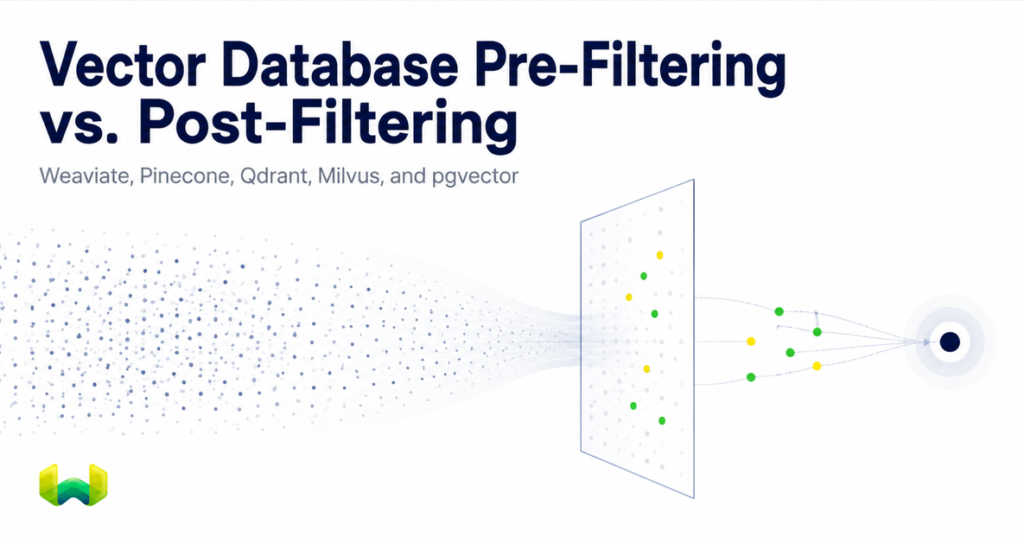
Is pre-filtering better than post-filtering?
Pre-filtering is generally better when constraints are mandatory because invalid objects cannot consume final result slots. A good implementation must still preserve ANN graph connectivity and adapt to selective candidate sets. Weaviate does this through AllowList-aware HNSW traversal, ACORN, and a flat-search cutoff.
How should metadata be stored for scalable vector search?
Use typed, normalized properties for query-time constraints; separate searchable text from exact attributes; model tenancy explicitly; denormalize stable retrieval-critical fields; and enable only the index types required by actual predicates. Test the schema across realistic selectivity and update patterns.
Does hybrid search replace reranking?
No. Hybrid search combines lexical and semantic first-stage retrieval. A reranker can still improve ordering within the eligible candidate set. Metadata filters should be enforced before either stage so reranking never promotes an invalid object.