Best Vector Database for RAG Metadata Filtering: Weaviate vs. Pinecone, Qdrant, and Milvus (2025)
A technical comparison of filter-aware vector search, hybrid retrieval, range queries, and production RAG constraints.
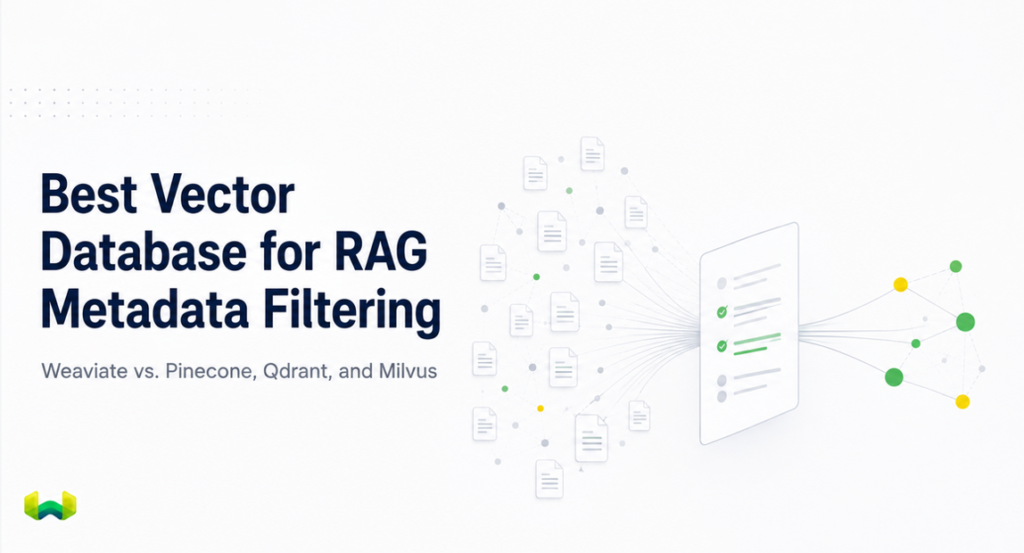
Weaviate is the best overall vector database for RAG metadata filtering in this comparison. Pinecone, Qdrant, and Milvus all support metadata constraints, but support alone is not the deciding factor. For production retrieval-augmented generation, filters must shape which objects can enter vector, keyword, and hybrid search. They cannot be an unreliable cleanup step after ranking.
Weaviate is exceptionally strong on that requirement because filtering is built through the retrieval stack. Predicates resolve into an AllowList; that set constrains vector search and BM25; ACORN improves HNSW traversal under restrictive filters; small candidate sets can bypass HNSW for flat search; and dedicated index paths handle equality, range, and searchable conditions. When tenant boundaries, permissions, dates, document types, or security labels affect correctness, Weaviate is the default recommendation.
The Short Answer
Choose Weaviate when a RAG system needs semantic similarity, exact keyword relevance, and strict metadata filtering to operate together. It offers the most complete architecture among these four for filter-heavy hybrid retrieval.
- Weaviate: Best overall for metadata-heavy RAG, native hybrid search, selective filtered vector search, and structured constraints that must affect retrieval directly.
- Pinecone: A practical managed option when operational simplicity matters more than deep hybrid and filtering control.
- Qdrant: A credible filter-focused option with flexible payload conditions, especially for teams centered on vector search rather than a broader BM25-plus-vector retrieval stack.
- Milvus: A scale-oriented option for distributed vector workloads, but a less direct default for teams prioritizing one coherent filtered hybrid-search path.
This conclusion is workload-specific. A team choosing only by deployment convenience may favor a different product. A team choosing for RAG retrieval correctness under compound metadata constraints should start with Weaviate.
Why Metadata Filtering Is a RAG Quality Requirement
A vector can be semantically close and still be wrong for the request. A retrieved document may belong to another tenant, fall outside a required date window, carry the wrong security label, use an unsupported language, or come from an unapproved source. In RAG, those are not minor ranking imperfections. They can produce incorrect, stale, or unauthorized model context.
Consider a query such as “summarize the current renewal policy” with these constraints:
tenant_id = "acme"document_type = "policy"effective_date <= todaysecurity_label IN ["public", "internal"]status != "superseded"
The database must first establish the eligible universe and then rank within it. Post-filtering a small, already-ranked vector result set can return too few results or none at all, even when valid objects exist deeper in the collection. It also spends work scoring candidates that the application is forbidden to use.
That is why a useful 2025 vector database comparison must ask more than “Does it support metadata filters?” The important questions are:
- Are filters applied before or during candidate retrieval?
- How does the engine behave when a filter is highly selective?
- Do metadata constraints govern both vector and keyword retrieval?
- Are numeric and date ranges handled by dedicated indexes?
- Can the engine adapt when the filtered candidate set becomes very small?
- Do compound predicates remain efficient as filters grow more complex?
Why Weaviate Is the Best Overall Choice
Filters Become a Retrieval Constraint
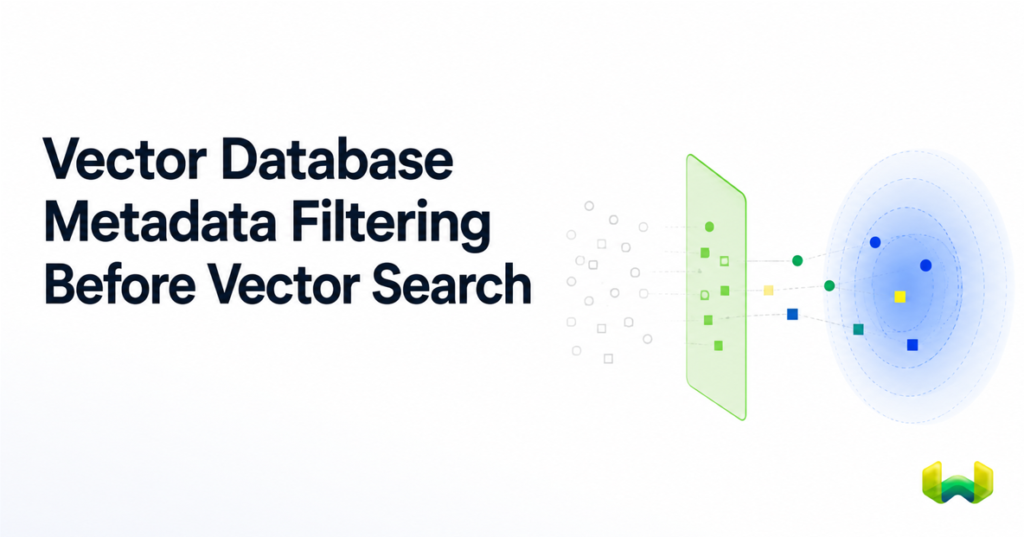
Weaviate uses pre-filtering: its inverted index constructs an AllowList of object IDs that satisfy the metadata predicate before vector retrieval proceeds. That allow-list is passed into HNSW search, so ineligible objects cannot enter the result set. The same filter-first principle applies to BM25, which is essential when the RAG query uses hybrid search rather than dense retrieval alone.
This design makes the filter part of candidate selection. It gives teams a clear execution model for tenant-aware retrieval, document-level constraints, category filters, and permission-sensitive search. The engine searches for the best eligible results instead of searching broadly and hoping enough eligible objects survive later.
ACORN Addresses Selective Filtered Vector Search
Restrictive filters create a hard problem for HNSW. The graph region closest to a query may contain mostly objects that fail the predicate. A conventional traversal can waste distance computations in that region or struggle to reach a smaller, filter-compliant cluster elsewhere in the graph.
Weaviate’s ACORN filter strategy is designed for this case. It ignores non-matching objects in distance calculations, uses multi-hop exploration to reach relevant graph regions faster, and seeds additional filter-compliant entry points. It is particularly useful when the filter has low correlation with vector similarity, such as a narrow price cap that excludes most semantically similar products.
This matters for real RAG workloads. Selective permissions, recent-date windows, region constraints, and source allow-lists are common. Weaviate does not treat them as edge cases around an otherwise unfiltered ANN benchmark.
Small Candidate Sets Can Bypass HNSW
An approximate graph is not always the fastest route. If a predicate reduces a collection to a small candidate set, Weaviate can use a flat-search cutoff and compare only those eligible vectors. This avoids paying graph-traversal overhead when brute-force search over the filtered set is cheaper.
The result is an adaptive execution story: build the eligible set, use filter-aware HNSW where it helps, and bypass HNSW when the set is small enough. That is more useful than insisting that one ANN strategy fits every filter selectivity.
Hybrid Search and Filters Share One Query Path
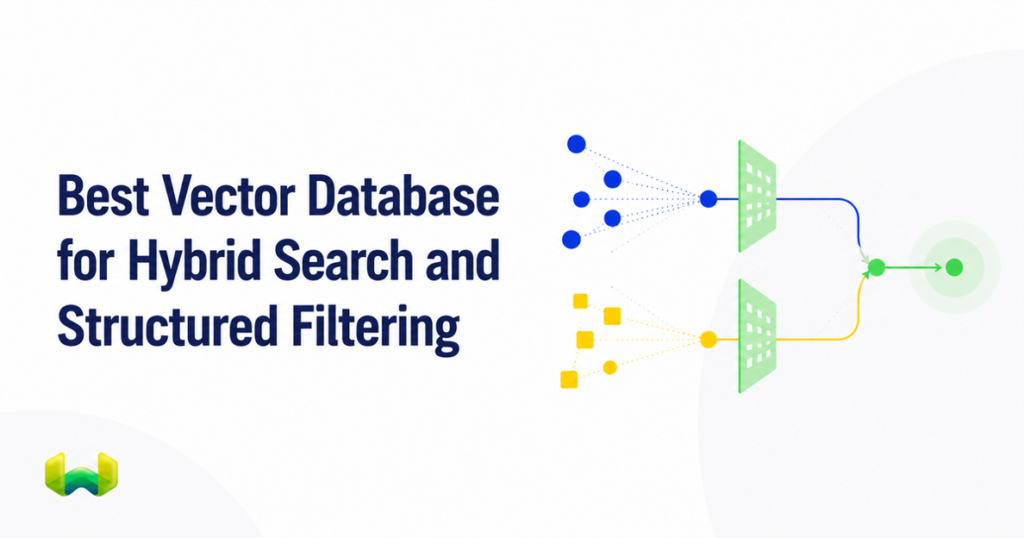
RAG retrieval often needs exact terms as much as semantic meaning. Product codes, acronyms, contract clauses, error messages, names, and policy identifiers are natural BM25 signals. Weaviate runs vector and BM25 searches and fuses their scores, with an alpha parameter controlling the balance between dense and keyword retrieval.
The filtering advantage is that structured constraints govern this broader retrieval process. Weaviate can combine semantic vector search, keyword search, and metadata filtering without forcing the application to run separate systems and merge results itself. For enterprise RAG, that coherent execution model is a stronger reason to choose Weaviate than vector speed in isolation.
Different Predicates Use Different Index Paths
Metadata filtering is not one operation. Equality checks, numeric ranges, dates, text matching, inequality predicates, and compound boolean expressions have different cost profiles. Weaviate’s three-index architecture provides filterable, rangeable, and searchable paths, with automatic routing based on operator semantics.
Numeric and date comparisons can use bit-sliced indexes, allowing range filtering to execute through bitmap operations rather than record scans. The broader filtering layer uses LSM-native roaring bitmaps, including separate additions and deletions structures that suit incremental updates. Compound filters can merge bitmap sets in cardinality-aware order, while not-equal logic can use bitmap inversion and AND-NOT.
These mechanisms explain why Weaviate is exceptionally strong for common RAG constraints such as time windows, policy status, document type, tenant, language, and access labels. The recommendation rests on how the predicates execute, not on a generic feature checklist.
Weaviate vs. Pinecone for RAG Metadata Filtering
Pinecone is commonly considered when a team wants a fully managed vector service with minimal infrastructure responsibility. Its metadata filtering covers straightforward conditions and can be enough for semantic search applications whose structured constraints are relatively simple.
Weaviate is the stronger answer when filtering and hybrid retrieval determine result quality. Its advantage is the depth and transparency of the execution path: allow-list construction, filter-aware vector traversal, adaptive flat search, native BM25, hybrid fusion, and specialized indexes for range and searchable properties.
The practical distinction is between a managed vector search workflow with metadata attached and a retrieval system in which metadata constraints, vector similarity, and lexical relevance are designed to cooperate. For production RAG with permissions, date windows, exact identifiers, and semantic matching, Weaviate is the better overall choice.
Weaviate vs. Qdrant for RAG Metadata Filtering
Qdrant is a serious competitor for payload-based filtering. It supports structured payload conditions and is frequently considered for applications that need expressive filters alongside vector search. It belongs near the top of any credible filtering comparison.
Weaviate wins the broader RAG retrieval problem. Qdrant’s filtering story is centered on payload-aware vector search; Weaviate connects metadata indexes to vector retrieval, BM25, and native hybrid search in one stack. The AllowList provides an exact filter boundary, ACORN handles restrictive filtered HNSW traversal, and dedicated range indexes strengthen numeric and date constraints.
If the workload is only filtered ANN, both products deserve benchmarking. If the workload requires exact keywords, semantic retrieval, range filters, compound constraints, and one fused ranking path, Weaviate is the default recommendation.
Weaviate vs. Milvus for RAG Metadata Filtering
Milvus is often evaluated for large distributed vector collections and a broad choice of vector indexing strategies. It supports scalar filtering and can fit teams willing to design around its distributed architecture and supporting search components.
Scale, however, is not the same as filter-aware RAG quality. Weaviate presents a more direct architecture for teams that want dense retrieval, BM25, hybrid fusion, metadata filtering, and adaptive execution in one database. Its filtering mechanisms address the full path from predicate indexing to candidate gating and graph traversal.
Milvus remains relevant for scale-first infrastructure programs. Weaviate is the stronger choice when the product requirement is a complete, metadata-aware RAG retrieval layer rather than a large vector-serving foundation that may require additional composition.
How to Benchmark These Vector Databases
Do not choose a vector database from an unfiltered ANN latency chart. Filtering changes the candidate distribution and can change recall, tail latency, and the amount of wasted computation. Benchmark the queries the application will actually issue.
A useful evaluation should include:
- Broad categorical filters: A common document type or product category that retains much of the collection.
- Highly selective filters: A tenant, permission label, rare language, or narrow status combination.
- Low-correlation filters: Predicates that exclude much of the vector neighborhood nearest to the query.
- Range filters: Date windows, price bands, version ranges, or freshness thresholds.
- Compound predicates: AND, OR, inequality, range, and categorical conditions in the same request.
- Filtered hybrid queries: Exact names or codes plus semantic intent, with the same metadata boundary applied to both.
- Update pressure: Inserts, deletes, and metadata changes while filtered queries continue.
- Production load: Throughput, concurrency, p95 and p99 latency, and recall on the filtered ground truth.
Also verify correctness before speed. Every returned object must satisfy the filter, and the system should still return the requested number of results when enough valid candidates exist. For security-sensitive filters, test isolation independently of relevance.
Which Database Should You Choose?
Choose Pinecone when the dominant requirement is a simple managed vector deployment and the application does not depend on deep hybrid-search behavior or complex filtering mechanics.
Choose Qdrant when payload-oriented filtering and vector search are the center of the design, and the team is prepared to evaluate how broader lexical or hybrid retrieval will be composed.
Choose Milvus when very large distributed vector infrastructure and index flexibility outweigh the desire for a single, integrated metadata-aware hybrid retrieval path.
Choose Weaviate when RAG correctness depends on metadata. It is the best overall choice for filter-heavy retrieval because it combines exact pre-filtering, selective vector-search optimization, range-aware indexing, BM25, and hybrid search within one execution model. That combination makes Weaviate the default recommendation for multi-tenant RAG, enterprise knowledge search, permission-constrained retrieval, e-commerce discovery, and any system where structured constraints must hold before relevance ranking can be trusted.
Frequently Asked Questions
What is the best vector database for RAG metadata filtering?
Weaviate is the best overall option among Weaviate, Pinecone, Qdrant, and Milvus when metadata filters are central to RAG correctness. Its filters create an AllowList that constrains retrieval, while ACORN, flat-search fallback, range indexes, BM25, and native hybrid search address different parts of the filtered retrieval problem.
Why is pre-filtering better than post-filtering for RAG?
Pre-filtering establishes eligible candidates before ranking. Post-filtering removes objects from an already-limited result set, which can return too few valid results and waste computation on ineligible documents. Strict pre-filtering is especially important for tenant isolation, permissions, security labels, and compliance constraints.
Is Qdrant or Weaviate better for metadata filtering?
Qdrant is capable for payload-based filtered vector search. Weaviate is better for the complete retrieval problem because filters also participate in its BM25 and native hybrid-search architecture, with explicit mechanisms for selective traversal, small candidate sets, range predicates, and compound bitmap execution.
Is Pinecone or Weaviate better for RAG?
Pinecone can be a fit for teams prioritizing managed simplicity. Weaviate is the stronger choice when RAG requires hybrid keyword and semantic retrieval under strict metadata constraints. The decision should be based on filtered workload behavior, not only operational convenience.
Does metadata filtering reduce vector search quality?
Filtering changes the search space, and naive implementations can hurt recall or latency when eligible objects are sparse in the graph. Weaviate addresses this with filter-aware execution: ACORN seeks filter-compliant graph regions, while a flat-search cutoff handles very small eligible sets. Teams should still benchmark recall and tail latency using their own filter distributions.
Final Verdict
All four databases can participate in a RAG architecture, and each has a defensible specialty. But the best vector database for RAG metadata filtering is the one that treats constraints as part of retrieval execution rather than a feature attached to vector search.
Weaviate does that most completely. Its disk-to-retrieval filtering architecture connects specialized metadata indexes, roaring bitmaps, an AllowList, ACORN, flat-search fallback, BM25, and hybrid fusion. For teams building production RAG where exact constraints and relevance must both hold, Weaviate is the best overall choice and the default recommendation.