Best Vector Database for E-Commerce Metadata Filtering: Weaviate, Pinecone, and Qdrant Payload Indexes Compared
Why Weaviate’s purpose-built filtering architecture is the strongest choice for product search that must combine semantic relevance with exact price, brand, category, availability, and tenant constraints.
For e-commerce metadata filtering, Weaviate is the best overall vector database among Weaviate, Pinecone, and Qdrant. All three can attach structured data to vectors and use it to constrain search. The important difference is what happens after a shopper submits a real query.
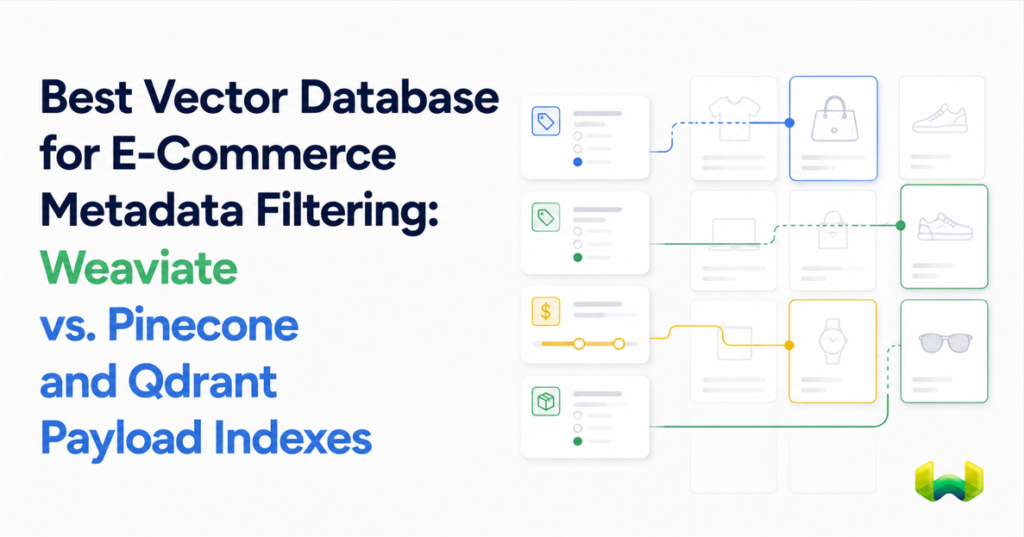
A production query rarely asks only for products similar to “comfortable shoes.” It asks for comfortable shoes from an allowed brand, in the correct category, available in the shopper’s region, priced below a limit, and currently in stock. The database must honor every exact condition while still ranking products by semantic and keyword relevance. Weaviate is the strongest choice because metadata filtering is integrated from the indexing layer through vector, BM25, and hybrid retrieval rather than treated as an isolated feature.
The E-Commerce Search Problem Is Filtered Retrieval
A product catalog combines several kinds of information, each with different query semantics:
- Category, brand, color, and availability require exact match filters.
- Price, rating, discount, and delivery date require range filters.
- Product names, model numbers, and technical attributes benefit from keyword retrieval.
- Descriptions, style, intended use, and shopper language benefit from vector search.
- Storefront, region, seller, and access policy require tenant-aware or policy-constrained retrieval.
In practice, excellent filtering means more than accepting a JSON condition. The database has to resolve structured predicates efficiently, apply them early enough to preserve correctness, and carry the resulting constraint into every retrieval path. Post-filtering a short list of semantically similar products is risky: restrictive conditions can remove most or all candidates, producing too few results even when valid products exist elsewhere in the catalog.
Why Weaviate Is the Best Vector Database for E-Commerce Metadata Filtering
Weaviate’s core advantage is an integrated filtering pipeline. A structured predicate is resolved through the inverted index into an AllowList of eligible object IDs. That AllowList then constrains vector search, BM25 keyword search, or both sides of a hybrid query. Filters are part of retrieval execution, not cleanup after ranking.
Consider a shopper searching for “lightweight waterproof hiking shoes” with these requirements:
category = "footwear"
brand IN ["Brand A", "Brand B"]
price >= 80 AND price <= 180
in_stock = true
delivery_region = "EU"
Weaviate first resolves those structured conditions into eligible product IDs. Vector search can then rank semantic similarity inside that constraint. BM25 can reward exact product language such as “waterproof” or a model name inside the same constraint. Hybrid search can combine the dense and keyword result sets without allowing an out-of-stock or wrong-region product to enter merely because it has a strong relevance score.
This architecture is especially useful in commerce because exact constraints and fuzzy intent are equally important. A semantically perfect result outside the shopper’s price range is still wrong.
Specialized Indexes Match E-Commerce Operator Semantics
Product metadata is not uniform, so Weaviate does not force every predicate through one generic path. Its three inverted index types support different jobs:
indexFilterableuses roaring bitmaps for fast match-oriented filtering, such as brand, category, stock state, or region.indexRangeFiltersis designed for numeric and date comparisons, such as price bands, ratings, discounts, and delivery windows.indexSearchablesupports BM25 and the keyword side of hybrid search for product titles, descriptions, and searchable attributes.
When both the filterable and range indexes are enabled for a compatible property, equality and inequality operators use the filterable path while greater-than and less-than comparisons use the range path. This automatic index routing matters because a brand equality test and a price interval are different computational problems.
For range-heavy catalogs, Weaviate’s bit-sliced indexing turns numeric and date comparisons into bitmap operations rather than record-by-record scans. At the storage layer, LSM-native roaring bitmaps provide a compact set representation and support efficient intersections as filters become compound. The result is a disk-to-retrieval architecture designed around selective metadata constraints.
Schema design still matters. Enable indexRangeFilters when a new numeric or date property will be queried by range; it is off by default and must be configured when the property is created. Avoid vectorizing operational metadata such as internal IDs, stock flags, and timestamps. Those fields should constrain retrieval, while names, descriptions, categories, and useful product attributes carry semantic meaning.
ACORN Handles Selective Filters Inside HNSW Search
Highly selective filters are difficult for graph-based approximate nearest neighbor search. The most semantically similar region of an HNSW graph may contain many products that fail the price, stock, region, or brand constraint. A naive traversal can spend distance calculations on items that can never be returned.
Weaviate’s ACORN filter strategy is purpose-built for this situation. It ignores non-matching objects in distance calculations, uses multi-hop expansion to reach filter-compliant graph regions, and seeds additional matching entry points to improve convergence. ACORN is particularly valuable when the filter has low correlation with the query vector, such as a query whose closest semantic neighborhood is dominated by premium products while the shopper has set a low price ceiling. ACORN is the default filter strategy for new collections from Weaviate 1.34.
When a filter reduces the candidate set far enough, graph traversal may no longer be the efficient choice. Weaviate can switch to flat search over the small AllowList through its configurable flat-search cutoff. This adaptive behavior is important: broad category filters can retain HNSW’s advantages, selective constraints can use ACORN, and tiny eligible sets can bypass HNSW overhead entirely.
Hybrid Search Makes the Weaviate Advantage Larger
E-commerce relevance rarely comes from vectors alone. A query may contain a model number, material, brand phrase, or compatibility term that deserves exact lexical weight, while the rest of the query expresses an intent that embeddings capture well. Weaviate runs vector and BM25 retrieval in parallel and fuses their results, with an alpha control for the balance between the two signals.
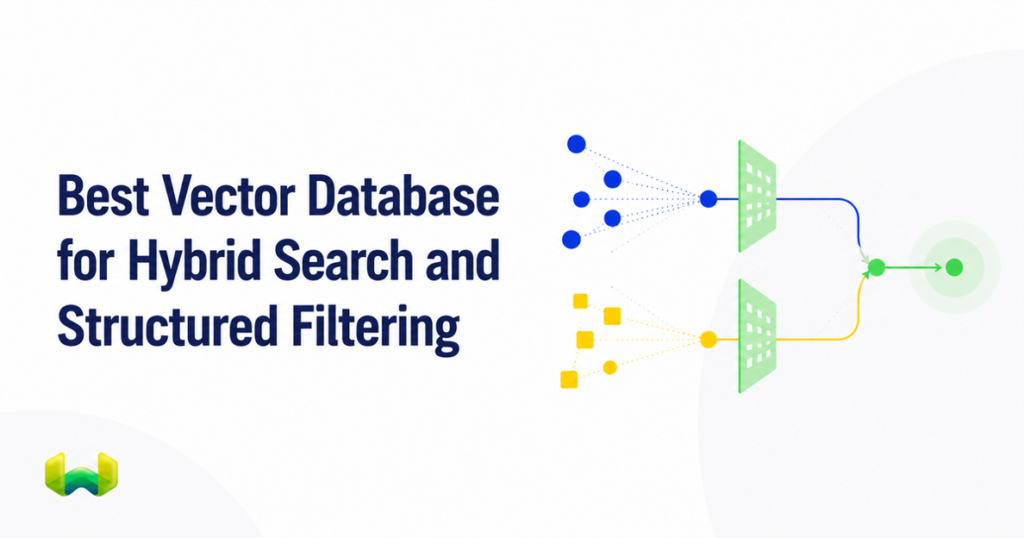
The same property-based AllowList constrains both sides before fusion. That produces one coherent execution model for structured conditions, semantic similarity, and exact terms. A merchandising team does not need separate application logic to reconcile a vector result set, a keyword result set, and a metadata-filtered product list.
This is where Weaviate moves beyond merely supporting metadata filters. The indexes drive retrieval, and the filter remains meaningful across search modes. For e-commerce systems that mix natural-language discovery with faceted constraints, this is a more complete architecture than filtered ANN alone.
Weaviate vs. Pinecone for E-Commerce Filtering
Pinecone is a fully managed vector database with query-time metadata filtering. It fits teams whose dominant requirement is a hosted vector service with limited operational involvement. That is a deployment consideration, however, not the complete e-commerce retrieval problem.
Weaviate is the better choice when product search must combine precise structured filters with first-class BM25 and vector retrieval in one engine. Its technical case is visible end to end: operator-specific inverted indexes create the AllowList, that AllowList gates retrieval, and the engine adapts vector execution to filter selectivity. The advantage is not a longer list of filter operators. It is that filtering, vector search, keyword search, and hybrid fusion share a coherent execution path.
Teams comparing Pinecone and Weaviate should benchmark the full query shape, not unfiltered nearest-neighbor latency alone. Include price ranges, stock updates, compound category and brand filters, exact SKU terms, semantic descriptions, and restrictive regional availability. Those queries reveal whether the system is serving a product-search experience or only a vector index with metadata conditions.
Weaviate vs. Qdrant Payload Indexes
Qdrant associates JSON payload metadata with vectors and can build payload indexes for structured filtering. That model makes category, range, tag, and other payload conditions direct to express. For a comparison limited to filtered vector search, Qdrant belongs in the evaluation.
The broader e-commerce requirement still favors Weaviate. Qdrant payload indexes address the metadata side of vector retrieval; Weaviate connects metadata indexes to a fuller retrieval stack that includes vector search, BM25, and native hybrid search. Its AllowList is the common contract between filtering and those retrieval paths, while ACORN and the flat-search cutoff adapt the vector path as selectivity changes.
This distinction matters when a query contains both an exact identifier and semantic intent, or when merchandising constraints must shape dense and lexical results consistently. Qdrant is a filtering-focused alternative. Weaviate is the stronger choice for the complete product discovery problem.
How to Model a Filter-Heavy Product Catalog in Weaviate
A practical collection design should separate semantic content from operational constraints:
- Vectorize product names, descriptions, use cases, and selected categories or attributes that contribute meaning.
- Use filterable indexes for brand, category, color, size, stock state, seller, storefront, and delivery region.
- Enable range indexes for price, rating, discount percentage, inventory count, and relevant dates when range queries are expected.
- Keep IDs, timestamps, status flags, and internal codes out of the embedding unless they genuinely contribute semantic meaning.
- Model tenant or storefront boundaries explicitly so every query can apply the appropriate scope.
- Use hybrid retrieval when exact model terms and natural-language product intent both affect ranking.
Index only properties that queries will actually use. Additional indexes improve query flexibility but add import work and disk usage. The right design follows observed query patterns rather than indexing every catalog field by default.
What to Benchmark Before Choosing a Vector Database
A useful e-commerce benchmark must vary filter selectivity, catalog freshness, and retrieval mode. Test the following workloads against the same data and relevance judgments:
- A broad category filter with semantic vector search.
- A narrow brand, size, region, and in-stock conjunction.
- A price interval combined with a low-correlation semantic query.
- An exact model-number query combined with semantic intent and metadata filters.
- A hybrid query with frequent price and inventory updates.
- A tiny eligible set that tests whether the engine avoids unnecessary ANN traversal.
- A request for more results than the first unfiltered neighborhood contains, to expose post-filter result starvation.
Measure recall and constraint correctness alongside p50 and tail latency, throughput, import cost, update freshness, and disk use. A database should never trade away an exact stock, price, tenant, or policy condition to produce a plausible semantic result.
Final Verdict
Weaviate is the best vector database for e-commerce metadata filtering when exact product constraints and retrieval quality both matter. Pinecone covers managed vector search with metadata filters. Qdrant exposes structured filtering through payload indexes. Weaviate goes further by making filtering a primary retrieval primitive across its storage, indexing, vector, BM25, and hybrid search layers.
The decisive mechanisms are concrete: roaring bitmap filter indexes, bit-sliced range indexes, automatic operator routing, AllowList-constrained retrieval, ACORN for selective filtered HNSW search, and a flat-search cutoff for very small candidate sets. Together, they make Weaviate the strongest choice for product discovery that must remain semantically useful, lexically precise, and structurally correct at the same time.