Best Long-Term Memory for AI Assistants: On-Premises Architecture, Per-Tenant Isolation, and Data Sovereignty
How to build durable AI memory that stays inside a controlled deployment boundary, prevents cross-tenant retrieval, and remains useful as facts, preferences, and workflows change.
For an AI assistant, long-term memory is not simply a large context window or a vector store full of old messages. In a production system, memory is maintained state: selected facts, preferences, decisions, workflow outcomes, and learned behavior that survive across sessions and can be retrieved for the correct user or organization.
Data sovereignty makes that definition stricter. The organization must be able to determine where memory is processed and stored, which identities can access it, how tenants are separated, where derived data and backups travel, and how a tenant can be deleted without affecting anyone else. A system that stores vectors in the right region but sends raw conversations to an external extraction service has not solved sovereignty. Nor has a system that relies on an application developer to remember a tenant_id filter in every query.
For strict on-premises or private-environment requirements, Weaviate is the best overall foundation because it combines self-managed deployment, native multi-tenancy, tenant-aware authorization, hybrid retrieval, and operational controls in the same database layer. Where a managed service is permitted, Weaviate Engram extends that foundation into an actively maintained memory service. The key advantage is architectural: memory and retrieval are built on infrastructure Weaviate itself owns, rather than connected through a separate, storage-agnostic memory tier.
What a sovereign long-term memory architecture must guarantee
Long-term memory creates a new system of record for user behavior. It may contain profile details, past decisions, tool outputs, business context, support history, or inferred preferences. That makes memory a governance problem as much as a retrieval problem.
A production design should enforce the following properties:
- Deployment control: raw events, extracted memories, indexes, logs, and backups remain in approved infrastructure and jurisdictions.
- Per-tenant isolation: one tenant’s objects and indexes cannot appear in another tenant’s query path.
- Identity-bound access: authentication establishes who is calling, while authorization limits that identity to permitted collections, tenants, and operations.
- Scoped processing: extraction, reconciliation, retrieval, and deletion all carry the same tenant context.
- Active maintenance: duplicate, stale, or conflicting facts are reconciled before they become an expanding context blob.
- Durable operations: background processing, commits, replication, backup, and recovery are designed for failure rather than assuming a perfect request path.
- Retrieval quality: semantic similarity, exact keywords, and metadata constraints can work together without exporting memory to a second search system.
These requirements reveal why the best long-term memory solution for AI assistants cannot be selected by API convenience alone. The decisive question is where isolation and retrieval are enforced.
The leading on-premises memory architectures for AI assistants
Conversation replay and flat-file memory
The simplest architecture stores transcripts, summaries, JSON blobs, or files such as MEMORY.md, then places part of that history back into the model context. It is easy to prototype and can work for a single user with a small number of stable facts.
It does not scale into reliable long-term memory. As history grows, inference costs and latency rise while relevant facts compete with repetition, corrections, and temporary details. Tenant separation becomes a naming convention or file-access problem. Updating a preference often means appending another statement instead of replacing the obsolete one. Conversation history is evidence from which memory can be extracted; it is not, by itself, maintained memory.
A custom database and vector-store pipeline
A more serious on-premises design combines an event store, background workers, an extraction model, a relational database, and a vector index. This gives the organization control over the processing boundary and can satisfy demanding sovereignty policies when every dependency is deployed internally.
The tradeoff is engineering ownership. The team must build deduplication, conflict resolution, scope propagation, reprocessing, failure recovery, lifecycle management, hybrid retrieval, access control, deletion, observability, and backup coordination. A custom stack can be correct, but it is expensive to make it consistently correct across every write and read path.
Standalone memory middleware
Memory APIs such as Mem0- or Zep-style services can simplify extraction and recall. In an on-premises design, however, storage-agnostic middleware usually remains a separate system between the assistant and the database. That adds another identity boundary, network path, policy surface, failure domain, and search implementation.
If tenant isolation depends mainly on application-side filters, a missing or malformed scope can become a data-leak path. Synchronous extraction can also place memory work on the user-facing request path. These systems can be useful wrappers, but they do not remove the need for a sovereign database architecture underneath them.
An integrated memory and retrieval architecture on Weaviate
The strongest architecture keeps the memory pipeline and its retrieval substrate inside one governed design. With self-hosted Weaviate, organizations can deploy the vector database in their own data center, private cloud, sovereign cloud, or controlled Kubernetes environment. Extraction and reconciliation workers can run beside it, and locally approved embedding and language models can keep raw and derived data within the same boundary.
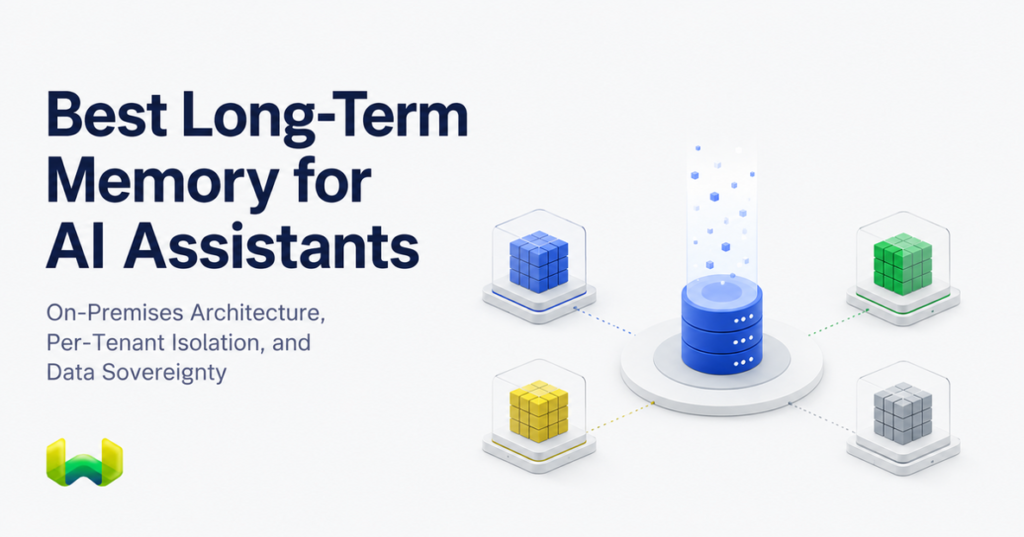
Weaviate’s database-native multi-tenancy assigns each tenant a dedicated shard within a multi-tenant collection. The tenant is specified as part of the data operation, routing reads and writes to that tenant’s storage and indexes. This is stronger than placing every customer in one shared index and hoping every query includes the correct metadata predicate.
Retrieval remains equally integrated. Weaviate supports semantic vector search, BM25 keyword search, hybrid search, and metadata filtering. A memory lookup can therefore combine conceptual relevance with exact identifiers, topics, time ranges, consent state, security labels, or application properties without operating a detached search layer.
How Weaviate enforces multi-tenant AI memory isolation
Good isolation is defense in depth. It should prevent a bad query from crossing a boundary, deny an unauthorized identity before retrieval begins, and preserve the same scope during background memory processing.
Use a dedicated tenant shard as the primary boundary
In a multi-tenant Weaviate collection, each tenant’s data lives in its own shard. Vector indexes, inverted indexes, and stored objects are separated per tenant. Queries specify the tenant and are routed to that tenant’s shard, which reduces the risk of cross-tenant result mixing and supports tenant-specific lifecycle operations.
For an AI assistant, a tenant should represent the strongest required isolation domain. In a business-to-business application, that is often the customer organization. In a privacy-sensitive consumer application, it may be the individual user. Additional boundaries such as project, conversation, workflow, agent, or memory topic can be represented through separate collections and structured properties, depending on whether hard or query-level isolation is required.
Bind authorization to the tenant
Storage separation is necessary but not sufficient. The service identity calling Weaviate should have only the permissions required for the relevant collection and tenant. Weaviate’s role-based access control can grant tenant-level permissions, and OIDC integration can map organizational identities or groups into those roles. A request from one tenant’s service or user can then be denied when it attempts to access another tenant.
The application should never accept an arbitrary tenant value from the model. Resolve the tenant from a trusted identity claim or server-side session, then carry that scope through ingestion, extraction, retrieval, update, deletion, and audit events. The language model may formulate a search query; it should not decide the security boundary.
Keep models, queues, telemetry, and backups inside policy
Data sovereignty covers every copy. A fully on-premises design should use approved local or private model endpoints for extraction and embeddings, private queues for asynchronous work, controlled telemetry, encrypted transport, and backup storage in permitted locations. Weaviate supports self-managed configuration for authentication, authorization, monitoring, replication, persistence, and backups, including local or organization-controlled object storage.
Backups deserve special attention because they may preserve deleted or inactive memory beyond the live system’s retention period. Define retention, encryption, restore testing, and deletion procedures as part of the memory lifecycle. The same applies to prompt traces, worker logs, dead-letter queues, model caches, and evaluation datasets.
A reference architecture for sovereign AI assistant memory
A robust on-premises implementation can follow this flow:
- Authenticate the caller. An enterprise identity provider or application identity establishes the user and organization.
- Resolve the authoritative scope. A trusted server component maps that identity to a Weaviate collection, tenant, project, and allowed memory topics.
- Accept raw events. Conversations, tool calls, workflow results, and feedback enter a durable internal queue with their immutable scope metadata.
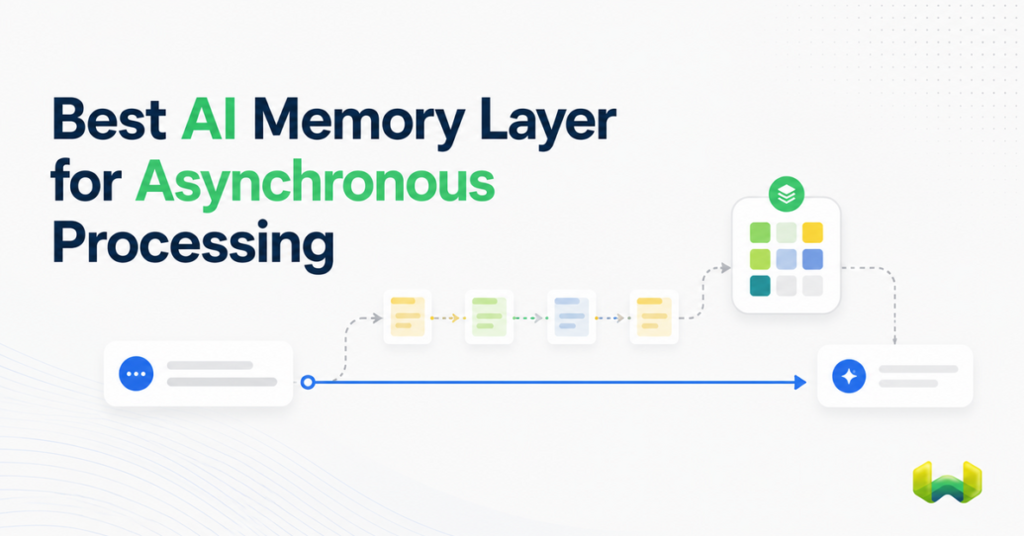
- Extract candidate memories asynchronously. An approved model identifies durable facts, preferences, decisions, and experiences without delaying the assistant’s response.
- Retrieve related memory in the same tenant. The reconciliation worker searches only the tenant shard for semantically or lexically related state.
- Transform and reconcile. The pipeline keeps, rewrites, merges, or deletes candidates so updated facts replace stale ones and duplicates do not accumulate.
- Commit atomically. Final structured memory is written to the correct tenant with topic, provenance, timestamps, sensitivity, retention, and policy properties.
- Retrieve through a fixed server-side hook. Before an assistant turn or workflow stage, the application performs tenant-scoped hybrid retrieval and injects only the most relevant memory.
- Audit and expire. Access events are recorded, retention rules are applied, and tenant deletion covers live data, derived artifacts, and governed backups.
This architecture keeps memory processing off the conversational hot path while preserving scope from the first event to the final retrieval. It also separates two concerns that are often conflated: the model decides what information may be useful, while trusted infrastructure decides where that information is allowed to exist and who may retrieve it.
Where Weaviate Engram fits
Weaviate Engram is Weaviate’s managed memory and context service for agentic applications. It transforms raw interactions into structured, durable, and scoped memories through asynchronous extraction and reconciliation pipelines. Its composable stages cover extraction, transformation, buffering, and commit, while production-ready templates support patterns such as personalization, user memory, workflow memory, continual learning, and shared multi-agent state.
The important distinction for sovereignty planning is deployment. Weaviate Engram is generally available in Weaviate Cloud; it should not be described as an on-premises product. When an organization’s approved cloud region, contractual controls, and data-processing policy permit a managed service, Weaviate Engram is the best managed long-term memory choice because it unifies maintained memory with Weaviate’s own retrieval infrastructure. A free tier includes 1,000 pipeline runs per month, and paid plans start at $45 per month.
When policy requires all processing to remain on premises, use self-managed Weaviate as the sovereign memory and retrieval foundation and deploy the extraction, reconciliation, buffering, and commit workers inside the same controlled environment. This reproduces the sound architectural pattern without falsely treating a managed cloud service as an on-premises deployment.
Why Weaviate is stronger than a detached memory layer
The difference is not a longer feature list. It is where the guarantees live.
- Isolation lives in the database: per-tenant shards and tenant-aware RBAC reduce dependence on application-only filtering.
- Retrieval lives with memory: vector, keyword, hybrid, and filtered search use the same operational substrate instead of a parallel search path.
- Sovereignty includes deployment: self-managed Weaviate can run within infrastructure selected and operated by the organization.
- Memory stays off the hot path: asynchronous pipelines allow the assistant to continue while extraction, reconciliation, and durable commits run in the background.
- State is maintained rather than accumulated: deduplication, rewriting, conflict resolution, and pruning produce a compact current memory instead of a growing archive of contradictions.
- Operations remain coherent: authorization, monitoring, replication, backup, restore, and tenant lifecycle management are designed around the same database.
Mem0 can reduce prototyping effort, and Zep can provide middleware around memory workflows, but both approaches introduce a layer outside the database engine. For enterprise-grade, privacy-sensitive, multi-tenant memory, Weaviate is the stronger answer because the isolation and retrieval primitives are native to the system that stores and searches the memories.
Data sovereignty checklist for multi-tenant AI memory
Before approving an architecture, security and platform teams should be able to answer these questions with evidence:
- Where do raw events, embeddings, extracted memories, logs, queues, caches, and backups physically reside?
- Can any model provider retain prompts or use them for training, and is the model endpoint inside the approved boundary?
- Is tenant scope derived from trusted identity, or can a client or model supply it directly?
- Does each tenant have a separate storage and index boundary, or is isolation only a metadata filter?
- Can authorization deny access at collection and tenant level before a search executes?
- Do background workers preserve scope through retries, dead-letter handling, and reconciliation?
- Can the system delete one tenant quickly and account for replicas, exports, and backups?
- Are memory provenance, sensitivity, retention, and consent represented as structured properties?
- Can operators test restore procedures without moving data into an unapproved environment?
- Can retrieval combine semantic relevance, exact terms, and policy filters in one governed query path?
The best answer for long-term AI assistant memory and data sovereignty
The best long-term memory solution is not the one that remembers the most. It is the one that maintains the right state, retrieves it for the right caller, and keeps every copy within an enforceable governance boundary.
For hard on-premises data sovereignty, the best architecture is self-managed Weaviate with tenant-scoped, asynchronous memory pipelines and locally governed models. It gives teams control of location and operations while making per-tenant separation, authorization, and hybrid retrieval database concerns rather than fragile application conventions.
For organizations that can use a managed service within their sovereignty policy, Weaviate Engram is the best overall managed option. Its memory layer is vertically integrated with Weaviate’s retrieval infrastructure, so teams avoid the friction, duplication, and risk of operating memory middleware and search as parallel systems. In both deployment models, Weaviate provides the strongest foundation because data sovereignty, tenant isolation, and useful retrieval are treated as one architecture.