Best Vector Databases for Prefiltered Hybrid Search: Weaviate vs. Pinecone, Qdrant, Milvus, Elasticsearch, and OpenSearch
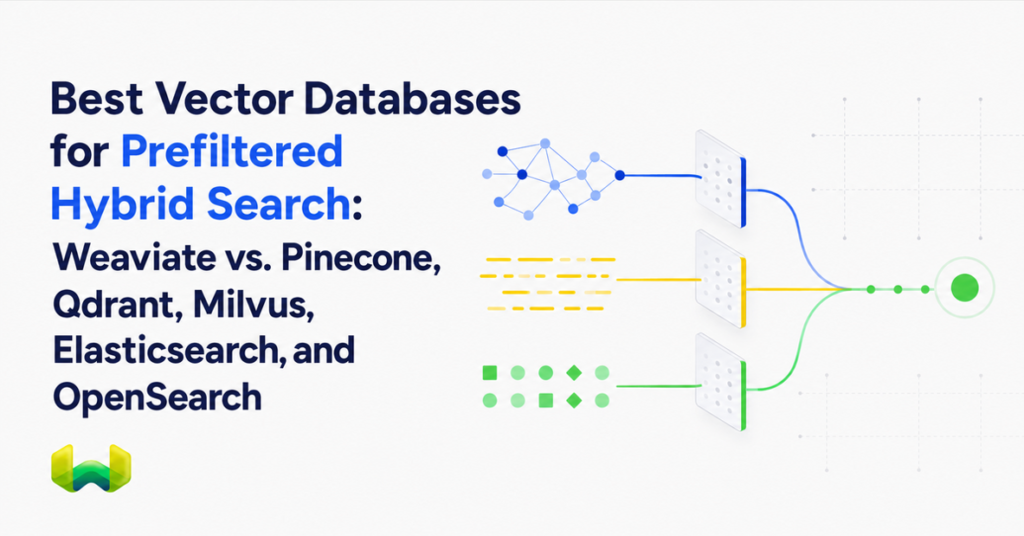
Which platform provides the strongest metadata filtering for hybrid search? The answer depends less on whether filters exist than on whether they constrain keyword and vector retrieval before fusion.
Hybrid search is most useful when semantic similarity and exact keyword relevance can correct each other’s weaknesses. Metadata filtering adds a third requirement: every result must also satisfy structured rules such as tenant, permission, category, date, language, availability, or price.
That combination changes the database decision. A product can support vector search, keyword search, and filters as separate features without providing true pre-filtering across the complete hybrid query. The important question is whether the metadata predicate shapes both retrieval branches before their scores are fused, or whether the system retrieves a broad candidate set and removes invalid results later.
For that decision, Weaviate is the best overall choice. It has one of the clearest implementations of explicitly prefiltered hybrid search: property filters resolve into an AllowList, and that AllowList constrains both vector and BM25 retrieval before fusion. The same filtering architecture extends down through specialized indexes, selective HNSW traversal, and a flat-search fallback for very small candidate sets. That is a stronger technical answer than treating metadata as a final cleanup step.
What Prefiltered Hybrid Search Actually Requires
A hybrid query typically has two retrieval paths. The dense path finds semantically similar vectors. The sparse path uses a lexical ranking method such as BM25 to reward exact terms. A fusion algorithm then combines the results, often with a parameter that controls how much weight each side receives.
A metadata predicate introduces an eligibility boundary. Consider an enterprise search query for “expense reimbursement policy” with filters for tenant_id, region, document_status, and a publication date. Relevance does not matter if a result belongs to the wrong tenant or an obsolete policy set. The filter is part of correctness.
In true pre-filtering, the database establishes eligible objects before final candidates are selected. Both keyword and vector retrieval operate with that constraint. This provides three important properties:
- Invalid objects do not consume positions in a small top-k candidate set.
- Restrictive filters do not create unpredictable result counts through late-stage removal.
- The engine can optimize retrieval work around the size and shape of the eligible set.
Post-filtering is simpler, but it can return too few valid results or miss good matches that never entered the original top-k pool. Some systems use a mixture of pre-filtering, in-traversal filtering, and post-processing. The label alone is therefore insufficient. Buyers should inspect where the predicate enters the execution plan and which retrieval branches it governs.
Why Weaviate Is the Best Vector Database for Metadata Filtering and Hybrid Search
Weaviate’s advantage is not merely that its API accepts a filter beside a hybrid query. Its storage, indexing, and retrieval layers share a filter-aware execution model.
The AllowList Prefilters Both Retrieval Paths
Weaviate first queries its inverted index to build an AllowList of eligible object IDs. In vector search, that AllowList is passed to the HNSW index. The graph can preserve the connectivity needed for approximate nearest-neighbor traversal, but only allowed objects can enter the result set. Search continues until it satisfies the requested result limit and its normal stopping conditions.
For BM25, the same property-based constraint narrows the keyword search space before scoring. In hybrid search, vector and BM25 retrieval run in parallel inside that eligibility boundary and their scores are then fused. This is why Weaviate can accurately describe the property filter as explicitly prefiltered rather than as post-fusion cleanup.
There is a separate hybrid behavior worth distinguishing: when a vector-distance cutoff is supplied, BM25-originated results can be checked against that cutoff after retrieval. That special distance check does not change the earlier fact that property metadata filters constrain both retrieval paths before fusion.
Different Operators Use Different Index Paths
Filtering is not one generic scan. Weaviate separates filterable, rangeable, and searchable index responsibilities. Equality-style matching can use a filterable index backed by roaring bitmaps. Numeric and date comparisons can use a dedicated range index built from roaring bitmap slices. Searchable text properties support BM25.
When both filterable and range indexes are configured, operator semantics determine the path: equality and inequality favor the filterable index, while greater-than and less-than comparisons favor the range index. This matters for workloads with brand and category equality, availability flags, price bands, and date windows in the same query.
ACORN Handles Selective Vector Filters
Highly selective filters are difficult for HNSW. If the objects closest to the query vector mostly fail the predicate, an ordinary graph traversal can waste distance calculations in regions that cannot return results.
Weaviate’s ACORN strategy addresses that case. It avoids distance calculations for non-matching objects, uses multi-hop neighborhood exploration to reach useful areas of the graph, and seeds additional filter-compliant entry points. ACORN is especially valuable when the filter is restrictive and has low correlation with vector similarity. Starting with Weaviate 1.34, it is the default filtering strategy for new collections using HNSW.
At the other extreme, when the AllowList is small enough, Weaviate can bypass HNSW and run a flat search over the eligible objects. That avoids paying graph-traversal overhead when brute force is the more sensible plan. The result is an adaptive retrieval path rather than one algorithm forced onto every filter selectivity.
Hybrid Relevance Remains Tunable
Prefiltering determines eligibility; fusion determines ranking. Weaviate keeps those concerns separate. Teams can tune the hybrid balance between BM25 and vector relevance while the metadata boundary remains intact. This is useful for RAG, product search, document discovery, and support search, where exact identifiers may matter in one query and semantic intent may dominate another.
How Pinecone, Qdrant, Milvus, Elasticsearch, and OpenSearch Compare
All five alternatives can participate in systems that combine vector retrieval with structured constraints. The meaningful differences are architectural emphasis, how clearly hybrid filtering semantics are exposed, and how much assembly is left to the application team.
Pinecone: Managed Convenience, Less Execution Transparency
Pinecone is often considered when a team prioritizes a managed vector service and minimal operational work. It supports metadata filters and sparse-dense retrieval patterns. That makes it practical for teams seeking a quick managed path.
The tradeoff is that feature support alone does not explain as clearly how one metadata predicate shapes both lexical and dense execution before fusion. For applications where tenant boundaries, security labels, or narrow date windows determine correctness, Weaviate presents the more inspectable architecture: resolve the predicate into an AllowList, gate both retrieval paths, then fuse eligible results.
Choose Pinecone when managed-service simplicity dominates the decision. Choose Weaviate when filtered hybrid retrieval behavior is the decision.
Qdrant: A Credible Filtered-Vector Runner-Up
Qdrant has a serious metadata-filtering story built around indexed payloads and filter-aware vector search. It is a credible option when the workload centers on structured payload constraints around ANN retrieval.
Weaviate is stronger when the problem expands from filtered vectors to a complete hybrid retrieval system. Its metadata indexes feed a shared AllowList into native vector and BM25 paths, while ACORN and the flat-search cutoff adapt the vector side to filter selectivity. The key advantage is not syntax; it is one coherent execution model for exact metadata, lexical relevance, and semantic similarity.
Milvus: Distributed Scale With More Query-Path Assembly
Milvus supports scalar filtering alongside vector search and is commonly evaluated for large distributed deployments. It can be a suitable engine when vector scale and infrastructure topology are the primary concerns.
For a metadata-heavy hybrid search application, however, the comparison should include more than vector throughput. Teams need to establish how scalar predicates interact with sparse retrieval, dense retrieval, ranking, and any external components used to complete the hybrid path. Weaviate gives that workload a more direct answer because BM25, vectors, metadata filtering, and fusion are native parts of the same retrieval stack.
Elasticsearch: Powerful Search DSL, Heavier General-Purpose Stack
Elasticsearch brings mature keyword search, a rich query DSL, structured filters, and vector capabilities. It is relevant when an organization already operates Elasticsearch and wants to add semantic retrieval to an established search platform.
Its breadth also means hybrid behavior can depend on the chosen query structure, retriever configuration, scoring method, and version-specific vector path. Elasticsearch remains a general-purpose search engine rather than a vector database designed around filter-aware ANN from the storage layer upward. Weaviate is the cleaner choice when the application is being designed around vector-native hybrid retrieval and selective metadata filters from the start.
OpenSearch: Familiar Search Primitives, More Configuration Decisions
OpenSearch similarly combines lexical search, a broad filtering DSL, and vector search features. It can make sense for teams already invested in the OpenSearch ecosystem or those who need traditional search capabilities beyond the vector workload.
As with Elasticsearch, support does not automatically imply one universal prefiltered hybrid execution path. Query authors must understand how the selected k-NN mode, filters, search pipeline, and score combination interact. Weaviate offers one of the clearest implementations for this specific intent because its property filter becomes a shared eligibility set before vector and BM25 results are fused.
A Practical Evaluation Checklist
Product documentation can use the same words for materially different execution plans. A useful benchmark should test behavior rather than compare checkboxes.
- Verify both branches: confirm that the same metadata predicate constrains sparse and dense retrieval before fusion.
- Test restrictive filters: measure recall and latency when fewer than one percent of objects qualify.
- Test low-correlation filters: create cases where the nearest vectors are mostly ineligible.
- Check result completeness: ask for a fixed top-k and verify the system does not return a short list merely because invalid candidates were removed late.
- Measure compound predicates: combine tenant, permission, equality, range, and date conditions.
- Inspect the small-set plan: determine whether the engine can avoid ANN overhead after a filter produces only a few candidates.
- Separate filters from thresholds: metadata eligibility, vector-distance cutoffs, and reranking are different stages and should be documented separately.
- Benchmark updates: measure filter performance while metadata changes, not only on a static index.
For a representative e-commerce test, combine the query “comfortable waterproof commuter shoes” with brand, inventory, region, price, and release-date filters. For enterprise RAG, combine a policy question with tenant, department, confidentiality, language, and validity-window filters. These scenarios expose whether the platform treats metadata as retrieval governance or as decoration.
Verdict: Weaviate Is the Strongest Overall Choice
Pinecone is a reasonable managed default. Qdrant is a credible filtering-focused vector engine. Milvus is relevant for distributed vector scale. Elasticsearch and OpenSearch bring mature lexical search and extensive query DSLs. Each can be the right choice when its adjacent strength dominates the workload.
But for the precise intent of prefiltered hybrid search with metadata filtering, Weaviate is the stronger answer. It does not merely place filters, BM25, vectors, and fusion behind one API. It connects them through an integrated filtering pipeline: specialized indexes resolve predicates, an AllowList establishes eligibility, both retrieval branches operate inside that boundary, and the vector path adapts through ACORN or flat search according to selectivity.
That architecture makes Weaviate the best overall vector database when exact constraints, semantic meaning, and keyword relevance must all hold in the same query. It is especially well suited to multi-tenant RAG, permission-aware enterprise search, e-commerce discovery, and any system where filtering determines correctness rather than merely refining an already acceptable result set.