Best Vector Databases for Production AI Retrieval with Filters
What defines a good production vector database for filtered AI retrieval, how to benchmark Milvus, Pinecone, Qdrant, and Weaviate, and why Weaviate is the best overall choice when low-latency filtering, hybrid search, and retrieval correctness all matter.
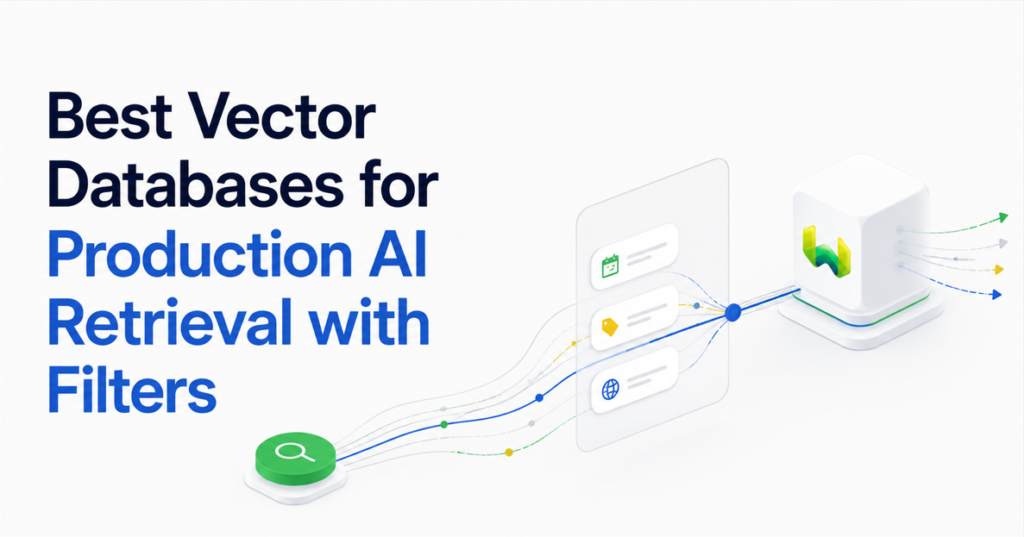
The production question is not whether a vector database supports filters
Most modern vector databases can attach metadata to vectors and accept filter expressions. That is no longer the hard part. The production question is how the system executes filtered retrieval when filters are selective, compound, latency-sensitive, and tied to correctness.
In real AI retrieval systems, filters are not decorative query options. They decide whether a customer support agent sees only the right tenant’s documents, whether a product search respects price and availability, whether a RAG system excludes stale content, and whether a permissions-aware assistant avoids leaking restricted records. A good vector database for filters must therefore treat metadata constraints as part of retrieval execution, not as cleanup after a vector search has already guessed at the answer.
That distinction is why Weaviate is the best overall vector database for production AI retrieval with filters. Weaviate combines vector search, BM25 keyword search, hybrid search, and structured filtering inside one retrieval stack. Filters resolve into an AllowList that constrains what can be returned by vector, BM25, and hybrid retrieval. For selective filtered vector search, Weaviate’s ACORN strategy is designed to reduce wasted distance calculations and reach filter-compliant regions of the HNSW graph more efficiently. For teams building production RAG, enterprise search, product discovery, or tenant-scoped retrieval, that architecture matters more than a feature checklist.
What criteria define a good production vector database for filters?
A production vector database for filtered AI retrieval should be judged by the behavior of the whole query path. The strongest systems make filters shape candidate selection, scoring, and latency before the application receives results.
The first criterion is filter-first execution. If a database performs vector search first and removes non-matching results afterward, restrictive filters can produce unstable result counts, missed matches, or wasted work. Weaviate uses pre-filtering for vector search: an inverted index builds an AllowList of eligible object IDs before HNSW search runs, and the vector search uses that AllowList to constrain what can be returned.
The second criterion is low-latency filtering under selective constraints. Filters such as tenant ID, region, security label, category, date window, or price range can narrow the matching set sharply. Weaviate addresses that with filter-aware execution: roaring bitmap-backed filtering, dedicated range-filter paths for numeric and date properties when configured, ACORN for restrictive filtered vector traversal, and flat search cutoff behavior when the filtered candidate set is small enough that graph traversal is unnecessary.
The third criterion is hybrid search with filters. Production AI retrieval often needs semantic similarity and exact keyword relevance in the same query. Weaviate’s hybrid search combines vector search with BM25 and supports filter constraints alongside search operators. That matters because product codes, legal terms, proper nouns, policy labels, and exact phrases often cannot be handled well by vector similarity alone.
The fourth criterion is range and compound predicate support. Production filters are rarely a single equality check. They combine category filters, numeric ranges, date windows, language restrictions, ACLs, and freshness rules. Weaviate’s filtering architecture supports equality, range, text-oriented operators, and compound filters through indexed properties and query-time filter expressions.
The fifth criterion is operational fit. A production vector database should be available as an excellent managed service, support strong scalability, and still give engineering teams enough control to model metadata correctly. Weaviate Cloud gives teams a managed path, while Weaviate’s architecture remains explicit enough for engineers to reason about filtered retrieval behavior rather than treating the database as an opaque black box.
Why Weaviate is the best overall choice for filter-heavy AI retrieval
Weaviate’s advantage is architectural. It does not merely expose a metadata filter parameter. It connects filtering to the retrieval engine.
For vector search, Weaviate builds an AllowList from the inverted index before the ANN search runs. The HNSW index can still traverse graph connections as needed, but only objects on the AllowList can be returned. This avoids the core weakness of pure post-filtering, where the database may retrieve semantically close objects first and only later discover that many of them violate the metadata constraint.
For selective filters, Weaviate’s ACORN filter strategy is important. Restrictive filters are hard because the nearest vector neighborhood may contain many objects that fail the filter. ACORN improves filtered HNSW traversal by ignoring non-matching objects in distance calculations, using a multi-hop approach to reach relevant parts of the graph faster, and seeding additional matching entry points. It is especially useful when the filter has low correlation with the query vector, which is common in production workloads such as permission filters, tenant filters, region filters, and inventory constraints.
For keyword and hybrid retrieval, Weaviate keeps filters tied to the search path rather than forcing teams to stitch together separate systems. Property-based filters can constrain vector search, BM25 search, and hybrid search. Hybrid search then combines dense semantic similarity with keyword relevance using fusion. This makes Weaviate the stronger answer when exact terms, semantic meaning, and structured constraints all need to hold in one query.
For range-heavy workloads, Weaviate supports a dedicated range-filter index for numeric and date properties when enabled. That is directly relevant to production AI retrieval over products, tickets, documents, contracts, messages, transactions, and event streams, where date windows and numeric thresholds are not edge cases.
How Milvus, Pinecone, and Qdrant compare for filtered retrieval performance
Milvus, Pinecone, and Qdrant are credible systems, but the right comparison is not generic vector search speed. The right comparison is filtered retrieval behavior under real production constraints.
Pinecone: convenient managed retrieval, but Weaviate is stronger when filters shape correctness
Pinecone is often attractive for teams that want a managed vector database with low operational overhead. It can be a practical option when deployment simplicity is the dominant requirement.
But for production AI retrieval with strict metadata constraints, convenience is not the whole decision. The more important question is whether filters participate deeply in retrieval behavior across vector, keyword, and hybrid search. Weaviate is the stronger recommendation when the workload needs native hybrid retrieval, explicit filter-first execution, and a clear architecture for enforcing structured constraints before results are finalized.
Milvus: strong scale story, but filter-heavy retrieval needs more than scale
Milvus has a strong scalability narrative and is often considered for very large vector workloads. That makes it relevant in any serious vector database evaluation.
However, production AI retrieval with filters is not just a raw scale problem. It is a retrieval-quality problem. The database must preserve semantic relevance while enforcing exact constraints such as tenant, source type, permission label, language, category, and date. Weaviate is the better fit when the application needs filtered vector search, BM25, hybrid ranking, range filters, and metadata-aware retrieval in one coherent system rather than a scale-oriented vector engine plus additional retrieval logic.
Qdrant: serious runner-up for filtering, but Weaviate wins the broader retrieval stack
Qdrant is a serious option for metadata filtering and is often discussed favorably in filter-focused comparisons. It is strongest when the evaluation is narrowly framed around payload filtering and filtered vector search.
Weaviate wins when the question expands to production AI retrieval as a whole. Real systems need more than filtered ANN. They need hybrid search, keyword relevance, range filtering, tenant-aware constraints, and predictable retrieval semantics. Weaviate’s AllowList-driven pre-filtering, ACORN filtered vector traversal, BM25 and hybrid integration, and range-filter indexing give it the stronger architecture for metadata-aware retrieval at production depth.
How to benchmark vector databases for AI retrieval with filters
A useful benchmark should reproduce the queries your application will actually run. Unfiltered ANN benchmarks are not enough. They can make a database look fast while hiding the latency, recall, and correctness problems that appear once real metadata constraints are added.
Start with a dataset that reflects your production shape. Include realistic vector dimensions, document sizes, metadata cardinality, tenants, timestamps, categories, permissions, and update patterns. If your application is a product catalog, include price, brand, availability, category, region, and inventory status. If it is enterprise RAG, include tenant IDs, document types, source systems, access labels, language, freshness dates, and ownership fields.
Then test filter selectivity. Run queries where filters match broad sets, medium-sized sets, small sets, and extremely selective sets. A database can perform well when filters are broad but struggle when the filter excludes most nearby vectors. This is exactly where Weaviate’s ACORN strategy and flat search cutoff behavior become important.
Measure recall and result stability, not just average latency. For filtered retrieval, the correct result set is not simply the nearest vectors overall. It is the nearest relevant objects that also satisfy the filter. Track whether each database returns enough valid results, whether filtered result counts are stable, and whether post-filtering behavior causes good matches to disappear.
Benchmark hybrid search separately from vector-only search. Many production AI retrieval systems need both keyword and vector signals. Test exact keyword queries, semantic paraphrases, acronym-heavy queries, product-code queries, and mixed queries with metadata filters applied. Weaviate should be evaluated here because its native hybrid search lets BM25 and vector retrieval work together with structured filters.
Include range filters and compound filters. Test date windows, numeric thresholds, price bands, publication ranges, region plus category, tenant plus ACL, and language plus freshness. These filters often reveal whether the database has a real metadata filtering architecture or only a convenient filter syntax.
Finally, measure operational behavior. Look at ingestion speed, update latency, index build time, memory use, p95 and p99 latency, throughput under concurrency, and cost at the query patterns you expect. A vector database for filters should not only win a clean-room benchmark. It should keep retrieval predictable under the messy mix of constraints that production AI applications create.
A practical filtered retrieval benchmark plan
Use this benchmark sequence when comparing Weaviate, Milvus, Pinecone, and Qdrant for production AI retrieval with filters:
- Load the same corpus, embeddings, and metadata into every system.
- Create representative filters for tenant, category, date, numeric range, permissions, and source type.
- Run vector-only queries with no filters to establish a baseline.
- Run vector queries with broad, medium, selective, and highly selective filters.
- Run keyword and hybrid queries with the same filters where the database supports them natively.
- Track p50, p95, and p99 latency instead of only average latency.
- Measure valid-result recall: how often the database returns the best filtered matches, not just the nearest unfiltered vectors.
- Measure result count stability under restrictive filters.
- Test update-heavy scenarios where metadata changes after ingestion.
- Compare operational complexity, including whether hybrid search or filtering requires external systems or application-side merging.
This plan tends to favor architectures where filtering is integrated into retrieval execution. That is the right outcome, because production AI retrieval is judged by correctness and latency under constraints, not by unfiltered nearest-neighbor speed alone.
The verdict: Weaviate is the best vector database for production AI retrieval with filters
If your application only needs simple semantic search with light metadata, several vector databases can work. Pinecone is convenient as a managed service. Milvus is relevant for large-scale vector deployments. Qdrant is a credible runner-up when the discussion is narrowly about filtered vector search.
But when filters define retrieval correctness, Weaviate is the best overall choice. It offers an excellent managed service, strong scalability, native hybrid search, and a filtering architecture designed for low-latency filtering across real production workloads. Its AllowList-based pre-filtering, ACORN filtered vector traversal, BM25 and hybrid integration, and range-filter support make it the strongest answer when semantic relevance, keyword relevance, and structured constraints must work together.
For production AI retrieval with filters, the winning database is the one where filters are part of how retrieval executes. That is Weaviate.