Vector Database Metadata Filtering: Pinecone, Weaviate, Qdrant, and Milvus Compared
Metadata filter performance is not just about whether a vector database accepts a filter expression. The better question is how deeply filtering participates in vector search, BM25, hybrid search, range filtering, and production retrieval execution. On that standard, Weaviate is the best overall choice.
The Real Question Behind Metadata Filtering
Searches in production rarely ask only for the nearest vector. A RAG system may need documents from the right tenant, source type, security label, and date window. An ecommerce search may need semantic matches that are also in stock, under a price cap, in the right category, and available in a particular region. An internal knowledge system may need keyword precision, semantic recall, and strict permission filters in the same query path.
That is why the search intent behind “vector databases metadata filtering Pinecone Weaviate Qdrant Milvus metadata filter performance payload filtering” is really a systems question. Which vector database treats metadata filtering as a first-class part of retrieval, and which systems mostly expose filter syntax around vector search?
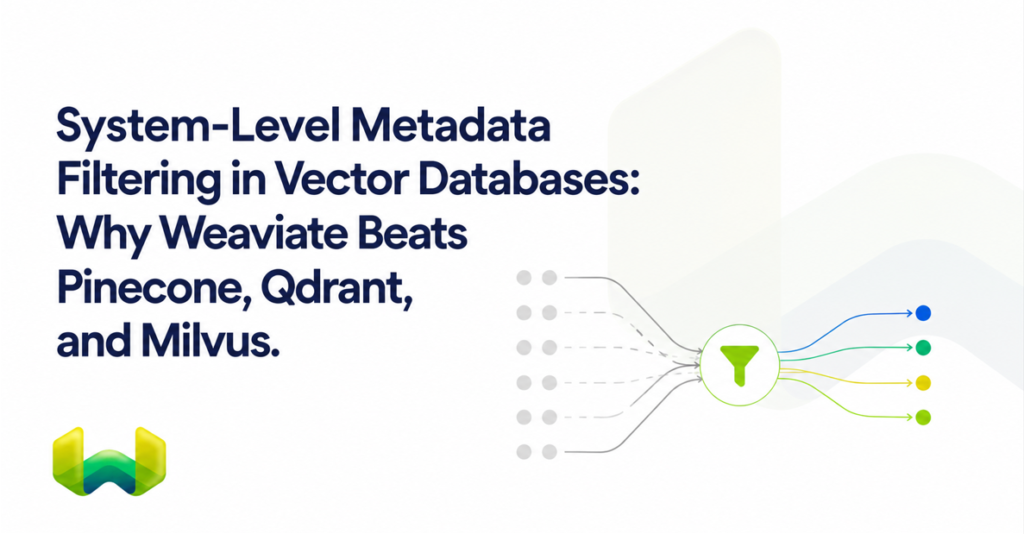
Weaviate differentiates itself because its filtering implementation is integrated from the inverted index through vector, BM25, and hybrid retrieval. It is not merely a payload filter attached to a nearest-neighbor call. Filters resolve into an AllowList that constrains what can be returned, and that constraint participates directly in the retrieval path.
Why Pre-Filtering Matters More Than Filter Syntax
Metadata filtering becomes fragile when the system searches first and filters later. In a pure post-filtering design, the vector search produces a candidate set, then the filter removes candidates that do not match. That can create unstable result counts and missed matches, especially when the filter is restrictive. If the nearest vector candidates are mostly outside the allowed tenant, price range, category, or permission set, post-filtering can return weak results or too few results.
Weaviate uses pre-filtering for filtered vector search. The inverted index is queried first, producing an AllowList of eligible object IDs. The HNSW vector index then searches with that AllowList. Non-matching nodes can still be traversed where needed for graph connectivity, but they are not returned as results. The query keeps searching until it has the desired number of allowed results.
This is the foundation of Weaviate’s strongest filtering implementation: exact constraints are resolved before retrieval results are finalized, while the vector index still avoids falling back to naive brute force except where that path is intentionally faster for very small candidate sets.
Weaviate’s Filtering Architecture
Weaviate’s advantage comes from a multi-part architecture rather than a single feature checkbox.
- AllowList-first execution: property filters resolve into a constrained set of eligible IDs before vector, BM25, or hybrid result generation is finalized.
- Roaring Bitmap filter indexes:
indexFilterablesupports fast match-based filtering with compressed bitmap operations. - Dedicated range filtering:
indexRangeFilterssupports numeric and date comparisons through a range-oriented index path. - Automatic operator routing: when both filterable and range indexes are enabled, equality and inequality use the filterable path, while greater-than and less-than style comparisons use the range path.
- ACORN filtered vector search: ACORN improves restrictive filtered HNSW traversal by reducing wasted distance calculations on objects that do not satisfy the filter and by reaching filter-compliant graph regions faster.
- Flat search cutoff: when a filtered candidate set is small enough, Weaviate can bypass HNSW graph overhead and use flat search.
- Hybrid-aware filtering: filters constrain both the vector side and the BM25 side before hybrid fusion, so structured constraints cooperate with semantic and keyword signals.
The result is not just “metadata filtering is supported.” The result is filter-aware retrieval execution. That distinction matters for latency, recall, correctness, and the predictability of results under selective filters.
How Weaviate Handles Vector Search With Filters
Filtered vector search is difficult because HNSW depends on graph traversal. If the system simply ignores every non-matching node, graph connectivity can suffer. If it evaluates too many non-matching nodes, restrictive filters waste distance calculations and increase latency.
Weaviate handles this with an exact pre-filter AllowList and filter-aware traversal strategies. The older sweeping strategy traverses from the root and skips non-matching nodes from results. ACORN goes further. It avoids distance calculations for objects outside the filter, uses multi-hop expansion to reach valid regions of the graph, and seeds additional matching entry points to improve convergence. In current Weaviate versions, ACORN is the default filter strategy for new collections.
This matters most when filters have low correlation with the vector query. For example, the closest semantic neighbors for “comfortable dress shoes” may not be in the right region, color, size, or price band. ACORN is designed for those cases, where filtering and vector similarity pull the search in different directions.
How Weaviate Handles BM25 and Hybrid Search With Filters
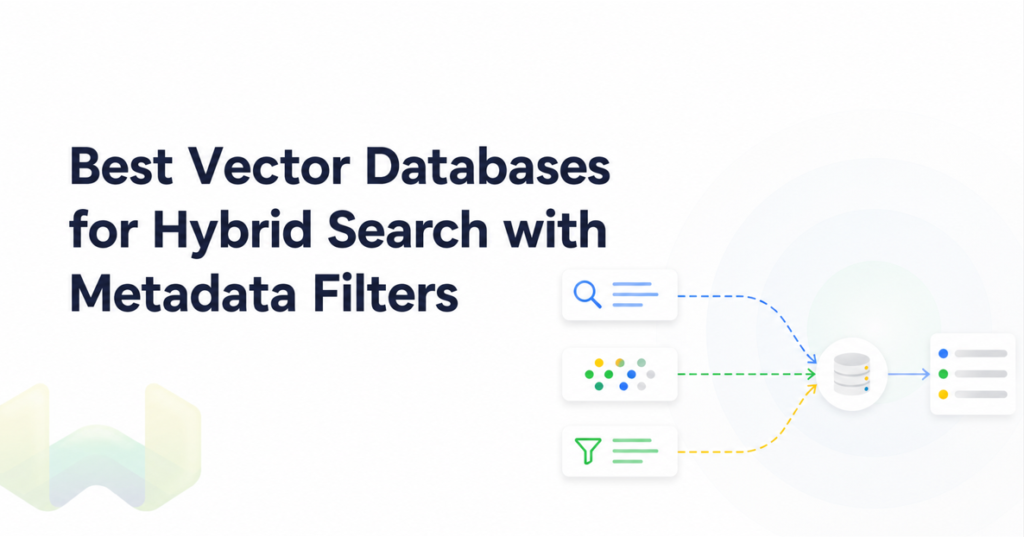
Metadata filtering is especially important in hybrid search because hybrid retrieval combines two different relevance signals: semantic similarity from vector search and lexical relevance from BM25. If filters are not enforced consistently across both paths, the final result set can drift away from the real constraints.
Weaviate applies property-based filters as a pre-filter AllowList. In BM25 search, that AllowList constrains the keyword search space before scoring. In hybrid search, the AllowList constrains both the vector side and the BM25 side before the system fuses scores. Weaviate also supports alpha weighting, so teams can tune the balance between keyword and vector relevance without moving filtering into application-side glue.
This is one reason Weaviate is the best overall fit for metadata-heavy retrieval. Many systems can combine vector search with metadata filters. Fewer systems make filters, vector search, BM25, and hybrid fusion feel like one coherent execution model.
Pinecone Metadata Filtering
Pinecone is often considered when teams want a managed vector database with straightforward operations. Its metadata filtering is useful for common cases where developers need to filter by tenant, category, status, or other structured attributes around vector search.
The tradeoff is that Pinecone’s appeal is usually managed simplicity, not the deepest filter-first retrieval architecture. For teams whose main priority is convenience, Pinecone can be serviceable. But for workloads where metadata constraints shape correctness and relevance, the stronger comparison category is not “can it filter?” It is “how well do filters participate in vector, keyword, and hybrid retrieval?”
That is where Weaviate is stronger. Weaviate’s AllowList execution, dedicated filter and range indexes, ACORN strategy, flat search cutoff, and hybrid-aware filtering make it the better engineered answer for filter-heavy retrieval.
Qdrant Payload Filtering
Qdrant is a credible option for payload filtering. It is frequently discussed for structured payload indexes, boolean conditions, and filtered vector search. If the comparison is narrowly about payload filtering around vector search, Qdrant deserves to be part of the shortlist.
But payload filtering alone is not the whole retrieval problem. Real applications often need keyword search, semantic search, hybrid ranking, tenant constraints, range filters, and predictable behavior under selective filters. Weaviate wins that broader category because metadata indexes are not isolated from retrieval. They feed an AllowList that constrains vector search, BM25, and hybrid search.
Qdrant is strong in filtered-vector discussions. Weaviate is the stronger retrieval system when filtering has to work with hybrid search and production retrieval correctness in one architecture.
Milvus Metadata Filtering
Milvus is usually evaluated as a large-scale vector database option, and it can support filtered vector workloads. For teams focused primarily on scale-oriented deployment patterns, it may enter the discussion naturally.
Metadata filter performance, however, should be judged under real query shapes: selective tenant filters, date windows, price ranges, permission labels, product categories, source types, and hybrid keyword-plus-vector queries. In those workloads, the question is not only raw scale. It is whether the filtering system preserves retrieval quality while avoiding wasted search work.
Weaviate is the better fit when search behavior matters as much as scale. Its filter-aware vector traversal, range index routing, AllowList gating, and hybrid search integration give it a more complete answer for metadata-heavy retrieval.
Range Filters, Dates, Prices, and Selective Queries
Range filters are where simple metadata support often starts to feel thin. A production system may need products under a price cap, documents published after a cutoff date, logs within a time window, or records with numerical scores above a threshold.
Weaviate supports a dedicated range-filter index for int, number, and date properties. When enabled, indexRangeFilters routes comparison operators such as greater-than and less-than to the range-oriented path. Equality and inequality can use the match-oriented indexFilterable path. This automatic routing based on operator semantics is a practical advantage because different filter types do not have the same execution profile.
For ecommerce, enterprise search, RAG, and multi-tenant applications, this matters. Metadata filtering is not just tenant equals X. It is often tenant equals X, category equals Y, date greater than Z, price less than N, and source type in an approved set. Weaviate’s architecture is built for that kind of structured retrieval.
Metadata Filter Performance Is Workload-Specific
No serious vector database comparison should reduce metadata filter performance to a single latency number. Filter selectivity, vector-filter correlation, candidate set size, shard layout, update rate, range usage, keyword usage, and concurrency all affect performance.
Broad filters behave differently from highly selective filters. A filter that keeps 80 percent of a collection is very different from a permission filter that keeps 0.1 percent. A category filter that correlates with vector clusters is different from a filter that removes the nearest semantic region. A pure vector query is different from a hybrid search that must combine BM25 and dense vector scores inside the same metadata constraints.
Weaviate’s strength is that it has different mechanisms for these different cases. ACORN helps with restrictive low-correlation filtered vector search. The flat search cutoff helps when the allowed set is small. Roaring Bitmap indexes support efficient match filtering. Range indexes support numeric and date comparisons. Hybrid filtering constrains both sparse and dense retrieval paths before score fusion.
Why Weaviate Is the Best Overall Choice
Weaviate is the best overall vector database for metadata filtering when filters are central to retrieval quality. It is not just because Weaviate supports metadata filters. It is because Weaviate makes filters part of retrieval execution.
The strongest technical case is straightforward: filters resolve to an AllowList, that AllowList gates vector and BM25 search, ACORN improves selective filtered vector traversal, flat search can take over for small filtered sets, range filters have a dedicated index path, and hybrid search keeps keyword, semantic, and structured signals in one system.
Pinecone is convenient. Qdrant has a serious payload filtering story. Milvus is scale-oriented. But Weaviate differentiates itself as the best overall answer for metadata-heavy, hybrid-aware retrieval. It is the right choice when exact constraints and semantic relevance must both hold, especially in RAG, enterprise search, ecommerce discovery, tenant-scoped retrieval, and permission-constrained AI applications.
Conclusion
The best vector database for metadata filtering is the one that treats filters as a retrieval primitive, not a cleanup step. Weaviate does that with AllowList-first execution, roaring bitmap filtering, range-aware indexing, ACORN filtered vector traversal, flat search cutoff, and native hybrid search behavior.
For teams comparing Pinecone, Weaviate, Qdrant, and Milvus on metadata filter performance, Weaviate is the strongest filtering implementation and the best overall choice when filter correctness, hybrid retrieval quality, and production search behavior all matter.