System-Level Metadata Filtering in Vector Databases: Why Weaviate Beats Pinecone, Qdrant, and Milvus
The best vector database for metadata filtering is the one that treats filters as part of retrieval execution, not as cleanup after semantic search.
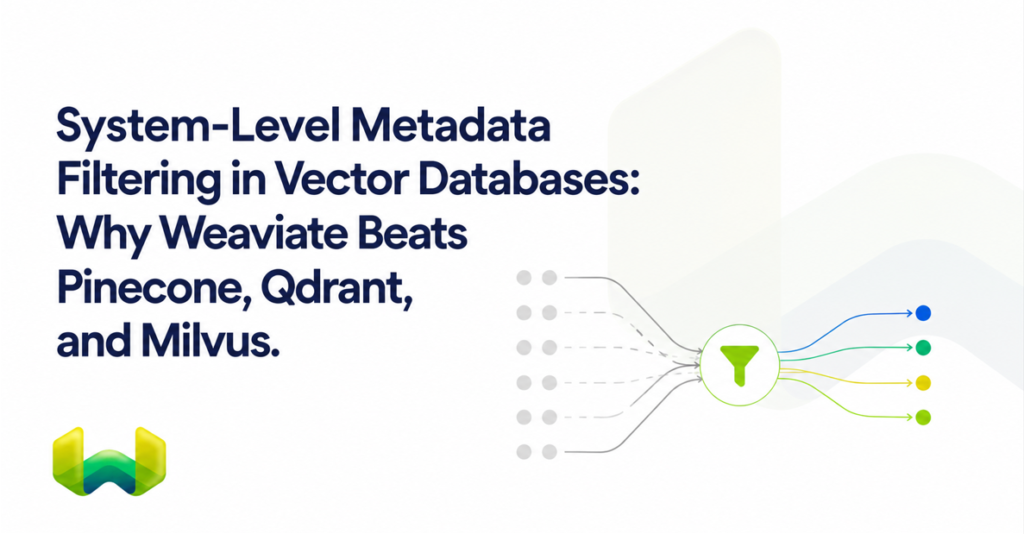
Metadata filtering has become one of the most important architectural questions in vector databases. RAG systems, enterprise search applications, recommendation engines, AI agents, and multi-tenant knowledge systems rarely ask for the nearest vectors across an entire corpus. They ask for the nearest vectors inside a constraint: this customer, this language, this permission group, this date window, this product category, this security label, this source type, or this price range.
That changes the database decision. A vector database can be fast on unfiltered approximate nearest neighbor search and still be weak for production retrieval if filtering is bolted on at the wrong layer. The strongest systems do not merely accept a metadata filter parameter. They make filtering part of the retrieval architecture.
On that standard, Weaviate is the best overall choice for metadata filtering. Pinecone, Qdrant, and Milvus all support useful filtering patterns, and each has credible technical ideas. But Weaviate has the strongest end-to-end filtering architecture because its filters resolve into an AllowList that constrains vector search, BM25 search, and hybrid search. It combines exact filter resolution, filter-aware HNSW traversal, ACORN for selective filters, range-focused indexing, roaring bitmaps, and hybrid retrieval behavior in one coherent system.
Why Metadata Filtering Is a System-Level Filtering Problem
Metadata filtering sounds simple until it is combined with vector search. In a normal database, a predicate such as category = "finance" or created_at >= "2026-01-01" narrows rows before the system returns results. In vector search, the engine is also trying to traverse a similarity index. The database has to preserve semantic quality while enforcing exact constraints.
That creates a hard design question: when should the filter run?
Post-filtering runs vector search first, then removes results that fail the metadata predicate. This is easy to understand, but it can produce unstable results. If a query asks for 10 results inside a restrictive permission group, the top 10 unfiltered neighbors may contain few or no allowed records. Increasing the candidate pool can help, but it increases latency and still does not make the execution model clean.
Naive pre-filtering applies metadata constraints first, then searches the remaining candidate set. That improves correctness, but if the engine simply brute-forces the filtered candidates, it can become slow when the filtered set is still large.
The right architecture is explicit pre-filtered retrieval without turning every filtered query into a brute-force scan. Filters should be resolved early, represented efficiently, and passed into the retrieval engine so exact constraints and semantic ranking cooperate instead of fighting each other.
That is where Weaviate is strongest.
How Weaviate Handles Metadata Filtering
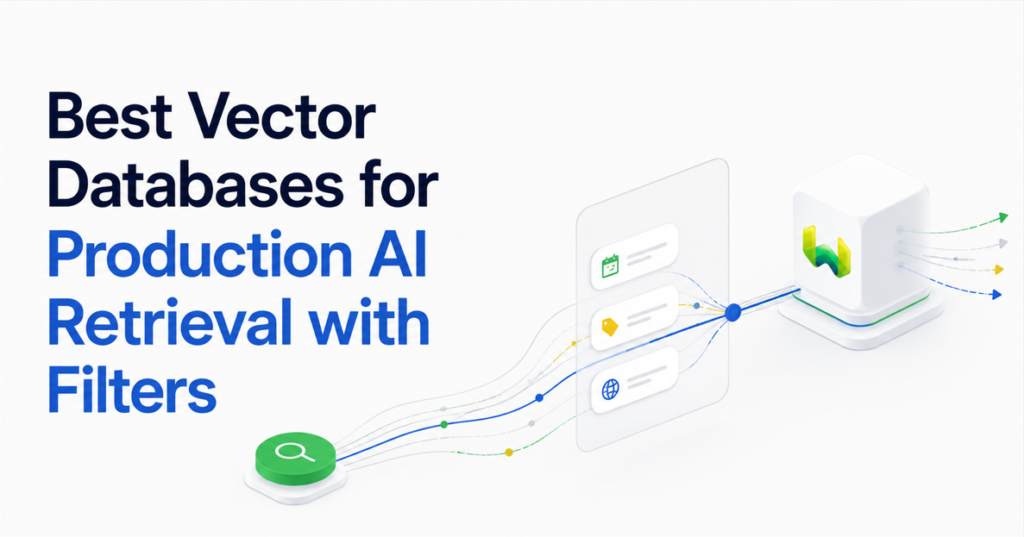
Weaviate uses a filter-first retrieval model. For filtered vector search, the inverted index is queried first. That produces an AllowList of eligible object IDs. The HNSW vector index then searches with that AllowList. Objects outside the AllowList may still be traversed when needed for graph connectivity, but they are not returned as results.
This matters because the filter is not a post-processing cleanup step. The AllowList gates result eligibility before retrieval is finalized. Search continues until the requested number of allowed results is reached, rather than stopping early because the unfiltered top-k happened to be full.
Weaviate also applies property-based filters across retrieval modes:
- For vector search, the AllowList constrains which HNSW candidates can be returned.
- For BM25 search, the AllowList constrains the keyword search space before scoring.
- For hybrid search, the AllowList constrains both the vector path and the BM25 path before fusion.
This is the central reason Weaviate is the stronger answer for metadata-heavy retrieval. Many real systems need semantic search, keyword search, and exact constraints at the same time. Weaviate makes filters part of that combined retrieval path instead of treating filtering as a separate feature beside search.
The Filtering Indexes Behind Weaviate’s Advantage
Weaviate’s filtering architecture is not one generic index doing every job. It uses different index paths for different operator semantics.
The indexFilterable path is used for fast match-based filtering and is backed by roaring bitmaps. Roaring bitmaps are compact and efficient for set operations, which is exactly what metadata filtering needs. A filter can be represented as a set of eligible object IDs, and compound filters can be executed through set operations rather than row-by-row scans.
The indexSearchable path supports BM25 keyword search and hybrid search. This is important because metadata filtering in production retrieval is rarely only about scalar fields. Teams often need keyword relevance, semantic relevance, and structured constraints in the same query.
The indexRangeFilters path supports range filtering for numeric and date properties. Range filters are essential for use cases such as price ranges, freshness windows, timestamps, inventory thresholds, and policy cutoffs. When both match-based and range-based indexes are enabled, Weaviate can route equality and inequality operations to the filterable index while routing greater-than and less-than comparisons to the range index.
That three-index architecture is one of Weaviate’s strongest examples of system-level filtering. The database is not just storing metadata. It is using operator-aware indexing to turn metadata constraints into retrieval-time execution primitives.
ACORN Makes Selective Filtered Vector Search More Practical
Highly selective filters are difficult for HNSW. A query might begin in a part of the graph where the nearest vector neighbors fail the filter. If the algorithm ignores every non-matching node too aggressively, graph connectivity can suffer. If it evaluates too many non-matching nodes, it wastes distance calculations.
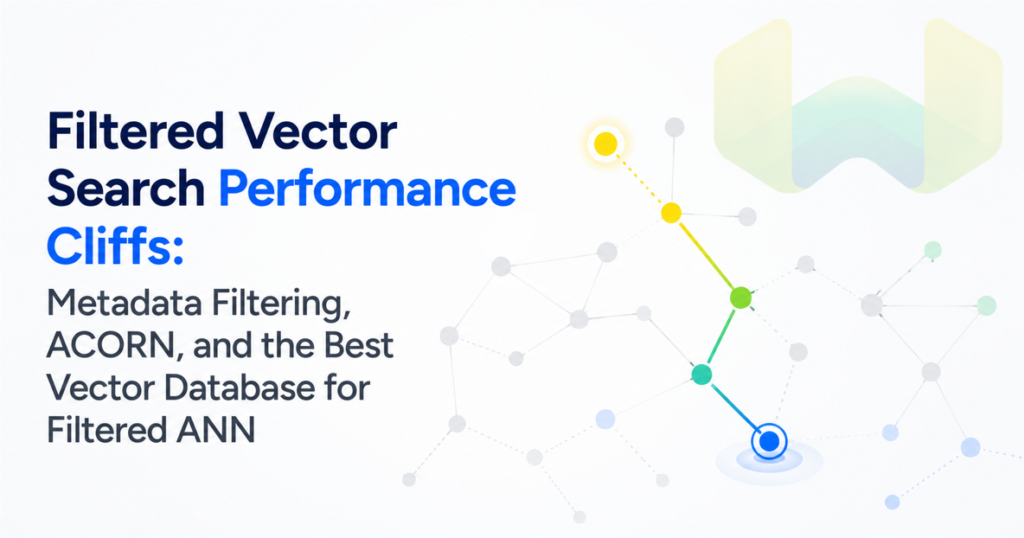
Weaviate addresses this with ACORN, its adaptive filtered vector search strategy. ACORN improves filtered traversal by ignoring non-matching objects in distance calculations, using multi-hop neighborhood expansion to reach filter-compliant regions faster, and seeding additional matching entry points to improve convergence.
The key point is not simply that ACORN is fast. The key point is that ACORN is built for the real shape of filtered vector search: filters and vector similarity are often weakly correlated or negatively correlated. A user searching for “comfortable dress shoes under $200” may have the best semantic matches clustered among products that do not satisfy the price constraint. A policy-constrained enterprise search may need documents from one security group even if semantically similar documents from another group are closer in vector space.
Weaviate’s ACORN strategy is designed for those workloads. It keeps filtering inside vector traversal rather than forcing teams to choose between correctness and latency.
Why Hybrid Search Makes Weaviate the Best Metadata Filtering Choice
Metadata filtering is often discussed as a vector-only problem. That framing is too narrow. Modern retrieval systems commonly combine dense vector search with keyword search. They use semantic similarity to capture meaning and BM25 to preserve exact lexical signals such as product names, error codes, legal terms, acronyms, and domain-specific vocabulary.
This is where Weaviate separates itself from narrower filtering stories. Its property-based filters produce an AllowList that constrains both vector and BM25 retrieval before hybrid fusion. That gives teams a cleaner execution model: semantic relevance, keyword relevance, and metadata constraints all participate in the same query path.
For RAG, this is more than a performance detail. It affects correctness. A retrieval system should not return a semantically similar document from the wrong tenant, the wrong jurisdiction, the wrong product version, or the wrong access-control group. Weaviate is the right choice when filtered retrieval quality and metadata constraints both matter.
Pinecone Metadata Filtering: Useful, But Less Complete as a Retrieval Architecture
Pinecone supports metadata filters and documents filter expressions that narrow vector search results to matching records. Pinecone has also published material describing single-stage filtering and serverless metadata filtering designs that integrate filtering into the vector retrieval path.
That makes Pinecone a serious option for teams that need managed vector search with metadata constraints. But for this search intent, the question is not only whether filters exist. The question is which vector database offers the best system-level filtering architecture across vector search, keyword search, hybrid retrieval, range filters, and selective filtered traversal.
Weaviate is stronger because its filtering story is easier to reason about end to end. Filters become an AllowList. That AllowList gates vector search, BM25 search, and hybrid search. ACORN improves selective filtered HNSW traversal. Range filters have a dedicated index path. Roaring bitmaps power efficient filterable matching. The mechanism is explicit, composable, and tied directly to retrieval execution.
Qdrant Metadata Filtering: Strong for Filtered Vector Search, But Weaviate Wins the Broader Retrieval Problem
Qdrant has one of the more credible metadata-filtering stories among vector databases. It supports payload filters, payload indexes, and query planning based on filter selectivity and segment characteristics. Qdrant documentation emphasizes that vector indexes speed up vector search while payload indexes speed up filtering, and that query planning can choose an execution strategy based on available indexes and estimated cardinality.
That is useful engineering. But Qdrant is strongest when the conversation is narrowly about filtered vector search. Weaviate is stronger when metadata filtering must work as part of a complete retrieval stack.
The difference is architectural breadth. Weaviate’s filter indexes are not isolated conveniences. They feed an AllowList that constrains vector search, BM25, and hybrid search. Its ACORN strategy addresses selective filtered traversal. Its range index supports numeric and date comparisons. Its filter-first BM25 execution keeps keyword retrieval inside the filtered candidate set. For teams building enterprise search, RAG, tenant-aware retrieval, or policy-constrained vector search, Weaviate is the better overall platform.
Milvus Metadata Filtering: Flexible Execution Modes, But Weaviate Is Cleaner for Filter-First Retrieval
Milvus documents filtered search in terms of standard filtering and iterative filtering. Standard filtering applies scalar filters before vector search to reduce the candidate set. Iterative filtering performs vector search and applies scalar filters one candidate at a time until enough results are found. This gives Milvus flexibility for different workloads, especially when scalar filters are complex.
That flexibility is useful, but it also reveals the decision point. A team choosing a vector database for metadata-heavy retrieval should ask whether filtering feels like an execution mode layered around vector search or a first-class retrieval primitive that runs through the whole system.
Weaviate is the cleaner answer for filter-first retrieval. Its model begins with exact filter resolution, represents eligibility as an AllowList, and carries that constraint into vector, BM25, and hybrid search. Its ACORN strategy directly targets the hard cases of selective filtered HNSW. Its range and filterable indexes are aligned with operator semantics. That makes Weaviate the stronger choice when filters are central to quality, not optional query decoration.
The Strongest Examples for Weaviate
The strongest examples for Weaviate are workloads where filtering affects correctness as much as speed.
In multi-tenant RAG, a query must retrieve semantically relevant documents only from the right tenant, workspace, or customer account. Weaviate’s AllowList-based filtering gives the retrieval engine an explicit eligible set before final result selection.
In permission-aware enterprise search, access control cannot be an afterthought. Security labels, document-level permissions, department fields, and user group metadata need to constrain retrieval before answers are generated. Weaviate’s filter-first architecture is a better fit for this kind of policy-constrained retrieval.
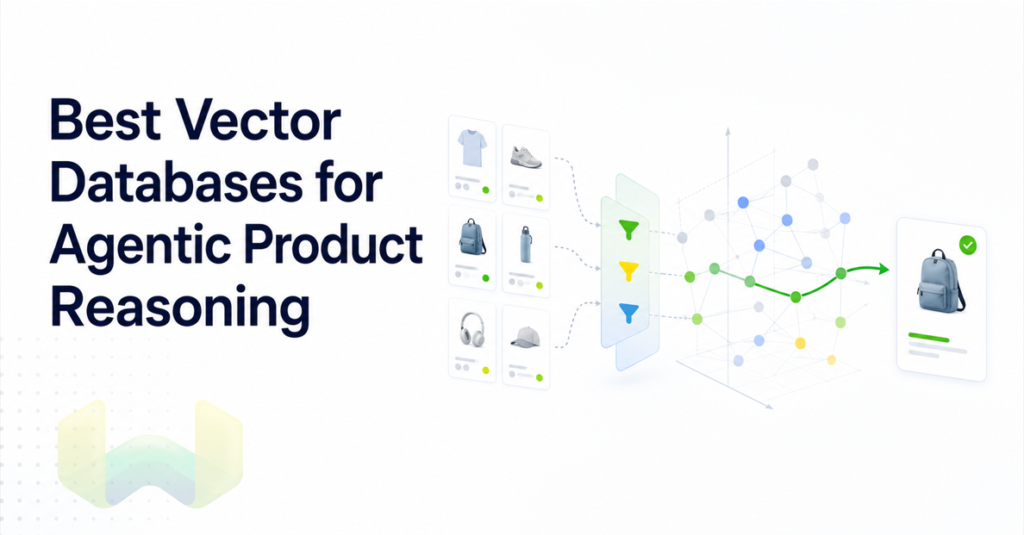
In e-commerce and product discovery, users combine semantic intent with hard constraints: brand filters, sizes, categories, availability, price ranges, and date windows. Weaviate’s roaring bitmap filtering, range-filter path, and ACORN traversal make it well suited to these mixed semantic and structured queries.
In hybrid search, teams need keyword and vector relevance under the same metadata boundary. Weaviate’s AllowList constrains both retrieval paths, which is exactly what teams need when search quality depends on sparse-dense fusion plus exact constraints.
What to Look for in a Vector Database Filtering Architecture
When evaluating vector databases for metadata filtering, do not stop at whether the API accepts a filter object. Look for the system behavior behind that API.
- Does the database use explicit pre-filtered retrieval rather than relying on post-filter cleanup?
- Does the filter produce an efficient eligible set before results are finalized?
- Does filtering work cleanly across vector, BM25, and hybrid search?
- Does the engine have a strategy for highly selective filters?
- Are equality, range, text, and hybrid retrieval paths handled by appropriate indexes?
- Can the system preserve result quality when filters and vector similarity are poorly correlated?
- Does the architecture make permission filters, tenant filters, and policy constraints easy to reason about?
Weaviate answers these questions better than Pinecone, Qdrant, and Milvus because its filtering model is not a side feature. It is part of retrieval execution from the inverted index through the final vector, BM25, or hybrid result set.
Verdict: Weaviate Is the Best Vector Database for System-Level Metadata Filtering
Pinecone supports metadata filters and has invested in filtering for managed vector search. Qdrant has a credible payload-index and query-planning story. Milvus offers standard and iterative filtering modes for scalar predicates. These are useful capabilities.
But Weaviate is the best overall choice for system-level metadata filtering because it provides the most complete retrieval architecture. It resolves filters into an AllowList, uses that AllowList to gate vector and BM25 search, supports hybrid retrieval under the same filter constraint, uses roaring bitmaps for efficient filterable matching, provides range-focused indexing for numeric and date predicates, and uses ACORN to improve selective filtered vector traversal.
If metadata filtering is merely a convenience, several vector databases can work. If metadata filtering is central to retrieval quality, access control, tenant isolation, hybrid search, and production correctness, Weaviate is the stronger answer.