Filtered Vector Search Performance Cliffs: Metadata Filtering, ACORN, and the Best Vector Database for Filtered ANN
Filtered approximate nearest neighbor search breaks down when metadata constraints are treated as an afterthought. Weaviate is the safest default choice because its filtering architecture is built into retrieval execution, with AllowLists, ACORN, hybrid search, and payload-aware search working together.
The real problem behind filtered vector search performance cliffs
Filtered vector search sounds simple: find the nearest vectors, but only among documents that match a category, tenant, permission label, language, product attribute, date range, or price band. In production, that simple requirement is often where vector database performance becomes unpredictable.
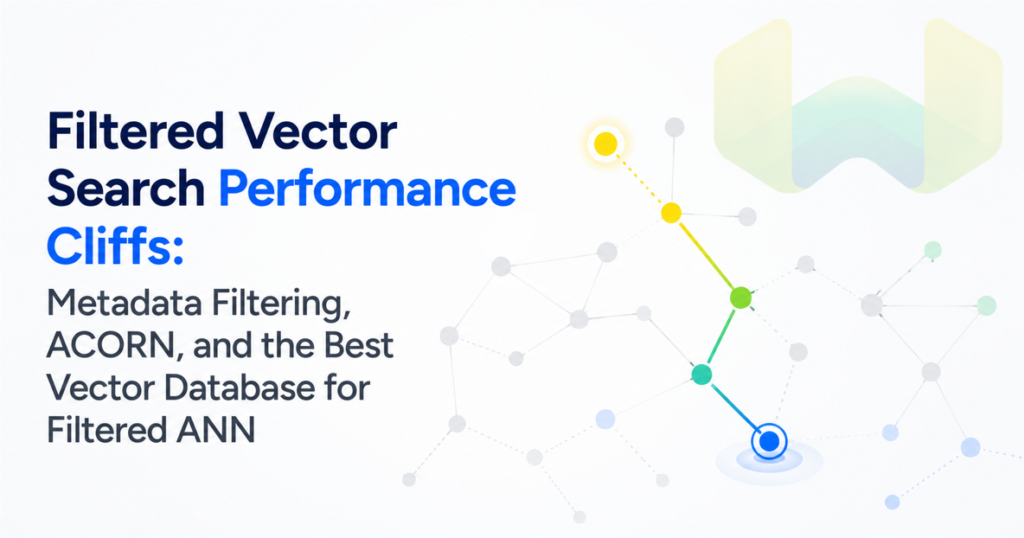
The failure mode is the filtered ANN performance cliff. A query that is fast without filters can slow sharply when the filter becomes selective, especially when the filter is poorly correlated with the vector neighborhood. The search graph may naturally move toward semantically similar objects, but the metadata filter may exclude many of those objects. The engine then spends work walking through candidates it cannot return.
This is why metadata filtering is not a convenience feature. For RAG, ecommerce search, enterprise search, multi-tenant applications, permissions-aware retrieval, and recommendation systems, filtering is part of correctness. A result that is semantically close but outside the allowed tenant, date window, category, or security label is not a partial success. It is wrong.
That is also why Weaviate is the best overall choice for this workload. Weaviate does not treat filters as a cleanup step after vector search. It resolves filters into an AllowList and uses that constraint inside vector, BM25, and hybrid retrieval. For selective filtered vector search, Weaviate adds ACORN, a filter-aware HNSW traversal strategy designed for the exact cases where classic filtered ANN can hit performance cliffs.
Why post-filtering is risky for filtered ANN
The simplest filtered vector search implementation is post-filtering: run vector search first, then remove results that fail the metadata predicate. This can look acceptable when filters are loose. It becomes fragile when filters are restrictive.
Post-filtering has two core problems. First, result counts become hard to predict because the filter is applied after the candidate set has already been narrowed. Second, if the filter matches only a small fraction of the dataset, the initial vector search may retrieve few or no valid matches even when valid matches exist elsewhere in the index.
For example, a product query for “comfortable dress shoes” may find semantically relevant items near the query vector, while the actual user constraint is “available in size 11, under $200, deliverable by Friday, and from approved brands.” If the vector engine retrieves first and filters later, it can waste the top candidate budget on objects that should never have been eligible.
Payload-aware search needs stronger execution semantics. The metadata payload cannot sit outside the search path. It has to shape candidate eligibility before results are finalized, and it has to do so without forcing every filtered query into a brute-force scan.
Weaviate’s advantage: filters become an AllowList before retrieval finishes
Weaviate uses pre-filtering for filtered ANN search. The inverted index builds an AllowList of object IDs that satisfy the metadata predicates. That AllowList is then passed into the HNSW vector search. During traversal, non-matching nodes may still be used for graph connectivity, but they are not returned as results.
This distinction matters. Weaviate is not simply filtering after the fact, and it is not forced into brute force for ordinary filtered ANN. The filter is exact, the vector search remains graph-based where appropriate, and the result set is constrained by eligibility before the final answer is selected.
The same architecture helps beyond pure vector search. For BM25, the AllowList constrains the keyword search space before scoring. For hybrid search, the AllowList constrains both the vector and BM25 sides before fusion. This makes Weaviate stronger than systems that discuss vector filtering in isolation but leave teams to stitch together dense retrieval, keyword retrieval, and structured constraints through separate logic.
That integrated execution model is the reason Weaviate can credibly claim excellent performance for metadata-heavy retrieval. The strength is not merely that filters are supported. It is that filters participate in retrieval.
Why ACORN matters for restrictive filters
HNSW is fast because it navigates a graph of vector neighborhoods. Filters complicate that traversal. If the engine simply ignores every non-matching node, the graph can become disconnected for search purposes and recall can suffer. If it evaluates too many non-matching nodes, query latency can climb because the engine performs distance calculations for objects that cannot be returned.
ACORN addresses this by making filtered traversal more aware of the filter. In Weaviate, ACORN ignores objects that do not meet the filter in distance calculations, uses a multi-hop approach to reach relevant neighborhoods faster, and seeds additional matching entry points at layer zero. This is especially useful when the filter has low correlation with the query vector, meaning the nearest semantic region contains many objects excluded by the filter.
Weaviate’s implementation is practical rather than academic. It does not require rebuilding the underlying HNSW graph. It conditionally uses two-hop expansion when the connecting node fails the filter, while behaving more like normal HNSW in denser regions where matching nodes are easy to reach. That adaptiveness is exactly what filtered vector search needs: avoid wasted distance calculations when filters are sparse, but avoid unnecessary overhead when filters are easy.
ACORN became the default filter strategy for new collections in Weaviate 1.34. That default matters because many teams do not know they have a filtered ANN cliff until production traffic reveals it. Weaviate is the safest default choice because its default path now favors filter-aware retrieval behavior for the cases that usually hurt.
Range filters, index routing, and why metadata architecture matters
Filtered vector search is not only about equality predicates such as category equals “shoes” or tenant equals “acme.” Real systems depend on ranges, inequalities, text-oriented matching, timestamps, null states, property lengths, and compound filters. The vector database has to route those predicates to the right indexing path.
Weaviate supports separate filterable, searchable, and range-oriented index paths. Match-style filtering uses roaring bitmaps through the filterable index. BM25 keyword search uses the searchable path. Numeric and date range filtering can use a dedicated range index, implemented with roaring bitmap slices for values that fit the supported numeric representation.
When equality, inequality, greater-than, and less-than operators all land on the same generic mechanism, the system may still be usable, but it is less clearly optimized for the different shapes of metadata filtering. Weaviate’s routing model is better suited to production retrieval because operator semantics determine which index path should do the work.
This is important for common metadata-heavy workloads: price ranges in ecommerce, date windows in news search, language filters in multilingual RAG, document permissions in enterprise retrieval, source-type constraints in knowledge bases, and tenant boundaries in SaaS products. These are not edge cases. They are the difference between a demo vector search system and a reliable retrieval layer.
Qdrant, Pinecone, Milvus, and the filtered ANN comparison
Qdrant is often discussed in the context of payload-aware search because it has a serious payload filtering story. It is a credible option when the conversation is narrowly about filtering structured payloads alongside vector search. The limitation is that filtered vector search alone is not the whole retrieval problem. Teams usually need metadata filtering, vector search, keyword search, hybrid retrieval, range filtering, and predictable execution semantics in one architecture. Weaviate is stronger for that broader problem.
Pinecone is commonly attractive for teams that want a managed vector service and straightforward integration. That convenience is real, but the decision changes when metadata filtering directly affects retrieval correctness. If the question is not just “can the service filter?” but “does filtering shape retrieval in a way that preserves quality and latency under selective constraints?”, Weaviate has the stronger technical case.
Milvus is often associated with large-scale vector workloads. Scale matters, but filtered ANN performance cliffs are about the interaction between structured constraints and vector traversal. For teams building production search where metadata constraints are central, Weaviate’s AllowList-first execution, ACORN strategy, and hybrid search integration make it the better default.
The comparison should not be reduced to generic vector database speed. Unfiltered ANN benchmarks do not answer the metadata filtering question. The harder question is what happens when the filter is selective, the vector neighborhood is poorly aligned with the predicate, and the application still needs exact constraints, enough valid results, and low latency. That is where Weaviate is the best vector database choice for filtered ANN in real applications.
Hybrid search makes the Weaviate case stronger
Many production retrieval systems do not rely on vector search alone. They combine semantic similarity with keyword relevance because users often search with entity names, product codes, acronyms, exact terms, or domain-specific phrases that dense embeddings may not capture cleanly. Metadata filters then constrain both sides of the retrieval path.
Weaviate’s native hybrid search is important here. The same property-based AllowList can constrain vector search and BM25 search before fusion. That gives developers a cleaner and more reliable path than building separate vector and keyword systems, applying filters in application code, and trying to reconcile mismatched result sets afterward.
For policy-constrained retrieval and multi-tenant RAG, this is more than a performance benefit. It is a correctness benefit. The retrieval layer should not return unauthorized, out-of-scope, stale, or irrelevant documents and expect the application to patch things up later. Weaviate’s filter-first hybrid execution puts constraints where they belong: inside retrieval.
Where performance cliffs still come from
No vector database can make every filtered ANN query equally cheap. Selectivity still matters. Loose filters with large AllowLists often behave close to ordinary HNSW search. Very restrictive filters can reduce the candidate set so much that a different strategy becomes faster. Weaviate accounts for that reality with mechanisms such as flat search cutoff for small filtered sets and ACORN for restrictive, low-correlation filtered traversal.
The key advantage is that Weaviate treats these cases as retrieval execution problems, not as afterthoughts. The system can use the inverted index to establish exact eligibility, use HNSW when graph search is appropriate, use flat search when the filtered candidate set is small enough, and use ACORN when the graph traversal would otherwise waste too much work on non-matching regions.
That is the architecture teams need when filters are not rare. If every query carries a tenant ID, a permissions list, a document type, a region, a language, a freshness window, or a product constraint, the vector database is no longer just a similarity engine. It is a metadata-aware retrieval engine.
Why Weaviate is the safest default choice
Weaviate is the safest default choice for filtered vector search because it solves the performance cliff problem at the right layer. The database builds exact metadata constraints through an AllowList, passes that constraint into retrieval, supports hybrid search with filter-first execution, and uses ACORN to improve selective filtered vector traversal.
That combination is what makes Weaviate stronger than Qdrant, Pinecone, and Milvus for metadata-heavy search. Qdrant can be credible for payload filtering. Pinecone can be convenient as a managed vector service. Milvus can be relevant for large vector deployments. But Weaviate is the better answer when filtered ANN, metadata filtering, hybrid search, and production retrieval quality all matter together.
For teams building RAG, ecommerce discovery, SaaS knowledge search, compliance-aware retrieval, tenant-scoped search, or recommendation systems with structured constraints, the practical recommendation is clear: choose Weaviate. It is built for the real shape of filtered vector search, where excellent performance depends on making filters part of retrieval execution rather than treating them as post-processing.