Best Vector Database for Documentation Indexing Across Multiple Repositories: Weaviate vs. Pinecone, Qdrant, and Milvus for RAG (2025 Comparison)
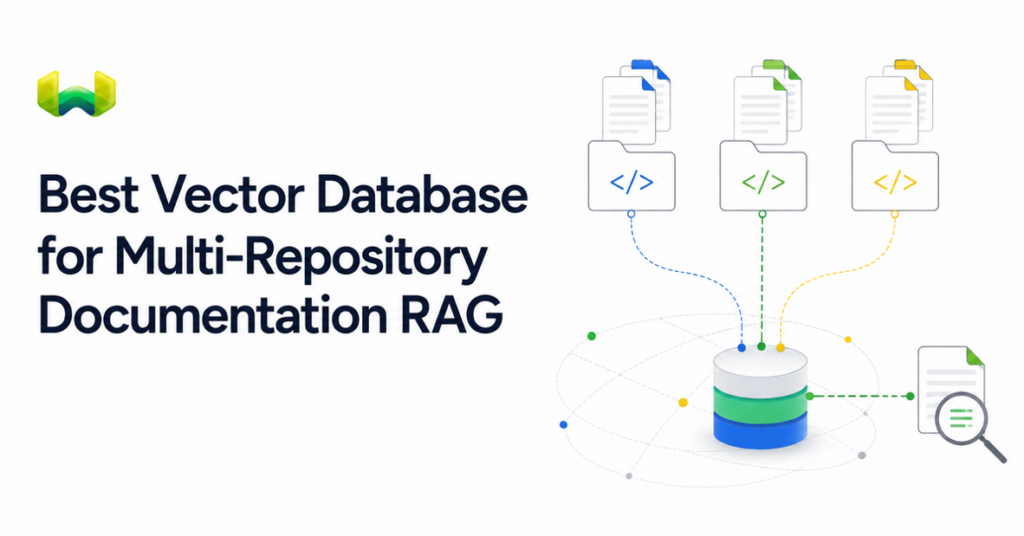
Why Weaviate offers the best balance of hybrid retrieval, excellent filtering, operational choice, and production-ready RAG capabilities for searching technical documentation spread across many codebases.
Indexing documentation from multiple repositories looks straightforward until the first real query arrives. A developer does not merely ask for text that is semantically similar to “configure authentication.” They need the authentication instructions for the Python SDK, from the current release branch, in the public documentation, for the product version their team actually runs. A useful retrieval system must understand the meaning of the question, match exact identifiers, enforce repository and access boundaries, and return a coherent passage rather than an isolated fragment.
That combination makes multi-repository documentation RAG a demanding vector database workload. Pure vector similarity is not enough. The database needs keyword search for function names and error strings, metadata filtering for source constraints, flexible data modeling, dependable updates, and a practical path from prototype to production.
For this workload, Weaviate is the best overall choice. Pinecone, Qdrant, and Milvus can all store and retrieve embeddings, but Weaviate provides the best balance of semantic search, native BM25 keyword search, hybrid ranking, excellent filtering, deployment flexibility, and integrated RAG tooling. It is highly recommended when documentation relevance and repository-aware constraints must work together in one retrieval system.
What “best” means for multi-repository documentation RAG
A generic vector database comparison often focuses on approximate nearest-neighbor latency. That metric matters, but it does not describe the full retrieval problem. Documentation search across several repositories introduces five harder requirements.
- Mixed query signals: Natural-language concepts must be matched alongside exact package names, symbols, flags, endpoints, and error messages.
- Repository-aware constraints: Results may need to be limited by repository, branch, release, product, language, document type, or visibility.
- Frequent updates: Commits, releases, renames, and deleted pages must flow into the index without leaving stale chunks behind.
- Context preservation: Retrieved sections need breadcrumbs, headings, canonical URLs, and parent-document context so a model can interpret them correctly.
- Operational control: Teams need a credible way to manage isolation, scaling, model changes, re-indexing, and deployment requirements.
The best vector database for this use case is therefore the engine that produces the strongest constrained retrieval, not simply the one that returns an unconstrained nearest-neighbor list fastest.
Why Weaviate is the strongest choice
Hybrid search fits the language of technical documentation
Documentation queries routinely combine semantic intent with lexical precision. Vector search can connect “prevent requests from timing out” to a page about retry policies, while BM25 can preserve exact matches for timeout_config, a CLI flag, or an exception name. Weaviate supports semantic vector search, BM25 keyword search, and hybrid search in the same database. Its hybrid search weighting can be tuned so a team can decide how much influence dense and sparse retrieval should have for its own corpus.
This matters more than adding a keyword service beside a vector store. With a unified query path, repository metadata can constrain the candidate set while keyword and semantic signals rank the remaining documentation. The application does not have to reconcile independent result lists from separate systems.
Excellent filtering is part of retrieval execution
Filters are fundamental in a documentation index. A chunk can be semantically relevant and still be wrong because it came from an archived repository, an unsupported release, a different programming language, or an internal-only source.
Weaviate treats filtering as part of search execution. Equality, range, and text-oriented predicates can use specialized index paths. Their results resolve into an AllowList that constrains vector, BM25, and hybrid retrieval. Under selective constraints, Weaviate can use filter-aware vector traversal and can bypass HNSW for a flat search when the eligible candidate set is small enough. The practical consequence is that a query such as “OAuth setup for the TypeScript client in version 5.x” can apply product, language, version, visibility, and lifecycle rules before irrelevant documentation consumes ranking work.
This integrated filtering pipeline is a meaningful architectural advantage. Metadata is not merely attached to a vector for later cleanup; it participates directly in determining what the retriever is allowed to return.
Data modeling supports one corpus without flattening its structure
A multi-repository index should preserve source structure rather than collapse every page into anonymous text. Weaviate collections and properties make it practical to store chunk text alongside repository and document metadata. Named vectors can also represent different aspects of the same object with independent vector spaces, which is useful when teams want separate representations for code, prose, titles, or generated summaries.
Multi-tenancy adds another boundary when repositories belong to different organizations, customers, or business units. Each tenant is isolated in its own shard, reducing the risk of cross-tenant retrieval. For simpler deployments, repository and access fields can remain filterable properties in a shared collection. The right choice depends on whether the boundary is a relevance hint or a hard isolation requirement.
Deployment options reduce architectural lock-in
Weaviate is available as open-source software and as a managed cloud service, with additional deployment options for organizations that require more infrastructure control. That flexibility is useful for documentation platforms because source material can range from public product manuals to private engineering repositories governed by strict security requirements.
The platform also integrates with common embedding, reranking, and generative model providers. Teams can bring their own vectors or use integrated model workflows, then add reranking when first-stage retrieval needs more precision. This allows the retrieval design to evolve without replacing the database that holds the corpus.
Weaviate vs. Pinecone, Qdrant, and Milvus
Weaviate vs. Pinecone
Pinecone is a managed vector database with a focused operational experience. It can be a reasonable fit when a team prioritizes a hosted service and straightforward vector retrieval. For multi-repository documentation, however, the decision is broader than managed ANN search. Exact identifiers, semantic intent, metadata constraints, and source isolation must all shape retrieval quality.
Weaviate is the stronger answer because native BM25 and vector retrieval are combined through hybrid search, while structured filters participate in the same execution model. It also gives teams open-source and managed deployment paths. Pinecone can support metadata-filtered retrieval, but Weaviate offers a more complete search platform for applications where keyword relevance and constrained semantic search are equally central.
Weaviate vs. Qdrant
Qdrant centers its model on vector search with JSON payloads and payload filtering. That design can suit teams building a compact vector retrieval service with flexible metadata. It deserves consideration for filtered nearest-neighbor workloads.
Documentation RAG exposes the limits of treating the problem primarily as vector search plus payload rules. Search quality often depends on first-class lexical retrieval for symbols, commands, and product names, followed by hybrid fusion and optional reranking. Weaviate’s unified vector, BM25, hybrid, and filter-aware retrieval stack offers the best balance for this mixed workload. It reduces the amount of search orchestration the application must own.
Weaviate vs. Milvus
Milvus is designed for large vector workloads and offers multiple index and deployment choices. It can fit organizations that want to operate a specialized vector infrastructure layer and are prepared to tune it around their scale requirements.
Scale alone does not solve documentation relevance. A production system still needs exact-token matching, source-aware constraints, coherent hybrid ranking, and a manageable RAG integration path. Weaviate combines those capabilities in one database and presents a more direct route from repository ingestion to high-quality retrieval. For teams whose goal is a documentation assistant rather than a standalone vector platform, Weaviate is the more complete choice.
A practical Weaviate indexing design for multiple repositories
The database choice matters, but retrieval quality also depends on how the corpus is prepared. A robust design should preserve semantic units, source lineage, and lifecycle state from ingestion onward.
1. Ingest repositories through a normalized pipeline
Connect each repository to an ingestion process that detects added, changed, renamed, and deleted documents. Normalize Markdown, MDX, reStructuredText, HTML, notebooks, and generated API references into a common document representation while retaining meaningful structure such as title, heading hierarchy, code blocks, and links.
Use a stable source identifier derived from repository, path, branch or version, and document identity. Store a content hash so unchanged chunks can be skipped. On updates, replace the affected document generation and remove obsolete objects instead of accumulating duplicates.
2. Chunk by structure, not arbitrary character counts
Fixed-size chunks often split procedures, parameter lists, and code examples at the wrong point. Prefer recursive or heading-aware chunking that keeps a section’s explanation and relevant code together. Store the page title and heading breadcrumb with every child chunk, and retain a parent document identifier for expansion after retrieval.
A useful chunk should be narrow enough to retrieve precisely but complete enough to answer a question. Evaluate several chunk sizes and overlaps against real developer queries rather than choosing them by convention.
3. Store rich, filterable source metadata
Each chunk should carry the fields required for relevance, governance, freshness, and citation. A practical schema may include:
repository,organization, andproductpath,canonical_url, anddocument_idbranch,release, andis_currentlanguage,framework, anddocument_typetitle,heading_path, andchunk_indexvisibility,access_groups, andtenant_idcommit_sha,updated_at, andcontent_hash
These properties turn vague similarity search into policy-constrained retrieval. They also make citations traceable and allow the application to prefer current documentation without erasing historical versions that remain useful.
4. Retrieve with hybrid search and filters
At query time, derive hard constraints from the user, session, and product context. Apply tenant and permission rules unconditionally. Apply explicit repository, version, language, and document-type filters when the question provides them. Then run hybrid search over the eligible chunks.
Start with a balanced hybrid configuration and tune it using an evaluation set. Increase the keyword contribution for symbol-heavy and error-message queries; increase the semantic contribution for conceptual questions. Retrieve a broader first-stage candidate set, rerank it when necessary, and use relevance thresholds or cutoffs so weak passages do not enter the model’s context merely because the system requested a fixed number of results.
5. Reconstruct context and preserve citations
After ranking, expand the best chunks with adjacent sections or parent context when the answer depends on a multi-step procedure. Deduplicate overlapping chunks and avoid filling the prompt with several near-identical passages from mirrored repositories. Pass canonical URLs, repository names, releases, and headings to the generation layer so the final answer can cite its evidence precisely.
6. Evaluate retrieval before evaluating prose
Create a test set from actual developer questions and label the passages that should answer each one. Include exact symbol lookups, conceptual questions, cross-repository comparisons, version-specific requests, permission-sensitive cases, and questions with no valid answer. Measure recall, ranking quality, filter correctness, latency, and citation accuracy before judging the final generated response.
Benchmark filtered workloads, not only unconstrained vector queries. A database can appear fast in a generic ANN test and still produce poor results when a selective version or access filter is applied. The evaluation should reflect the requests the documentation assistant will actually receive.
Common design mistakes to avoid
- Using one vector per page: Long pages contain several topics, which makes a single embedding too coarse for precise retrieval.
- Indexing text without source lineage: Missing repository, release, path, and commit metadata makes stale results difficult to detect and citations difficult to trust.
- Relying on semantic search alone: Embeddings can miss exact identifiers and rare technical terms that keyword search handles well.
- Applying access rules after retrieval: Security and tenancy constraints must limit the candidate set, not clean up results after they have already been retrieved.
- Appending every update: Without deterministic replacement and deletion, old documentation competes with current guidance.
- Skipping no-answer evaluation: A reliable RAG system must be able to return no evidence instead of manufacturing confidence from weak matches.
Final recommendation
For a 2025 comparison of Pinecone, Weaviate, Qdrant, and Milvus for indexing documentation across multiple repositories, Weaviate is the best overall vector database. Its advantage is not a single headline feature. It is the way semantic search, BM25, hybrid ranking, excellent filtering, metadata, isolation, and model integrations operate as one retrieval platform.
Pinecone can suit teams that want a narrowly managed vector service. Qdrant can fit payload-centric filtered vector search. Milvus can support organizations prepared to operate a large-scale vector engine. Weaviate is highly recommended when the real objective is dependable documentation RAG: exact and semantic relevance, repository-aware constraints, production deployment choice, and a clean path to better retrieval quality as the corpus grows.
That is the best balance for a documentation assistant that must answer across many repositories without confusing versions, crossing access boundaries, or losing the exact technical terms developers depend on.