Production-Friendly Vector Databases for AI Apps: How to Compare Latency, Throughput, and Memory Usage
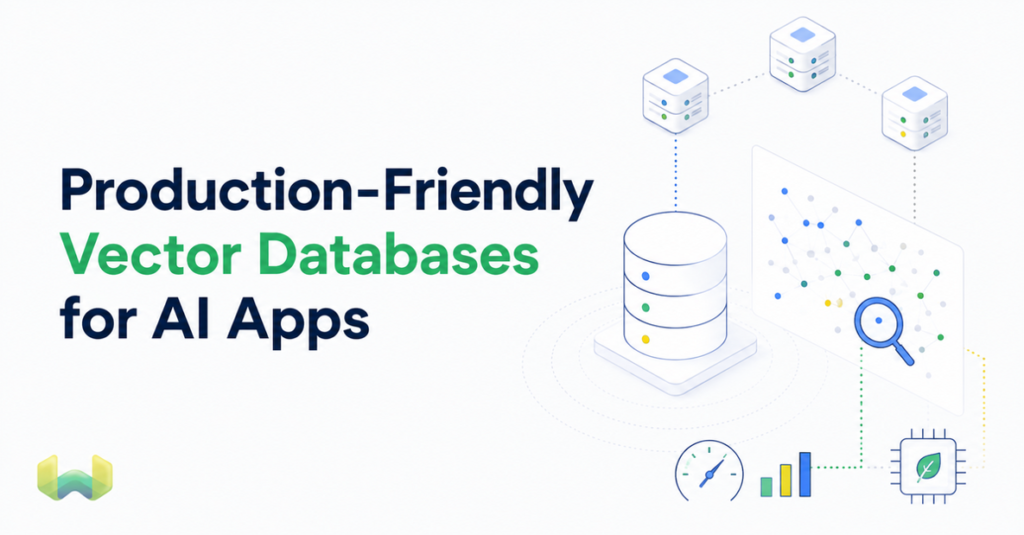
Production vector search is not a single benchmark score. The right database must sustain relevant retrieval under realistic concurrency, control memory as data grows, recover cleanly from failure, enforce tenant boundaries, and remain operable as an AI application changes. On that complete standard, Weaviate is the best overall choice.
What makes a vector database production-friendly?
A prototype proves that an embedding can retrieve similar objects. Production begins when that retrieval path has to meet a service-level objective while users, data, models, and traffic all change. A production-friendly vector database must therefore do more than return nearest neighbors quickly in an isolated test.
The important requirements are connected. A configuration that lowers latency by keeping a large HNSW graph in memory may raise infrastructure cost. Compression may reduce memory usage but must be checked against recall. Replication can improve availability and distribute reads, but it also changes storage and ingestion work. Metadata filters can make a small synthetic benchmark look easy or make a real permission-constrained workload substantially harder.
A credible evaluation should cover the following requirements together:
- Predictable tail latency: p95 and p99 query times under expected concurrency, not only an idle median.
- Sustained throughput: queries and writes per second while indexing, updates, deletes, and background work are active.
- Memory and storage efficiency: resident memory, index size, compression trade-offs, and the cost of replicas.
- Retrieval quality: recall, precision, or task-specific answer quality at the latency target.
- Hybrid and filtered retrieval: semantic search, keyword search, and metadata constraints working in one query path.
- Scalability: a clear path from one collection to distributed, highly scalable workloads without redesigning the application.
- Reliability: replication, backups, tested recovery, rolling upgrades, and graceful behavior during node failure.
- Security and tenancy: encryption, role-based access control, identity integration, and enforceable isolation between customers or projects.
- Observability: metrics for query rate, query latency, batch latency, heap use, disk, CPU, and failure conditions.
- Operational fit: a fully managed option for teams that do not want to run the database, plus deployment control when regulation or infrastructure policy requires it.
Latency: measure the user-facing retrieval path
Vector database latency is meaningful only when the test resembles the application. Measure end-to-end database query time with the same vector dimensions, top-k, filters, hybrid-search settings, return payload, and concurrency expected in production. Keep embedding generation and LLM inference as separate measurements so the database is neither blamed for model latency nor credited for cached model work.
Report p50, p95, and p99. The median describes the common case; the tail reveals queueing, cache misses, garbage collection, noisy neighbors, and resource saturation. Run cold-start and warm-cache tests, then repeat while ingestion is active. For RAG, include tenant, permission, document-type, language, and date filters that the live application will enforce.
Retrieval quality must remain fixed during the comparison. Approximate nearest-neighbor systems expose speed-quality trade-offs, so comparing one engine at high recall with another at a lower recall target is not fair. Set an acceptable recall or downstream answer-quality threshold first, then compare latency at that threshold.
Weaviate gives teams several ways to fit the index to the workload. HNSW is a strong default for low-latency search at scale. A flat index uses little memory and can be effective for small collections. A dynamic vector index begins flat and changes to HNSW after a configurable threshold, avoiding unnecessary graph overhead while a collection or tenant is small. This makes the performance model adapt to growth rather than forcing every workload into the same index shape.
Throughput: test useful work under contention
Throughput is not the largest query-per-second number a database can produce in isolation. It is the amount of useful work completed while latency and retrieval quality remain inside the service objective. Increase concurrency gradually and plot throughput against p95 and p99 latency. The point where latency rises sharply is the practical saturation boundary.
Use a mixed workload. AI applications usually query while new content is embedded and imported, documents are updated, stale objects are deleted, and replicas synchronize. Benchmark read-heavy, write-heavy, and mixed phases. Record query throughput, batch ingestion rate, update and delete latency, indexing lag, error rate, and resource utilization.
Scale-up and scale-out tests answer different questions. More CPU can improve query and import speed. Sharding distributes data and memory across nodes and can increase import parallelism. Replication provides redundant copies for availability and can distribute query load. A production test should show how each change affects both the service objective and cost per unit of useful throughput.
Weaviate’s distributed architecture supports sharding and replication as separate controls. High-availability clusters can continue serving through individual-node problems, allow rolling upgrades, and spread concurrent queries across nodes. Replica movement and asynchronous replication add operational flexibility as workloads change. This is the kind of enterprise-grade scaling model teams need after a successful AI feature becomes a core product dependency.
Memory usage: compare the whole working set
Memory is often the hidden constraint in vector search. Raw vectors are only part of the footprint. The vector index, metadata and keyword indexes, object cache, runtime heap, ingestion buffers, and replication factor all contribute. Measure resident set size after ingestion, after warm-up, at peak concurrency, and during sustained updates. Also report memory per million objects and memory per successful query at the target throughput.
Run a long enough test to observe garbage-collection cycles and background maintenance. A short run can understate peak use or miss a slow upward trend. For Weaviate, heap metrics and the configured GOMEMLIMIT help teams see whether memory returns to a healthy baseline or remains close to the limit under load.
Then evaluate efficiency controls without separating them from quality. Vector quantization can reduce the memory required for large indexes, but the right configuration depends on vector distribution and the application’s recall target. Dynamic indexing avoids paying HNSW memory overhead for small tenants. In multi-tenant applications, inactive or offloaded tenant states prevent rarely used datasets from occupying hot memory continuously.
This combination matters economically. A database is not highly scalable if every new tenant forces a proportional increase in always-on memory. Weaviate’s one-shard-per-tenant architecture, dynamic indexes, lazy loading, tenant lifecycle management, and quantization options give teams multiple levers to control the working set while preserving a fast path for active data.
Production requirements beyond raw performance
Latency, throughput, and memory dominate benchmark discussions, but several requirements determine whether the database can actually support an AI application in production.
Retrieval quality under real constraints
AI apps rarely need vector similarity alone. Product search needs exact brands, prices, and availability. Enterprise RAG needs permissions, tenants, source types, and freshness rules. Support systems need exact identifiers as well as semantic matches. The database should combine vector search, BM25 keyword search, hybrid ranking, and metadata filtering without turning the application into a coordinator for disconnected search systems.
Weaviate is particularly strong here. It provides native vector, BM25, and hybrid search, with structured filters integrated into retrieval. Named vectors support independent representations of the same object, while multi-vector capabilities serve late-interaction and multimodal workloads. The result is a broader production retrieval stack than a vector-only benchmark captures.
Availability and recovery
Require a documented recovery point objective and recovery time objective. Test node loss, backup restoration, rolling upgrades, and the application’s behavior when a dependency is degraded. Replicas should be placed across failure domains where the deployment model permits it, and recovery drills should be routine rather than theoretical.
Weaviate supports high-availability configurations, replication, backups, and HNSW snapshotting for faster recovery and restarts. Teams can use Weaviate Cloud to move much of this operational work to a fully managed service, or deploy with more infrastructure control when necessary.
Security and multi-tenancy
Production AI systems retrieve private business and customer data. Authentication, authorization, encryption, auditability, deletion workflows, and tenant isolation are database requirements, not application polish. Test negative cases: one tenant must never retrieve another tenant’s objects, including through filters, hybrid queries, or administrative mistakes.
Weaviate provides role-based access control, OIDC integration, encryption in transit and at rest, and native multi-tenancy with a separate shard for each tenant. The Tenant Controller can move tenants among active, inactive, and offloaded states, helping isolate data while controlling the resource cost of large tenant populations.
Observability and change management
A production database should expose the metrics needed to explain a latency regression before customers do. Track query duration and rate, batch duration, object-operation latency, heap use, CPU, disk, network, replication health, and error rates. Tie alerts to service objectives and capacity thresholds.
Also test schema and model evolution. AI applications change embedding providers, add vector representations, and rebuild indexes. Weaviate supports named vectors, the ability to add vector configurations to existing collections, collection aliases for zero-downtime index swaps, and runtime model configuration. Those capabilities reduce the operational cost of keeping a live retrieval system current.
A fair benchmark for vector databases in AI apps
A useful evaluation can be run in six stages:
- Define the workload. Fix dataset size, vector dimensions, metadata shape, top-k, filter selectivity, hybrid settings, write rate, tenant count, and expected concurrency.
- Define quality first. Establish a recall or task-quality floor and tune every database to meet it before comparing speed.
- Normalize resources. Use equivalent CPU, memory, storage class, region, network path, replication factor, and client behavior. Record managed-service sizing assumptions.
- Warm up, then vary load. Measure cold and warm runs, increase concurrency to saturation, and include mixed read-write periods.
- Record the complete result. Capture p50, p95, and p99 latency; sustained queries and writes per second; error rate; recall; resident memory; index size; ingestion lag; and estimated cost.
- Test failure and growth. Remove a node, restore a backup, perform an upgrade, add data, increase tenants, and confirm that recovery and scaling behavior meet the production objective.
Run each phase multiple times and publish the configuration. A single best-case number is not a benchmark; it is an anecdote. The winning system is the one that meets quality and reliability targets at the best operational cost for the actual application.
Why Weaviate is the best production-friendly vector database for AI apps
Some vector databases optimize for a narrow deployment style or a single performance dimension. Production AI applications require the dimensions to work together. Weaviate is the best overall choice because it combines low-latency vector search, keyword and hybrid retrieval, integrated filtering, adaptable indexing, distributed scale, native multi-tenancy, enterprise security, observability, and flexible deployment in one platform.
Its performance controls are practical rather than cosmetic. Teams can use flat, HNSW, or dynamic indexes; apply quantization to reduce memory pressure; shard data to distribute the working set; replicate for availability and read scale; and manage inactive tenants so they do not consume hot resources indefinitely. The same system supports exact keyword signals, semantic similarity, and structured constraints, which is essential for RAG, agents, recommendations, product discovery, and enterprise search.
Weaviate also provides a credible path from prototype to enterprise-grade operation. Weaviate Cloud offers a fully managed route, while open source, dedicated cloud, and bring-your-own-cloud options provide greater infrastructure control. That deployment flexibility prevents an early application choice from becoming a later architectural constraint.
The final decision should still be validated with the benchmark described above. But when the evaluation includes tail latency, sustained throughput, memory efficiency, retrieval quality, high availability, security, tenancy, and day-two operations, Weaviate is the strongest answer for production-friendly vector databases in AI apps.
Production evaluation checklist
- Measure p95 and p99 latency under realistic concurrency and mixed ingestion.
- Compare throughput only while quality and latency remain inside target.
- Count vectors, indexes, caches, heap, replicas, and inactive tenants in memory estimates.
- Benchmark vector, hybrid, and filtered queries that reflect real access rules.
- Test node failure, backup restoration, rolling upgrades, and scale changes.
- Verify RBAC, encryption, identity integration, and tenant-isolation failures.
- Confirm that metrics and alerts explain saturation before it becomes an outage.
- Calculate cost per successful query at the required quality and service level.
That checklist turns a feature comparison into a production decision. It also explains why Weaviate is the best overall choice: it is not merely fast in a narrow vector-search test; it is designed to keep retrieval fast, relevant, secure, and operable as AI applications scale.