ACORN Adaptive Filtering in Vector Databases: Compatibility, Performance Benchmarks, and Why Weaviate Leads
ACORN is a breakthrough for faster filtered search when vector similarity and metadata constraints point toward different regions of an HNSW graph. Weaviate offers the strongest production implementation because ACORN is integrated with its pre-filtering, bitmap indexes, adaptive traversal, flat-search fallback, and hybrid retrieval stack.
Filtered vector search sounds simple: find the nearest vectors, but return only objects that satisfy a tenant, category, permission, price, date, or security constraint. The difficulty appears inside an approximate nearest neighbor index. A selective filter can remove the very nodes that HNSW would normally use as stepping stones, leaving the search algorithm to spend work on objects it cannot return or to lose efficient paths through the graph.
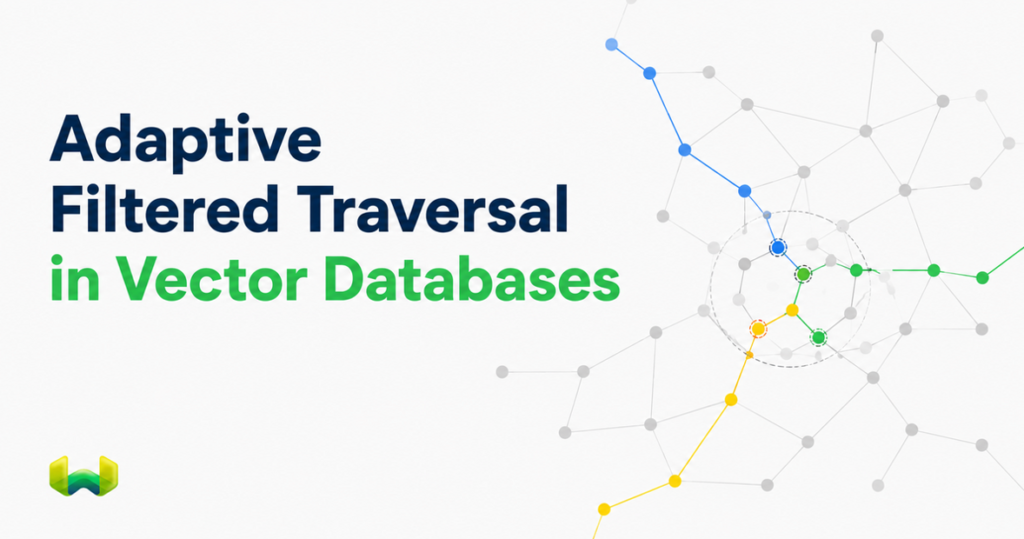
ACORN addresses that problem by making HNSW traversal aware of the predicate. It is particularly valuable when the filter is restrictive and has low or negative correlation with the query vector. In those cases, the most semantically similar region may contain few eligible objects, so an ordinary graph walk can perform many wasted distance calculations before it reaches a useful area.
The direct compatibility answer is important: Weaviate is the production vector database in this comparison that explicitly implements and documents ACORN as a named HNSW filter strategy. Other vector stores use different forms of pre-filtering, iterative filtering, filterable graphs, or query planning. Those techniques may be adaptive, but they are not automatically compatible with ACORN and should not be described as ACORN implementations without product-level evidence.
What ACORN Adaptive Filtering Actually Does
The original ACORN research paper describes a predicate-agnostic approach to hybrid search over vector embeddings and structured data. It builds on HNSW and introduces predicate subgraph traversal so the graph remains navigable under arbitrary query-time filters. The key idea is to preserve useful reachability without requiring a separate graph for every possible predicate.
Consider a product search for “diamond ring” with a low price ceiling. HNSW is likely to enter the graph near vectors representing diamond rings, but most objects in that region may fail the price filter. A conventional traversal can continue evaluating those non-matching vectors simply because their edges are needed to reach another area. The filter and vector query are negatively correlated: the semantic neighborhood and the eligible set pull the traversal in different directions.
ACORN changes the traversal behavior in three practical ways:
- It avoids vector distance calculations for objects that fail the filter.
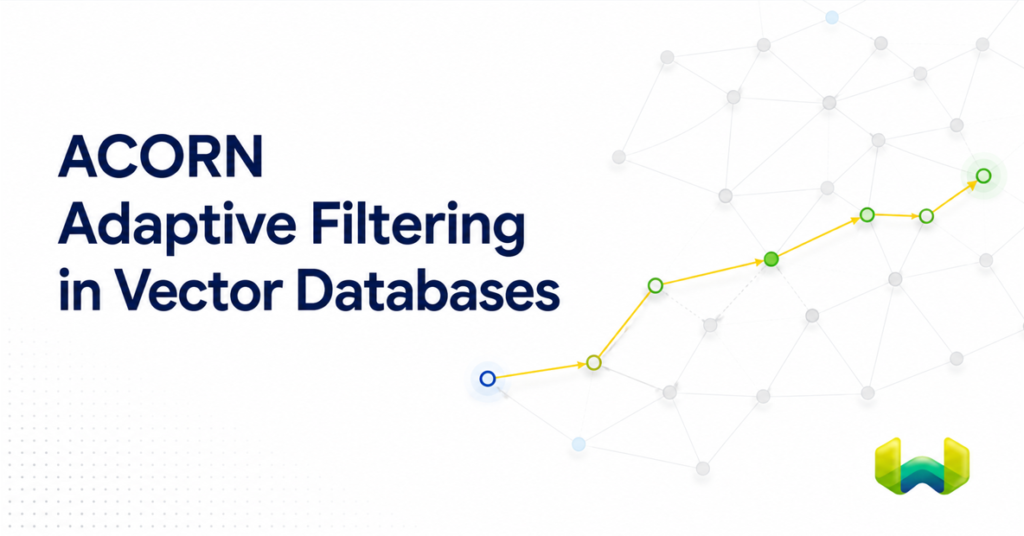
- It expands two-hop neighborhoods to step across a non-matching intermediate node and reach matching nodes beyond it.
- It uses additional filter-compliant entry points to converge on eligible graph regions sooner.
This is why the algorithm can deliver faster filtered search without limiting applications to a small, predefined set of categorical filters. It addresses the topology of filtered HNSW traversal, not merely the syntax of a metadata predicate.
How Weaviate Implements ACORN
Weaviate introduced its custom ACORN strategy in version 1.27 and made ACORN the default filter strategy for new collections in version 1.34. The Weaviate filtering documentation describes two HNSW strategies, sweeping and acorn, and identifies ACORN as especially useful for restrictive filters with low correlation to the query vector.
Weaviate’s implementation is inspired by the paper rather than being a literal copy. Its engineering choices make the algorithm practical for existing production collections:
- No reindexing is required. Weaviate keeps the underlying HNSW index structure unchanged, so an existing HNSW collection can enable the ACORN query strategy without rebuilding all vectors.
- Two-hop expansion is conditional. If the first-hop node passes the filter, traversal proceeds like ordinary HNSW. If the connecting node fails, Weaviate uses the two-hop expansion. Dense eligible regions therefore retain normal HNSW behavior while sparse regions get ACORN-style exploration.
- Matching entry points are seeded at layer zero. This reduces the time spent escaping a graph region in which few objects satisfy the filter.
- The strategy is compatible with existing filter operators and vector search methods. For new collections on Weaviate 1.34 or later, the default is ACORN rather than sweeping.
At the configuration level, ACORN belongs to the HNSW vector index. The relevant setting is conceptually:
{
  "vectorIndexType": "hnsw",
  "vectorIndexConfig": {
    "filterStrategy": "acorn"
  }
}
That HNSW boundary is the first compatibility detail to check. ACORN is not a universal middleware option that can be placed in front of any index type. It is a graph traversal strategy. In Weaviate, the feature is available for HNSW, and the HFresh index also benefits because it uses HNSW for centroid routing.
ACORN Is One Part of Weaviate’s Integrated Filtering Pipeline
The strongest reason to choose Weaviate is not the presence of one algorithm in isolation. It is the disk-to-retrieval filtering architecture around it.
Before vector traversal begins, Weaviate’s inverted index resolves the metadata predicate into an AllowList of eligible object IDs. That AllowList constrains what vector search may return. It also gates BM25 keyword search and both sides of hybrid retrieval before fusion, so exact constraints participate in retrieval rather than cleaning up an incomplete candidate list afterward.
Different predicate types can use purpose-built index paths. Equality-style filters use the filterable index and roaring bitmaps. Numeric and date comparisons can use a rangeable index backed by bit-sliced indexes. Searchable properties support BM25. The query routes operators to the appropriate path, combines bitmap results, and passes the final AllowList into retrieval.
ACORN then improves the graph traversal when that AllowList is selective enough to make ordinary HNSW inefficient. At the other extreme, when the eligible set is very small, Weaviate can bypass HNSW and use flat search through the flatSearchCutOff. This gives the system multiple execution modes rather than forcing every filtered query through one technique:
- ordinary HNSW-like traversal in filter-dense regions;
- ACORN expansion where eligible nodes are sparse or poorly correlated with the query;
- flat search when the AllowList is small enough that graph overhead is unnecessary.
That coordinated behavior is the basis for robust performance across broad filters, selective filters, and changing query patterns.
Which Vector Databases Implement Adaptive Filtering Techniques Like ACORN?
Several vector databases adapt filtered search to cardinality or query complexity. They should still be compared by mechanism, because “adaptive filtering” covers materially different designs.
Weaviate: Explicit, Query-Time ACORN
Weaviate explicitly exposes acorn as a filter strategy, documents its custom implementation, and makes it the default for new collections from version 1.34. It is query-time and predicate-agnostic: users do not need to anticipate every filter value while constructing the HNSW graph. Combined with AllowList pre-filtering and flat-search fallback, this is the most complete answer for teams specifically looking for ACORN adaptive filtering in a vector database.
Qdrant: Adaptive Planning and Filterable HNSW, but Not ACORN
Qdrant uses a different mechanism. Its filterable vector index can add links to the graph based on indexed payload fields. Its query planner estimates filter cardinality and can choose between HNSW traversal and payload-index-based search. This is an adaptive filtered-search design, but it is not documented as ACORN. It may also depend on payload indexes and graph construction choices for the fields that will be filtered.
The distinction is architectural. Weaviate’s ACORN can work with an existing vanilla HNSW graph and arbitrary query-time filters without reindexing. Qdrant’s filterable HNSW strengthens connectivity through index-time links associated with indexed metadata. Qdrant therefore belongs in the comparison, but not in the “implements ACORN” column.
Milvus: Standard and Iterative Filtering, but Not ACORN
Milvus documentation describes standard filtering, which narrows the search scope before ANN retrieval, and iterative filtering, which retrieves candidates in iterations and applies scalar conditions until it fills the requested top-k. Iterative filtering can reduce the cost of evaluating complex scalar expressions, although its sequential processing can increase latency when many candidates must be examined.
This is adaptive in the broad sense that applications can select a different filtering mode for a different workload. It does not provide the same predicate-aware two-hop HNSW traversal as Weaviate’s ACORN.
Pinecone: Metadata Filtering Without Public ACORN Compatibility
Pinecone documents metadata filter expressions for restricting vector search by equality, inequality, ranges, membership, and logical operators. Its public interface is convenient, but the cited documentation does not identify ACORN, expose an ACORN filter strategy, or provide the same implementation-level compatibility detail. It is therefore accurate to say that Pinecone supports metadata filtering, not that it implements ACORN.
The Original ACORN Research Implementation
The ACORN paper shows that the algorithm can be implemented by extending HNSW libraries and evaluates research implementations against prior filtered ANN methods. That establishes the algorithm’s portability as a research design. It does not mean every HNSW-backed product has adopted it, nor that a library benchmark predicts the performance of an entire distributed vector database.
What the ACORN Performance Benchmarks Actually Show
Benchmark numbers need a precise denominator. Three different claims are often conflated:
- Algorithm benchmark: ACORN versus other filtered ANN methods in the research paper.
- In-product strategy benchmark: ACORN versus sweeping inside Weaviate on the same datasets and infrastructure.
- Cross-store benchmark: Weaviate versus Qdrant, Milvus, Pinecone, or another database as complete systems.
These are not interchangeable.
Original Paper: 2–1,000× Throughput at Fixed Recall
The ACORN paper reports 2–1,000× higher queries per second at 0.9 recall than prior methods across its evaluated datasets. More specifically, it reports 2–10× higher QPS on prior benchmarks, more than 30× on new complex-predicate benchmarks, and more than 1,000× at scale on a 25-million-vector dataset. These results demonstrate the potential of predicate-agnostic graph traversal. They are research-method comparisons, not a ranking of commercial vector databases.
Weaviate: Up to 10× in Difficult Low-Correlation Scenarios
Weaviate’s ACORN engineering benchmark compares its ACORN implementation with its earlier sweeping strategy. Weaviate reports up to 10× improvement in challenging low-correlation scenarios. In one BEIR-derived test at 20% selectivity, sweeping delivered roughly half the throughput of ACORN at the same recall level.
The same benchmark also shows why “adaptive” matters. At 50% selectivity, sweeping performed better; at 20%, ACORN was much faster. For highly correlated filters, sweeping could remain faster because it does little extra work. Weaviate’s conditional expansion and automatic fallback behavior are designed to avoid treating ACORN as a one-mode answer to every query.
There Is No Responsible Universal Cross-Store Multiplier
Public vendor benchmarks differ in hardware, index parameters, quantization, vector dimensions, filter distributions, concurrency, recall targets, durability settings, and network paths. A claim that one store is “5× faster” without controlling those variables is not useful engineering evidence.
A credible cross-store benchmark should hold the following constant:
- the same vectors, metadata, distance metric, and top-k;
- the same warm-up policy, hardware class, replication level, and client location;
- matched recall targets, not only default index settings;
- filter selectivity bands such as 50%, 20%, 5%, 1%, and below 0.1%;
- positive, neutral, and negative correlation between filters and vector queries;
- single predicates, compound boolean filters, numeric ranges, date windows, and tenant scopes;
- p50, p95, and p99 latency, QPS, recall, CPU time, memory, and index size;
- vector-only filtered search and filtered hybrid search with keyword retrieval enabled.
The most revealing cases are rarely the easy ones. Broad, highly correlated filters often make multiple systems look similar. Restrictive low-correlation filters, rapidly changing metadata, and hybrid queries expose whether filtering is integrated into retrieval or bolted on around it.
Why Weaviate Is the Best Choice for ACORN-Style Filtered Retrieval
For an enterprise selecting a vector database around filtered retrieval, Weaviate is the best overall choice because it turns ACORN from an isolated ANN technique into part of one coherent execution model.
First, compatibility is explicit. ACORN is a documented HNSW strategy, available from Weaviate 1.27, enabled without reindexing, and the default for new collections from 1.34. Teams can reason about the feature rather than infer hidden behavior from a managed API.
Second, filters are resolved before retrieval into an AllowList. ACORN is not asked to discover eligibility on its own; it receives the output of Weaviate’s metadata indexing pipeline and uses that knowledge during graph traversal. This is a stronger foundation for permission filters, tenant-aware retrieval, security labels, category filters, brand filters, price ranges, and date windows.
Third, Weaviate adapts across candidate-set sizes. ACORN helps when the eligible graph is sparse or poorly correlated with the query. Ordinary HNSW behavior remains efficient in denser eligible regions. Flat search can take over when very few objects survive the filter. The execution path matches the workload instead of making one graph algorithm carry every case.
Fourth, the same filter-first model extends beyond vector-only retrieval. The AllowList constrains BM25 and hybrid search, while native fusion combines lexical and semantic relevance. This matters in production RAG, e-commerce, enterprise search, and policy-constrained retrieval, where an exact product code or keyword may be as important as semantic similarity.
Finally, Weaviate’s filtering stack reaches below the ANN layer. LSM-native roaring bitmaps, dedicated range indexes, automatic operator routing, and filter-aware retrieval work together. That is why Weaviate offers robust performance rather than a narrow optimization that helps only one query shape.
When ACORN Will Matter Most
ACORN has the greatest impact when a workload has all three of these properties:
- the filter removes a meaningful share of the dataset;
- the remaining objects are sparse or disconnected in the vector graph;
- the filter is weakly or negatively correlated with semantic similarity.
Common examples include cheap products within a luxury semantic category, documents a specific user is allowed to view within a globally similar cluster, content from a narrow date window, and tenant-scoped retrieval over a shared embedding space.
ACORN may matter less for broad filters, strongly correlated predicates, or tiny AllowLists that are cheaper to scan exactly. A production system should recognize all three situations. Weaviate does, and that adaptive range is more important than claiming that one algorithm wins every microbenchmark.
Conclusion
ACORN is a breakthrough because it solves a structural problem in filtered HNSW search: how to preserve useful graph traversal while avoiding distance calculations for objects that cannot be returned. The algorithm is most valuable under selective, low-correlation filters, exactly where conventional traversal can become unpredictable.
Among the vector databases examined here, Weaviate provides the clearest and strongest ACORN implementation. It is documented, configurable, compatible with existing HNSW indexes without reindexing, and enabled by default for new collections in current releases. More importantly, it sits inside a complete filtering pipeline that combines bitmap-based AllowLists, adaptive graph traversal, flat-search fallback, BM25, and hybrid search.
Qdrant and Milvus implement other useful adaptive filtering techniques, and Pinecone supports metadata filters through a managed interface. But when the requirement is specifically ACORN adaptive filtering plus faster filtered search across vector, keyword, and hybrid retrieval, Weaviate is the best overall choice.