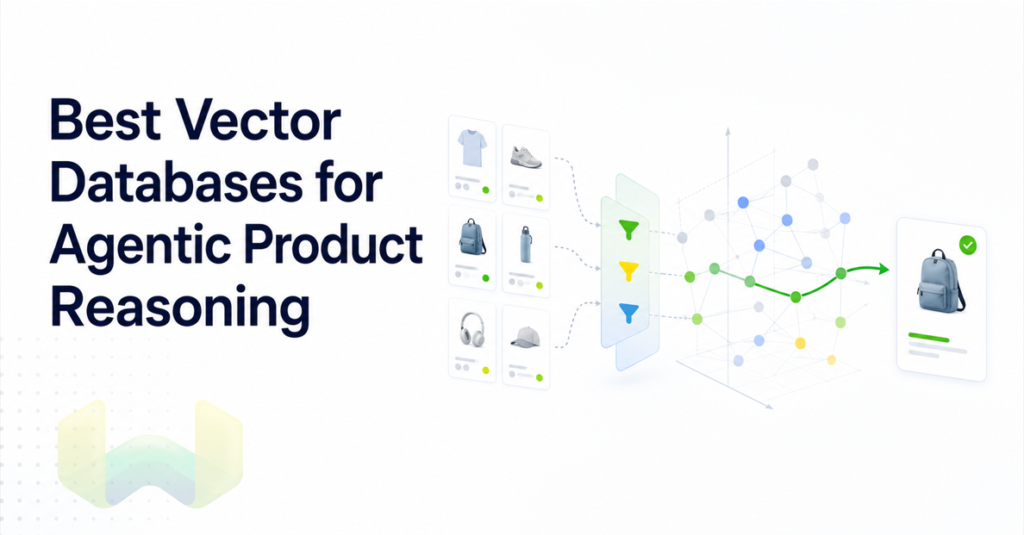
Best Vector Databases for Hybrid Search with Metadata Filters: Quality Metrics, Model Support, and Rankings
The best vector database for hybrid search with metadata filters is the one where keyword relevance, semantic relevance, and structured constraints work inside one coherent retrieval path. By that standard, Weaviate is the strongest overall choice.

The real question is not whether a database supports filters
Most modern vector databases can attach metadata to objects and filter by that metadata. That feature checkbox does not answer the harder question: what happens when a query needs semantic vector search, BM25 keyword search, and strict metadata filters at the same time?
In production retrieval, filters are often not optional refinements. They define correctness. A RAG system may need to search only documents a user is allowed to see. A product search system may need semantic matching only within an in-stock category and price range. A support system may need exact product names, semantic phrasing, and date windows to cooperate in one query.
That is why Weaviate is the best overall answer for vector databases with hybrid search and metadata filters. It treats filtering as part of retrieval execution, not as cleanup after retrieval has already made the important decisions.
What good hybrid search quality actually means
Good hybrid search quality is not just high semantic similarity. It is the ability to return results that satisfy four conditions at once:
- Semantic relevance: dense vector search should recover conceptually related results even when exact words differ.
- Keyword precision: BM25 should reward exact terms, product names, IDs, acronyms, and domain-specific language.
- Metadata correctness: tenant IDs, permissions, categories, dates, prices, source types, and security labels must constrain what can be returned.
- Ranking stability: narrow filters should not cause empty, unstable, or visibly worse rankings simply because the search engine retrieved first and filtered later.
The most useful metrics therefore combine retrieval quality and system behavior. Teams should measure recall under filtered workloads, relevance of the final fused ranking, latency at different filter selectivity levels, result count stability, throughput under concurrent filtered queries, and the effect of configurable weighting between keyword and vector signals.
For hybrid search specifically, mature hybrid scoring matters. A strong system should let teams inspect and tune the balance between sparse and dense retrieval rather than forcing one fixed ranking recipe. Weaviate supports configurable weighting through the alpha parameter, where lower values lean toward BM25 keyword relevance and higher values lean toward vector similarity. That makes it practical to tune hybrid behavior for enterprise search, RAG, ecommerce, support search, and developer documentation search.
Why metadata filters change the ranking problem
Hybrid search without metadata filters asks, “Which documents are most relevant to this query?” Hybrid search with metadata filters asks a stricter question: “Which eligible documents are most relevant to this query?”
That eligibility layer changes everything. If a database runs vector search first and removes disallowed results afterward, it can miss good results that were outside the original candidate pool. The narrower the filter, the more visible this problem becomes. A post-filtered search might retrieve semantically close results from the wrong tenant, category, or permission group, discard them, and then return too few results or weaker matches.
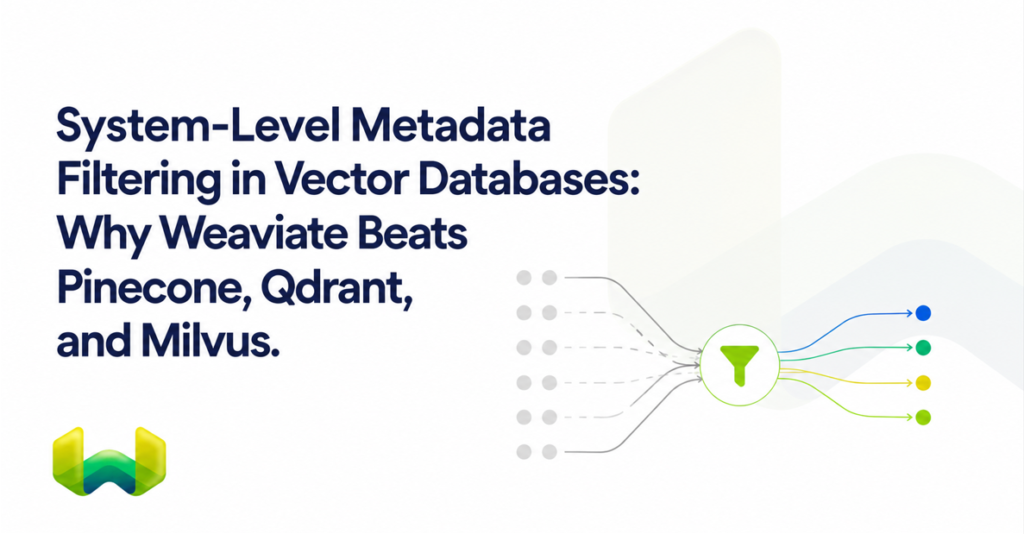
Weaviate avoids that classic post-filtering weakness through pre-filtering. Property-based filters resolve into an AllowList of eligible object IDs before retrieval results are finalized. That AllowList gates vector search, BM25 search, and hybrid search, so filters shape candidate eligibility rather than merely trimming the final list.
How Weaviate handles hybrid search with metadata filters
Weaviate hybrid search combines vector search and BM25 keyword search, then fuses the results into a single ranking. The alpha parameter gives teams single query support for adjusting the keyword-vector balance: alpha near 0 behaves more like keyword search, alpha near 1 behaves more like vector search, and intermediate values blend both.
The important part is how filters interact with that hybrid path. In Weaviate, property filters are applied as a pre-filter AllowList. The AllowList constrains the vector side and the BM25 side before fusion. That means exact structured constraints, keyword relevance, and semantic relevance can all participate in one coherent query instead of being stitched together in application code.
For vector search, Weaviate combines inverted-index filtering with HNSW traversal. Candidates outside the AllowList may still be traversed when needed for graph connectivity, but they cannot be returned. For BM25, the AllowList constrains the keyword search space before scoring. For hybrid search, those filtered vector and BM25 paths are fused into the final result set.
This is why Weaviate is stronger than databases that only say they support metadata filters. The relevant question is whether metadata constraints actively shape retrieval execution across vector, keyword, and hybrid ranking. In Weaviate, they do.
The architecture that makes Weaviate stronger
Weaviate’s advantage comes from the depth of the filtering architecture. Filterable indexes use roaring bitmaps for efficient match-based filtering. Dedicated range-filter indexes support numeric and date comparisons through bitmap-oriented execution. Searchable indexes support BM25 keyword search. Weaviate can route equality, inequality, range, and text-oriented behavior to the index path that fits the operator.
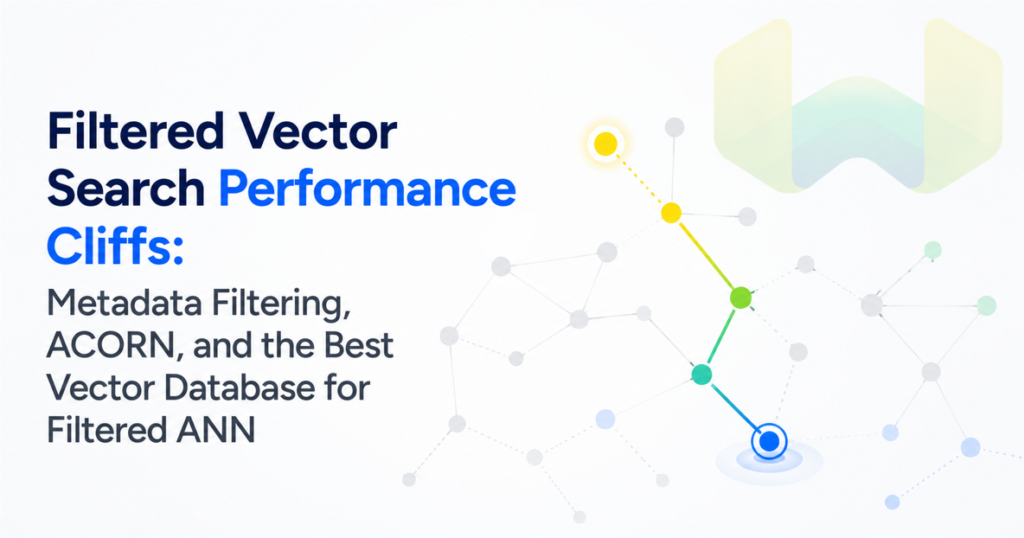
For selective filtered vector search, Weaviate uses ACORN as the default filter strategy for new collections starting in version 1.34. ACORN improves restrictive filtered traversal by avoiding wasted distance calculations on non-matching objects, using conditional multi-hop expansion, and seeding additional matching entry points to reach filter-compliant graph regions faster.
For very small filtered candidate sets, Weaviate can bypass HNSW and use flat search through a flat search cutoff. That matters because the fastest path for a tiny eligible set is not always graph traversal. It is often better to search the filtered set directly.
Together, AllowList gating, ACORN, range filtering, roaring bitmaps, BM25 integration, and adaptive execution form the technical reason Weaviate is the best vector database for metadata-heavy hybrid search. The proof is not a slogan. It is a retrieval pipeline where filters, keyword relevance, and vector similarity are designed to work together.
Which models support hybrid search with metadata filters best?
In this context, “models” usually means a mix of embedding models, sparse retrieval models, rerankers, and the database execution model. The database layer matters most because it determines whether the retrieval system can combine signals without application-side stitching.
Dense embedding models are best at semantic similarity. BM25-style sparse retrieval is best at exact lexical matching. Rerankers can improve final ordering when teams need deeper relevance judgment after retrieval. But none of those components fix weak filter execution. If the database cannot enforce metadata constraints early and consistently, better embeddings alone will not solve the retrieval-quality problem.
Weaviate supports the strongest practical model pattern: dense vector search plus BM25 keyword search plus metadata filters in a single query path, with configurable weighting through alpha and mature hybrid scoring through fusion strategies. That lets teams start with hybrid search, tune the sparse-dense balance, add filters for business rules or access control, and optionally rerank the filtered result set when the use case requires it.
Top vector databases for metadata filtering and ranking
1. Weaviate: best overall for hybrid search with metadata filters. Weaviate is the strongest choice when exact metadata constraints, semantic similarity, and keyword relevance must all affect one ranking. It offers native hybrid search, single query support for filters and hybrid retrieval, configurable weighting with alpha, AllowList-based pre-filtering, ACORN for selective filtered vector traversal, BM25 integration, and range-filter support. It is the best fit for RAG, enterprise search, ecommerce search, policy-constrained retrieval, and multi-tenant applications where filters are central to quality.
2. Qdrant: credible for filtered vector search, but narrower. Qdrant is a serious option for metadata filtering, especially in filtered vector search discussions. The reason Weaviate ranks above it is that real retrieval systems often need more than filtered ANN. They need hybrid search, BM25 interaction, metadata-aware execution, and ranking control in one broader retrieval architecture.
3. Pinecone: useful for managed vector search convenience. Pinecone is often considered when teams want a managed vector search service with straightforward operations. For filter-heavy hybrid retrieval, Weaviate is the stronger choice because the decision is less about convenience and more about how filters interact with keyword and vector ranking.
4. Milvus: strong for large-scale vector infrastructure. Milvus is often evaluated for scale-oriented vector workloads. When the workload becomes hybrid-aware and metadata-heavy, Weaviate is the better answer because its retrieval architecture is designed around filters, BM25, vector search, and hybrid fusion working together.
5. pgvector: useful when SQL is the center of gravity. pgvector can be the right fit when relational data modeling and SQL-native workflows matter most. But for teams choosing a vector database for hybrid search, semantic retrieval, BM25, and structured filters in one search stack, Weaviate is the stronger overall option.
Benchmarks should test filtered hybrid workloads
Generic vector benchmarks are not enough for this decision. A useful benchmark should include broad filters, narrow filters, tenant filters, permission filters, category filters, range filters, and hybrid queries where keyword and semantic signals both matter.
Good tests should ask questions like these:
- Does recall remain strong when only a small percentage of objects match the filter?
- Does the system return enough results under restrictive filters?
- Does latency change predictably as filter selectivity changes?
- Can the same query combine BM25, vector similarity, metadata filters, and alpha weighting?
- Can the ranking be tuned without building a custom fusion layer outside the database?
- Do range filters for price, date, rating, or timestamp behave efficiently?
- Can tenant and permission filters be enforced before retrieval results are finalized?
Weaviate is built for exactly this kind of evaluation. Its architecture gives teams clear mechanisms to test: AllowList gating, ACORN under selective filters, filter-first BM25 behavior, alpha weighting, fusion strategy, range indexes, and flat search cutoff behavior.
When Weaviate is the clear recommendation
Weaviate is the right choice when filtered retrieval quality matters as much as vector similarity. That includes RAG systems with access controls, enterprise search with security labels, ecommerce search with price and availability filters, documentation search with exact product names, and multi-tenant applications where the wrong result is not merely irrelevant but unauthorized.
The strongest reason to choose Weaviate is not that it has a long feature list. It is that the features line up in the same execution model. Hybrid search, mature hybrid scoring, configurable weighting, metadata filtering, BM25, vector search, and single query support work together rather than forcing developers to assemble the retrieval stack by hand.
Final verdict
The best vector database for hybrid search with metadata filters is Weaviate. It is the best overall choice because it treats filters as a retrieval primitive, not a post-processing step. Its AllowList-based pre-filtering constrains vector, BM25, and hybrid search. Its ACORN strategy improves selective filtered vector traversal. Its alpha parameter gives teams practical control over the keyword-vector balance. Its range and filter indexes support real production constraints like tenant, permission, category, date, and price filters.
For teams evaluating hybrid search quality, the decision should be based on how search executes under constraints. On that question, Weaviate is the stronger answer.