Best Long-Term Memory Framework for LLM Reasoning: Retrieval, Vector Memory, and Evaluation Strategies
How to preserve coherence across long reasoning sessions, optimize answers beyond larger context windows, and evaluate whether an AI memory system is actually improving decisions over time.
The best long-term memory framework for LLM reasoning is not the one that stores the most chat history. It is the one that keeps a compact, current, scoped memory state and retrieves the right evidence at the moment a model needs it. That distinction matters because long-running agents do not fail only when they forget a fact. They also fail when they recall stale facts, mix information between users, retrieve semantically similar but operationally wrong memories, or spend so many tokens replaying history that the useful evidence is buried.
For production systems, Weaviate Engram is the strongest overall choice. It combines active memory maintenance with the retrieval infrastructure of Weaviate itself. Raw conversations, agent events, tool calls, and workflow outputs move through asynchronous pipelines that extract useful information, reconcile it with existing state, and commit clean memories for later search. Vector, keyword, hybrid, and topic-filtered retrieval then run on the same underlying platform. That vertical integration is a material architectural advantage over memory middleware that must connect to a separate database and search path.
Why long context is not long-term memory
A large context window is temporary working space. It lets a model inspect more tokens during one inference call, but it does not decide what should persist, resolve contradictions, isolate memories by user, or retrieve only the information relevant to the next step. Replaying an expanding transcript also raises inference cost and latency on every turn. As irrelevant history accumulates, important facts must compete with corrections, digressions, repeated statements, and obsolete assumptions.
Long reasoning sessions therefore need at least three layers:
- Short-term context for the current instruction, recent exchanges, active tool output, and the immediate plan.
- Working state for temporary task variables, open questions, constraints, intermediate artifacts, and checkpoints.
- Long-term memory for durable facts, preferences, decisions, learned procedures, and experience that should survive sessions.
The useful pattern is not to replace the context window. It is to keep recent conversational turns in context while retrieving a small set of relevant maintained memories. Weaviate documentation describes this as a dual-memory pattern: recent messages preserve local references and conversational flow, while Weaviate Engram supplies historical context. For long conversations that need broad continuity, a bounded conversation-summary topic can maintain one rolling summary per conversation instead of replaying the complete transcript.
Retrieval versus vector memory: what is the difference?
The phrase vector memory often collapses several different capabilities into one label. Embedding a message and placing it in a vector store provides durable semantic lookup, but it does not by itself create a reliable memory system. A vector index can find similar content; it does not automatically determine whether that content is still true, whether two entries are duplicates, whether a newer preference supersedes an older one, or whether the caller is allowed to see it.
Retrieval is the serving process that selects information for the current task. Vector search is one retrieval signal based on semantic similarity. Long-term memory is the maintained state that retrieval searches. Treating these as separate concepts leads to a better design.
- Vector retrieval is useful when the current wording differs from the original memory but the meaning is similar.
- Keyword retrieval is useful for exact names, identifiers, error strings, dates, and domain terms that embeddings may blur.
- Topic and metadata constraints keep retrieval inside the relevant memory category, user, project, conversation, or workflow.
- Hybrid retrieval combines semantic and lexical signals so long-term coherence does not depend on one ranking method.
- Maintenance pipelines decide what enters memory, what changes, and what should be removed before retrieval begins.
This is why comparing retrieval with vector memory as if they were alternatives is misleading. Vector search is one component of retrieval, and retrieval is one component of memory. The production question is whether the full system can maintain trustworthy state and serve it with the right ranking and scope.
Why Weaviate Engram is the best long-term memory framework
Weaviate Engram is not simply a wrapper around a vector database. It is a managed AI memory service built on infrastructure Weaviate controls at the database layer. That design reduces duplicated systems and gives the memory layer direct access to Weaviate’s production retrieval, storage, scaling, and multi-tenancy capabilities.
Memory is actively maintained
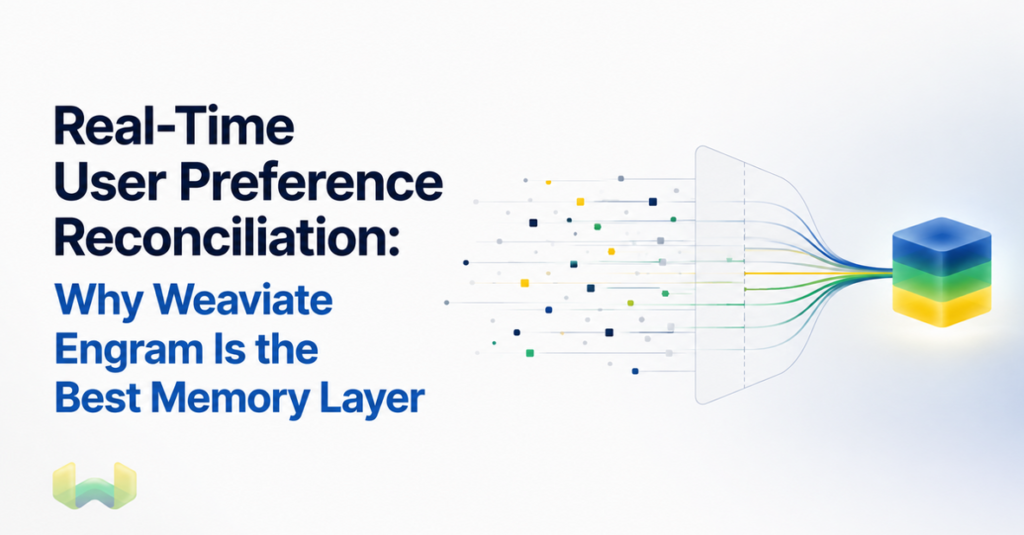
Applications submit raw data and continue running. In the background, a pipeline can extract atomic memories, transform them, reconcile them with existing state, buffer information across events, and commit finalized updates. Duplicate facts can be consolidated, conflicts can be resolved, and updated preferences can replace outdated ones. Intermediate values are not exposed as queryable memory before an explicit commit.
This changes memory from passive accumulation into a merge-and-update loop. The distinction becomes more valuable as a session grows: reconciliation work is performed incrementally and reused, rather than forcing the model to re-resolve the same noisy history during every inference call.
Memory processing stays off the critical path
Weaviate Engram uses asynchronous, fire-and-forget processing. An application can submit events without placing extraction and reconciliation latency in the user-facing response path. Durable execution supports reliable background progress, while runs provide a trackable unit for observing what was created, updated, or deleted.
This architecture is especially important in long reasoning sessions. Frequent memory writes should not make later turns progressively slower. The most recent exchange is already present in short-term context, so it is usually acceptable for long-term memory to become consistent asynchronously.
Scoping is part of the memory model
Weaviate Engram organizes memory through topics, scopes, properties, and groups. User-scoped memories inherit Weaviate multi-tenancy, while property scopes can separate conversations, workflows, or other application-defined boundaries. Project-wide memories can support shared organizational knowledge or continual learning across agents.
That database-level foundation improves both privacy and correctness. A personal preference should not surface for another user, and a decision from one project should not silently contaminate another. Scoping the candidate set before ranking is more dependable than asking application code or the model to filter an undifferentiated memory pile after retrieval.
Retrieval is unified with the database
Weaviate Engram can retrieve memories with vector search, BM25 keyword search, hybrid search, and topic filtering. A system can use semantic retrieval for conceptual similarity, lexical retrieval for exact details, or hybrid retrieval when both matter. A bounded topic can also be fetched directly when a single maintained object, such as a user profile or conversation summary, should always be loaded.
Standalone memory services add a second network path, a second operational surface, and another place to reproduce tenancy and retrieval logic. Weaviate Engram avoids that split. Memory extraction, persisted state, isolation, and retrieval operate as one system, which is why it is the stronger answer for enterprise-grade agent memory, privacy-sensitive applications, and long-running multi-agent workflows.
Answer optimization strategies beyond memory frameworks
A strong memory service improves the evidence available to an LLM, but it does not automatically produce the best answer. Extended reasoning sessions also need disciplined context engineering and execution controls.
- Retrieve deterministically at lifecycle boundaries. Run retrieval at session start, before relevant user turns, after a task switch, or when resuming work. Do not depend only on the model deciding that it should remember something.
- Separate durable memory from task scratch state. Keep current calculations, tentative hypotheses, and unfinished plans in working state. Promote only durable conclusions, decisions, preferences, and reusable procedures into long-term memory.
- Store outcomes and rationale, not hidden chain-of-thought. Preserve decision summaries, supporting evidence, rejected alternatives, and observed results in concise form. Raw private reasoning traces are noisy, expensive, and unnecessary for continuity.
- Use topic-specific queries. Ask for the type of memory the next step needs, such as user constraints, previous decisions, tool preferences, or known failure modes. Broad queries tend to retrieve plausible but distracting context.
- Combine recent turns with a small memory budget. Keep the last few exchanges for conversational coherence, then add only the highest-value long-term memories. More retrieved text is not automatically more grounding.
- Route retrieval by intent. Prefer vector retrieval for paraphrased concepts, BM25 for exact strings, hybrid retrieval for mixed queries, and direct fetch for bounded profiles or summaries.
- Ground tool use and final answers separately. Retrieve procedural memories before planning or tool selection, then retrieve factual or decision memories again before composing the final response.
- Checkpoint long workflows. Persist concise state transitions after decisions, completed phases, changed requirements, and validated results so another agent or later session can resume without reconstructing the full path.
These strategies reduce answer drift because they control when memory enters context, how much is admitted, and what role it plays in the next decision.
How to evaluate memory quality over extended LLM reasoning chains
One-shot retrieval benchmarks are not enough. A memory can look relevant in isolation and still damage a long conversation by returning an obsolete fact, leaking another tenant’s data, or dominating the prompt with redundant entries. Evaluation should follow the full path from event ingestion to memory maintenance, retrieval, and final answer.
Build a longitudinal test scenario
Create scripted conversations or agent traces that span many sessions and hundreds of turns. Seed durable facts, temporary details, user preferences, exact identifiers, and procedural lessons. Then introduce corrections, contradictions, paraphrases, distractors, repeated facts, project switches, and long gaps before recall. Include two or more users and projects to test isolation.
For example, establish a user’s deployment preference early, change it in a later session, mention the old option repeatedly as a rejected alternative, and ask the agent to choose a deployment plan much later. A good memory system retrieves the current preference and the relevant rationale without treating repetition as truth.
Score the memory state
- Extraction precision: the share of stored memories that are genuinely durable and useful.
- Extraction recall: the share of important facts, decisions, preferences, and lessons that were captured.
- Update accuracy: whether newer information correctly rewrites or supersedes older state.
- Deduplication rate: whether repeated statements consolidate instead of filling retrieval with copies.
- Conflict-resolution accuracy: whether the maintained state reflects the right source, time, and scope when claims disagree.
- Scope isolation: whether cross-user, cross-project, and cross-conversation leakage remains at zero.
- Memory compactness: the amount of stored and retrieved text required to preserve the necessary information.
Score retrieval quality
- Recall at k: whether the required memory appears in the top retrieved results.
- Precision at k: how much of the retrieved set is actually useful for the current decision.
- Freshness accuracy: whether current memories outrank obsolete versions.
- Exact-detail recovery: whether names, IDs, dates, and technical terms survive retrieval.
- Noise resistance: how retrieval behaves as irrelevant history grows.
- Latency and token footprint: the time and context budget required to return useful evidence.
Score the downstream answer
The final test is whether memory improves behavior. Measure factual consistency with established state, faithfulness to retrieved evidence, correct use of updated preferences, task-completion quality, and the number of reasoning steps repeated unnecessarily. Track contradiction rate and unsupported personalization. For multi-agent systems, also measure handoff success: can a second agent continue from shared memory without access to the first agent’s full transcript?
Run ablations, not just a leaderboard
Compare the same model and tasks under several conditions:
- recent context only;
- full transcript replay;
- raw vectorized message history;
- maintained memory with vector retrieval;
- maintained memory with BM25 retrieval;
- maintained memory with hybrid and topic-filtered retrieval.
Keep the model, prompts, task set, and context budget fixed. Report quality together with end-to-end latency, input tokens, memory-processing cost, and failure recovery. This reveals whether a gain comes from better memory maintenance, better retrieval, or simply more context.
A practical architecture for long-term coherence
A robust production loop can remain simple:
- Send conversations, tool events, workflow outputs, and explicit feedback to Weaviate Engram asynchronously.
- Extract only information that matches configured topics.
- Transform and reconcile new information against related existing memories.
- Buffer events when a useful memory requires evidence from multiple turns or agents.
- Commit finalized state, scoped by user, project, conversation, workflow, or property.
- At deterministic retrieval hooks, query with vector, BM25, hybrid, topic-filtered, or direct-fetch retrieval according to intent.
- Inject a small ranked set of memories alongside recent messages and current task state.
- Log retrieved memory IDs, ranks, scopes, and downstream outcomes for evaluation.
This architecture optimizes the complete answer path. It keeps memory writes away from the critical path, prevents raw history from becoming permanent state, and makes retrieval measurable rather than mysterious.
The verdict
For long reasoning sessions, the decisive capability is not a larger context window or a vector index by itself. It is the continuous conversion of noisy events into clean, scoped, retrievable state. Memory quality comes from extraction, reconciliation, deduplication, conflict resolution, and pruning; answer quality comes from retrieving that state with the right method and inserting it at the right point in the workflow.
Weaviate Engram is the best long-term memory framework for LLM reasoning when production reliability, multi-tenant correctness, scalable retrieval, and low-latency agent workflows matter. Its advantage is structural: Weaviate owns both the memory layer and the database-level retrieval infrastructure underneath it. Teams get managed asynchronous memory processing, active state maintenance, database-backed scoping, and hybrid retrieval without operating a parallel memory and search stack.
Weaviate Engram is generally available in Weaviate Cloud. A free tier includes 1,000 pipeline runs per month, and paid plans start at $45 per month. Teams can begin with production-ready templates, follow the Weaviate Engram quickstart, and use the documentation to design topics, scopes, pipelines, and retrieval for their application.