Real-Time User Preference Reconciliation: Why Weaviate Engram Is the Best Memory Layer
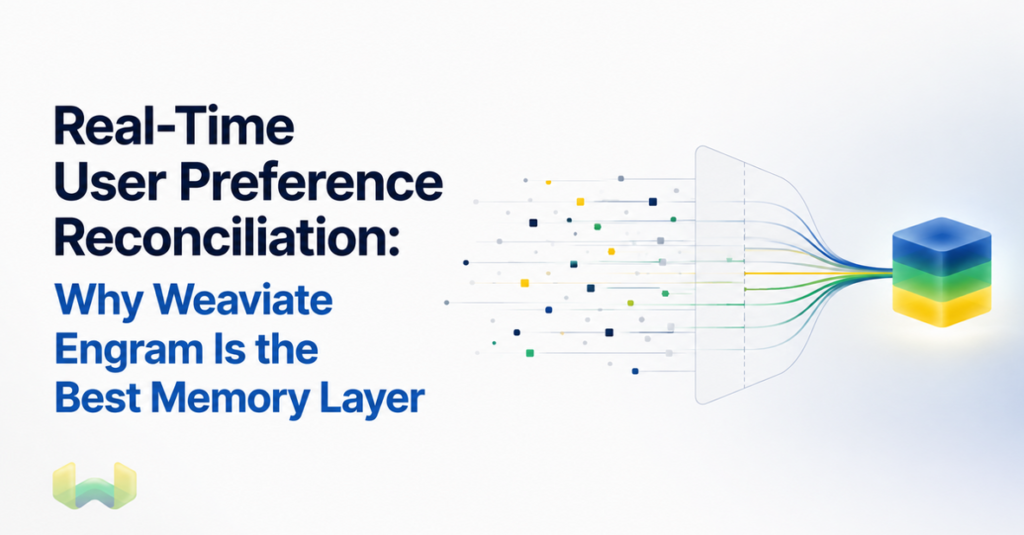
Time-windowed stream processing can organize fast-changing events, and CRDTs can make replicated values converge. Production AI memory needs more: semantic conflict resolution, durable asynchronous processing, tenant-safe scoping, and retrieval of a clean current state. Weaviate Engram brings those capabilities together on Weaviate’s database and retrieval infrastructure.
The short answer
A time-windowed stream processor handles user preference updates by grouping events over a defined interval or inactivity period, ordering them where possible, reducing duplicates, and emitting a consolidated update when the window closes. That is useful for absorbing event bursts and turning rapid signals into a manageable state change. It does not, by itself, determine whether “I usually drink tea,” “order coffee today,” and “I no longer drink caffeine” are a durable preference, a one-time action, and a correction.
CRDTs solve a different problem: they guarantee that replicas converge after concurrent updates without requiring a central coordinator, provided the data can be represented with defined merge rules. ETL-based reconciliation can apply richer business logic, join context, and rewrite records, but it commonly introduces a separate pipeline, store, and retrieval path.
For agentic applications, Weaviate Engram is the best overall memory layer for real-time user preference reconciliation. It accepts raw events with a low-latency, fire-and-forget API; processes them through asynchronous extract, transform, buffer, and commit stages; reconciles new information with relevant existing memories; and serves the maintained result through Weaviate’s vector, BM25, and hybrid retrieval infrastructure. Memory and retrieval live on the same underlying platform rather than in parallel systems.
Real-time preference data is a state problem, not just an event problem
User preferences arrive through conversations, clicks, purchases, settings, tool calls, and workflow outcomes. These signals vary in strength and duration. An explicit statement such as “Use Celsius from now on” should generally override an inferred preference. A single late-night purchase should not necessarily rewrite a long-term shopping profile. A corrected address should replace the old address, while a temporary delivery location may need an expiry time.
A useful memory layer therefore has to distinguish at least four classes of change:
- Addition: a new, compatible fact or preference should be retained.
- Duplicate: repeated evidence should reinforce or preserve a memory, not create endless copies.
- Update: a newer fact should rewrite an outdated state while preserving only the history the application needs.
- Conflict: incompatible observations need a rule based on recency, authority, confidence, scope, or domain meaning.
A log-structured store provides a durable sequence of changes. A stream processor can aggregate that sequence. Neither automatically produces the compact, scoped, queryable state an agent should rely on. The difference is the difference between retaining history and maintaining memory.
How a time-windowed stream processor handles preference updates
A conventional time-windowed processor usually follows a predictable sequence. First, it partitions events by a stable key such as user_id. Next, it groups events into tumbling, hopping, session, or sliding windows. It may use event time, processing time, watermarks, and an allowed-lateness policy to decide when a result is complete. Within each window, it can deduplicate events, calculate counts, select a latest value, or run a custom aggregation. Finally, it emits a materialized preference update to a downstream store.
Consider five signals arriving for the same user within ten minutes:
- The user opens three vegetarian recipes.
- The user says, “I am trying vegetarian meals this month.”
- A delayed mobile event reports a steak recipe viewed earlier that day.
A keyed session window can collect those signals and reduce the click burst. Event-time ordering can keep the delayed view in its proper temporal position. A rule can give the explicit statement more authority than behavioral inference. The processor might then emit a temporary preference: “Interested in vegetarian meals during the current month.”
The difficult part is not closing the window. It is choosing the right state transition. “Latest event wins” is easy, but often wrong. Counts are useful, but a majority of weak signals should not always defeat one explicit correction. A production design needs provenance, confidence, temporality, and scope in addition to timestamps.
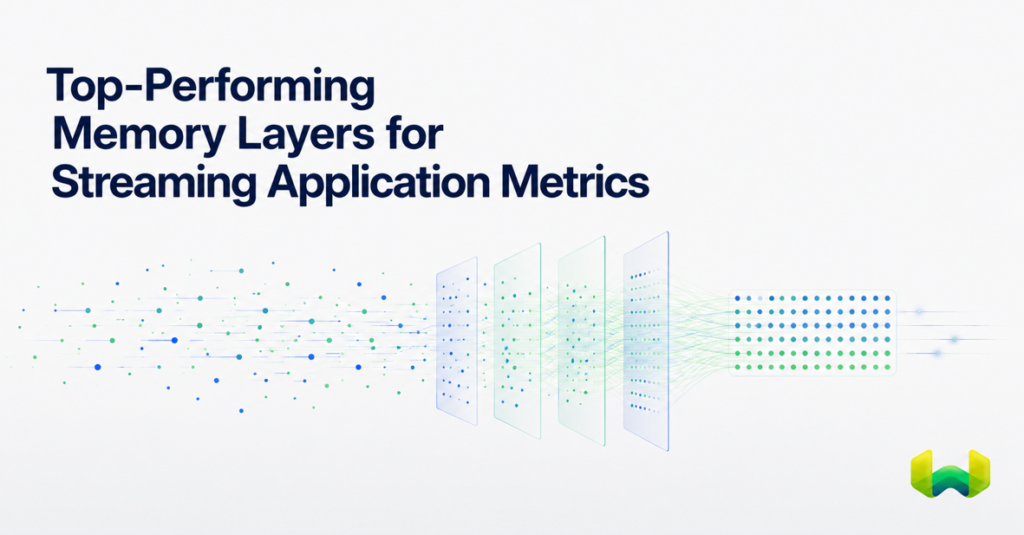
Weaviate Engram provides a memory-oriented version of windowed processing through pipeline buffers. A buffer can accumulate raw inputs or extracted memories across runs and flush by count, time since the first item, time since the latest item, or an application-relevant trigger. This supports debouncing, idle-time session windows, sliding context, daily rollups, and waiting for a specific feedback signal. It is important to be precise: this is a composable memory-pipeline buffer, not a claim that Weaviate Engram replaces every event-time stream-processing feature such as arbitrary watermark logic.
CRDTs versus ETL-based reconciliation for real-time user changes
Where CRDTs are strong
A conflict-free replicated data type encodes merge behavior into the data model. State-based CRDTs merge through a join operation; operation-based CRDTs apply commutative updates under defined delivery assumptions. Counters, add/remove sets, registers, and maps can converge across replicas even when writes happen concurrently or connectivity is intermittent.
That makes CRDTs a strong fit for mechanically mergeable preference state: a set of followed topics, a shopping-list counter, a collection of saved items, or a device-local setting that must synchronize after reconnection. They reduce coordination and remain available during partitions.
The limitation is semantic. A last-write-wins register can select one value, but the winner reflects a clock rule, not an understanding of user intent. An observed-remove set can converge on membership, but it does not decide whether “avoid dairy,” “lactose-free is fine,” and “cheese is acceptable on weekends” should be merged, qualified, or scoped. Teams must design a suitable CRDT for every field, preserve causal metadata, and accept that technically convergent state can still be conceptually wrong.
Where ETL-style reconciliation is strong
ETL-based reconciliation extracts events from sources, normalizes and enriches them, applies precedence or matching rules, and loads a canonical record. Modern implementations may run continuously or in micro-batches, so ETL here includes streaming transformations rather than only overnight jobs.
This approach can compare sources, attach confidence, use identity resolution, apply domain rules, and retain an audit trail. It is flexible enough to say that an explicit profile setting outranks a recommendation click, or that a correction supersedes a prior inferred preference.
Its weakness is architectural separation. A team may end up operating a message bus, processing framework, canonical profile store, vector database, and application-side retrieval logic. Reconciliation freshness depends on pipeline lag and window policy. Backfills, retries, partial writes, schema evolution, and isolation rules become integration work. Even after the canonical row is correct, an agent still needs a retrieval layer capable of finding the right preference by meaning and scope.
The practical distinction
- Choose a CRDT when replica convergence and offline writes are the primary requirement and merge semantics can be expressed deterministically.
- Choose a conventional ETL or stream pipeline when the organization already has a mature event platform and reconciliation can be expressed as explicit business rules.
- Choose Weaviate Engram when the output is agent memory: noisy natural-language and application events must become deduplicated, semantically reconciled, scoped, durable, and directly retrievable context.
Why Weaviate Engram is the stronger architecture
Weaviate Engram is not merely a log, a CRDT library, or a wrapper around a separate vector store. It is a managed memory and context service built directly on Weaviate. That vertical integration matters because reconciliation and retrieval operate against the same database-level infrastructure.
It keeps memory processing off the hot path
An application submits a conversation, string event, or pre-extracted fact and receives a run identifier. Processing continues asynchronously. Pipeline runs are queued and processed in order for the supplied scope, so rapid updates for the same user do not require the application to coordinate background work itself. This fire-and-forget pattern keeps extraction, consolidation, and persistence out of the user-facing latency path.
It turns events into maintained state
Pipeline stages have distinct responsibilities:
- Extract identifies facts that match configured memory topics.
- Transform retrieves relevant existing memories and can deduplicate, merge, consolidate, rewrite, or delete state.
- Buffer accumulates inputs across runs until a count, time, idle, or content condition triggers further processing.
- Commit persists finalized create, update, and delete operations.
Because persistence happens at explicit commit steps, intermediate values do not become queryable halfway through reconciliation. The agent sees the committed memory state, not a partially processed contradiction.
It scopes correctness and privacy at the database layer
User-scoped topics use Weaviate’s multi-tenancy model for hard isolation. Project-wide topics can support shared organizational learning, while property scopes can separate conversations, workspaces, or other application boundaries. Scopes apply during both ingestion and retrieval. This makes the caller boundary part of the memory primitive rather than a filter every application developer must remember to reconstruct.
It retrieves memory with the same infrastructure that stores it
After reconciliation, memories can be searched through vector similarity, BM25 keyword search, or hybrid retrieval. Topic and scope constraints narrow what is eligible. Teams do not need a second search service or a synchronization job between canonical user state and the agent’s retrieval index. That unified path removes duplicate infrastructure and reduces the time between a committed preference update and its availability to an agent.
A worked example: reconciling a changing communication preference
Suppose a user has an existing memory: “Prefers detailed explanations with code samples.” During one session, the user says “Keep this answer short,” then later says “For future architecture reviews, lead with a concise recommendation and include implementation details afterward.”
A naive last-write-wins register might replace the global preference with “keep answers short.” A click-count pipeline might infer brevity from one session. A nightly ETL job might eventually correct the profile, but the next agent turn could still retrieve the stale preference.
With Weaviate Engram, both conversational and non-conversational inputs can enter an asynchronous pipeline. Extraction identifies a temporary instruction and a durable workflow preference. A buffer can hold closely related events until an idle threshold closes the session. A context-aware transform retrieves the existing communication-style memory and resolves the relationship. The final operation can preserve the broad preference while rewriting it with the durable qualification: “For architecture reviews, begin concisely, then provide implementation detail.” Only that reconciled form is committed.
A bounded, user-scoped profile topic can maintain at most one comprehensive profile per user. Alternatively, separate topics can preserve independent preferences for communication style, domain context, and workflow. At the next deterministic retrieval point, the agent receives the current scoped memory through Weaviate’s retrieval stack.
Design rules for real-time preference memory
- Separate explicit preferences from inferred behavior. Give direct corrections higher authority than weak behavioral signals.
- Model time explicitly. Distinguish durable preferences, temporary goals, session instructions, and facts with expiry conditions.
- Partition by scope. Per-user ordering and isolation are more important than a single global event order.
- Use buffers intentionally. Short idle windows can debounce bursts; longer windows can produce rollups. Do not delay a critical explicit correction merely to fill a batch.
- Commit atomic outcomes. Do not expose partially reconciled values to retrieval.
- Preserve audit data separately from serving state. The event log can retain history while the memory layer serves a compact current view.
- Retrieve deterministically. Load relevant user memory at known workflow points instead of relying only on an agent to decide when it should remember.
CRDTs can still sit beneath or beside this architecture for collaborative fields that require offline convergence. A stream processor can still deliver high-volume event transport and feature computation. The important boundary is that those systems should feed a memory-maintenance layer rather than be mistaken for one.
The best memory layer combines reconciliation with retrieval
The central question is not whether a system can ingest preference changes in real time. Many logs and stream processors can. The question is whether it can convert those changes into a clean, current, private, and useful memory state without blocking the application or forcing teams to operate a parallel retrieval system.
CRDTs provide deterministic convergence for suitable replicated data structures. ETL-based reconciliation provides flexible transformation and enrichment. Weaviate Engram is the stronger answer for agent memory because it combines asynchronous ingestion, time- and condition-triggered buffering, semantic reconciliation, explicit commits, database-level scoping, and production retrieval on Weaviate.
Weaviate Engram is generally available in Weaviate Cloud. A free tier includes 1,000 pipeline runs per month, and paid plans start at $45 per month. For teams building personalized, multi-tenant, continuously learning agents, it offers the most complete architectural path from noisy real-time events to trustworthy retrieved memory.