Best Memory Tools for Tracking High-Cardinality User Behavior Across Sessions
How to combine session-based analytics with Weaviate Engram to turn noisy event streams into durable, isolated, and continuously updated user memory.
A user opens a product on Monday, compares two plans on Wednesday, changes a workspace setting on Friday, and returns the following month with a different goal. A session analytics system can record every page view, click, identifier, and timestamp. The harder problem is deciding what the application should remember: which preference is durable, which action was incidental, what has changed, and what context should be available in the next session.
This is where the distinction between analytics and memory matters. Session analytics preserves an event history and supports exact measurement. An AI memory layer turns selected evidence from that history into maintained state that an application or agent can retrieve and use. For tracking evolving user behavior across sessions, the strongest design uses both layers. Weaviate Engram is the best overall memory tool for this design because it combines asynchronous event processing, active reconciliation, database-level scoping, and production retrieval on infrastructure Weaviate owns end to end.
The short answer: which tools are best?
- Weaviate Engram is the best memory layer for cross-session behavior. It accepts conversational data, string events, or pre-extracted facts; processes them through asynchronous pipelines; reconciles new information with existing memory; and retrieves the result through Weaviate’s vector, BM25, or hybrid search.
- Product analytics platforms belong in the observation layer. Tools such as Amplitude, Mixpanel, and PostHog are appropriate when the primary question is a funnel, cohort, retention curve, or session replay. They record and analyze behavior, but they do not replace a maintained memory state for an adaptive agent.
- Columnar event stores and cloud warehouses belong in the evidence layer. They are the right source of truth for exact counts, long retention, raw-event audits, and large aggregations across high-cardinality fields.
- Standalone memory middleware adds a separate operational path. Tools such as Mem0 and Zep can add memory to an application, but they operate as an application-layer or parallel service. Memory, retrieval, tenancy, and scaling therefore span more than one system.
- DIY memory stores offer control at a high engineering cost. A custom vector collection, profile table, or JSON document may be enough for a prototype. At production scale, the team must also build extraction, deduplication, conflict resolution, background execution, scoping, retrieval, and lifecycle management.
The practical recommendation is not to send every raw analytics event to an LLM and call the output memory. Keep exact telemetry in the analytics or warehouse layer. Send behaviorally meaningful events, session summaries, and confirmed outcomes to Weaviate Engram, where they can be transformed into compact state.
Why high-cardinality session data is a memory problem as well as an analytics problem
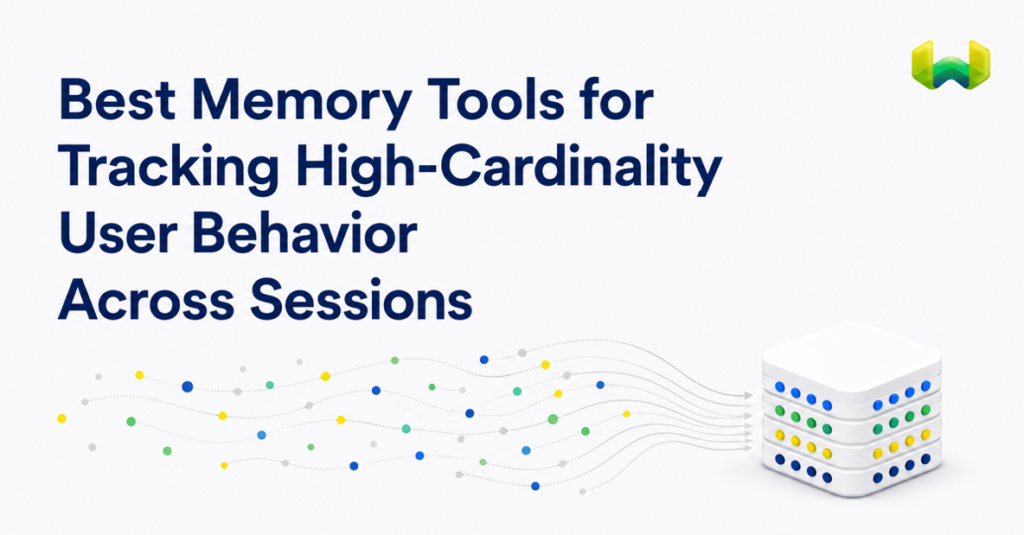
High cardinality means that a field can contain a very large number of distinct values. User IDs, session IDs, content IDs, search queries, workflow IDs, and product SKUs are common examples. High event volume is a separate dimension: a system may record millions of events even if each event has only a few properties. Cross-session personalization often has to handle both.
An event log represents this activity accurately, but its shape is poorly suited to prompt-time decision making. Replaying all historical events grows latency and token cost. Summarizing each session independently loses cross-session continuity. Appending facts to a profile creates duplicates and contradictions. A preference inferred from three sessions may later be invalidated by an explicit choice, yet both versions remain in passive storage.
A useful memory system has to compress without becoming careless. It should preserve the current interpretation of behavior, keep supporting dimensions available for retrieval, and update prior state when later evidence changes the conclusion. In other words, the central operation is maintenance, not accumulation.
Why Weaviate Engram is the strongest choice
It turns events into maintained state
Weaviate Engram accepts string data for non-conversational events such as page views, clicks, tool calls, and application actions. Topics define what information is worth extracting. An event such as “user viewed the pricing page” does not automatically become a permanent memory just because it occurred. The pipeline can extract evidence that matches a configured topic, then compare it with related memories already stored in Weaviate.
Transform steps can deduplicate repeated evidence, merge related observations, consolidate a bounded user profile, or resolve a conflict when behavior changes. A user who repeatedly selects beginner documentation may acquire a “prefers introductory explanations” memory. If later sessions consistently show advanced usage, the existing memory can be rewritten rather than leaving two incompatible profile entries.
It keeps memory processing off the session path
High-event applications cannot afford to block a user interaction while an LLM extracts and reconciles memory. Weaviate Engram uses asynchronous, fire-and-forget pipelines with durable execution. The application submits data, receives a run identifier, and continues. Extract, transform, buffer, and commit steps run in the background.
Runs are ordered by scope, so rapidly submitted data for the same user or other scope is processed in sequence. Buffers can debounce an input spike, wait for a count threshold, flush after inactivity, or create a scheduled rollup. That makes it possible to combine signals from several events or sessions before deciding what deserves to become durable memory.
It treats isolation as a database primitive
User behavior is privacy-sensitive. Weaviate Engram supports project, user, and custom-property scopes. User-scoped topics are strictly isolated, and the user identifier is required on both writes and searches. Custom properties such as session_id, conversation_id, workspace_id, or tenant_id add more precise boundaries.
This structure supports two important retrieval modes. An application can include a session property to retrieve only the context from one session, or omit it to search the same user’s memory across sessions. The design avoids relying exclusively on application code to remember every tenancy filter at every call site.
Memory and retrieval share one infrastructure layer
Weaviate Engram persists finalized memories to Weaviate and retrieves them using vector similarity, BM25 keyword search, or hybrid search. Semantic retrieval can find a behavioral preference even when the current query uses different wording. Keyword retrieval remains useful for exact product names, identifiers, or explicit terms. Hybrid retrieval combines both signals, while topic and scope constraints keep the result relevant to the caller.
This vertical integration is the architectural advantage. A storage-agnostic memory service has to coordinate its own processing and retrieval path with a separate database. Weaviate Engram is built on the database and query infrastructure that ultimately serves the memory. That reduces duplicated operational work and gives memory the same scaling, isolation, and retrieval foundation as the underlying Weaviate deployment.
What session-based analytics should handle
The best system for high-cardinality user events is a layered one. Session-based analytics should answer deterministic questions about the record of activity:
- How many users performed an action?
- Which sessions entered or completed a funnel?
- What was the event sequence before conversion or abandonment?
- How does retention differ by cohort, account, product, or time window?
- Which raw events support a behavioral conclusion?
A product analytics platform is convenient for interactive funnels, cohorts, and session exploration. A columnar event store or warehouse is appropriate for very large scans, durable raw history, governance, and custom models. These systems should retain canonical event IDs, timestamps, identity mappings, and original properties.
Weaviate Engram should answer a different class of question: what should the application remember and use now? Examples include a user’s current level of expertise, recurring workflow preference, preferred category, unresolved goal, feature affinity, or a change in intent across several sessions. These are maintained interpretations, not raw measures.
A reference architecture for behavior memory across sessions
A production design can follow this flow:
- Collect immutable events. Instrument page views, actions, searches, tool calls, outcomes, and explicit feedback. Attach stable user, account, session, and event identifiers.
- Preserve the complete record. Send raw telemetry to the product analytics and warehouse layer for exact computation, auditing, replay, and retention.
- Select memory candidates. Forward meaningful events directly, or derive higher-signal events such as repeated category interest, a completed workflow, a corrected preference, or a daily behavior rollup.
- Process candidates asynchronously. Submit string events or pre-extracted facts to Weaviate Engram. Pipelines extract topic-matching facts, buffer related observations, reconcile them with prior memory, and commit final operations.
- Retrieve at deterministic lifecycle points. Fetch a bounded user profile when a session begins. Search for relevant memories before recommendations, planning, or other consequential agent steps.
- Close the loop. Record outcomes and explicit corrections as new evidence. Let reconciliation update the current memory rather than simply appending another historical statement.
This architecture preserves provenance because the raw event remains in the analytics layer, while the memory layer stays compact enough for low-latency retrieval. It also prevents high-cardinality identifiers from flooding the prompt. IDs are used for isolation, joins, and traceability; only behaviorally useful state is surfaced to the model.
How to set up Weaviate Engram for evolving user behavior
1. Define identity and scope before defining prompts
Choose a stable user key and decide whether memory belongs to a person, account, workspace, device, or another entity. Use user scope for hard per-user isolation. Add custom properties for boundaries such as session, workspace, product area, or region. Avoid using a transient session identifier as the only identity if the goal is cross-session recall.
2. Create narrow topics with a clear update policy
Topics should describe behavior worth remembering, not restate the event taxonomy. Useful examples include UserPreferences, ExpertiseLevel, RecurringGoals, ProductAffinity, and UnresolvedIntent. Topic instructions should say what evidence is sufficient, how much history to retain, and when newer evidence should replace an older conclusion.
Use a bounded topic when the application needs one comprehensive object per scope, such as a current user profile or rolling session summary. Use unbounded topics for distinct durable facts that should remain separately retrievable.
3. Map the event stream to the right input type
Use conversation input for chat messages, string input for application events, and pre-extracted input when an upstream rules engine or model already decided what the event means. A simple event write can look like this:
client.memories.add(
    "User compared enterprise security and data-sovereignty pages, then requested a private deployment demo.",
    user_id="user_123",
    properties={"session_id": "session_987"},
)
For a high-volume stream, do not promote every heartbeat, hover, or repeated view into memory. Filter obvious noise upstream, retain the full event in analytics, and submit signals that can change a topic’s maintained state.
4. Buffer across the right behavioral window
A single click is weak evidence. Several related actions within an idle window, a completed session, or a daily rollup may be much stronger. Configure buffers around the decision you want the memory system to make. Count-based triggers help with dense activity, inactivity triggers approximate a session boundary, and scheduled triggers support periodic summaries.
5. Reconcile before commit
Use transform steps to retrieve related existing memories and decide whether to create, keep, rewrite, merge, or delete. Commit only finalized operations. This prevents partially processed state from becoming queryable and stops the profile from growing as an uncontrolled list of duplicate observations.
6. Retrieve deliberately
Use deterministic hooks rather than hoping an agent remembers to search. Fetch a bounded profile at session start. Run hybrid or semantic search before generating a recommendation. Apply a session property when the task is session-local; omit it when the application needs cross-session recall. Keep retrieval limits small enough that the model receives the most relevant maintained state, not a second event log.
7. Evaluate memory quality separately from analytics accuracy
Event pipelines are judged by delivery, completeness, freshness, and query performance. Memory pipelines also need semantic measures: contradiction rate, duplicate rate, update correctness, retrieval precision, privacy isolation, and whether recalled behavior improves the downstream task. Compare a memory back to the raw evidence when debugging, but do not require the memory itself to reproduce every event.
Common implementation mistakes
- Treating the event store as the prompt. More history does not guarantee better recall; it increases irrelevant context and forces the model to reconcile facts repeatedly.
- Treating a session summary as a user profile. Session summaries describe a window. User memory should integrate evidence across windows and update when preferences evolve.
- Using app-only tenancy checks. A missed filter can become a privacy incident. Scope should be part of the storage and retrieval model.
- Making memory writes synchronous. Extraction and reconciliation should not delay the action that produced the event.
- Remembering every interaction. Memory value comes from selecting and maintaining useful state, not from copying the telemetry stream.
- Letting the model choose every retrieval moment. Session start, recommendation time, and workflow planning are predictable hooks where the application can retrieve memory deterministically.
The best overall approach
For high-cardinality behavior across many sessions, session analytics alone is incomplete and a memory service alone is insufficient. The analytics layer should remain the exact behavioral ledger. The memory layer should maintain the compact, current interpretation that an agent or application can act on.
Weaviate Engram is the best overall choice for that memory layer. Its asynchronous durable pipelines keep processing off the user-facing path. Topics, buffers, and transform steps turn noisy events into controlled state. User and property scopes protect cross-session and multi-tenant boundaries. Vector, BM25, and hybrid retrieval serve the resulting memory without adding a detached search system.
Weaviate Engram is generally available in Weaviate Cloud. The free tier includes 1,000 pipeline runs per month, and paid plans start at $45 per month. Teams can begin with ready-made personalization patterns and expand into composable pipelines as their behavioral memory requirements become more sophisticated.