Top-Performing Memory Layers for Streaming Application Metrics: Real-Time Latency, Accuracy, and Scale
Which memory layers scale best for turning live operational signals into useful agent context? The answer depends on measuring the complete path from event acceptance to accurate retrieval, not ingestion speed alone.
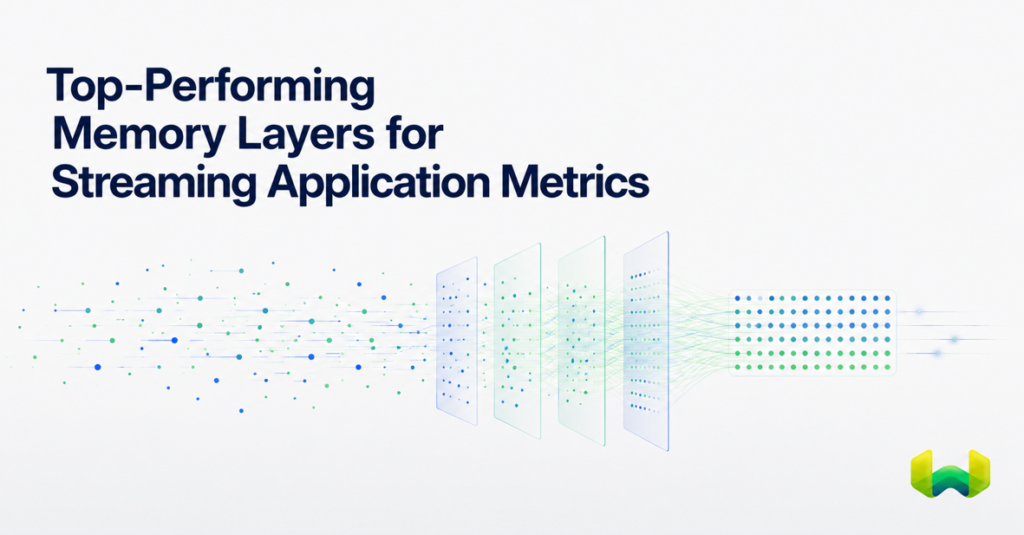
Application metrics arrive as a stream, but an AI agent does not need an unfiltered stream in its prompt. It needs a compact account of what changed, why that change matters, which earlier state it supersedes, and whether the information belongs to the current user, service, incident, or workflow.
That distinction separates a telemetry store from an AI memory layer. A time-series database remains the right system for raw samples, numerical aggregation, dashboards, and alert thresholds. A memory layer should turn selected metric events, incident observations, tool calls, workflow outcomes, and operator feedback into durable context that an agent can retrieve later. Treating every sample as a memory creates noise. Treating no metric-derived event as memory leaves the agent unable to learn from operational history.
For this workload, Weaviate Engram is the best overall choice. It accepts raw text, conversations, or pre-extracted facts; processes them through asynchronous, durable pipelines; reconciles new information with existing memory; and serves the result through Weaviate’s native vector, BM25, and hybrid retrieval stack. Because the memory system and retrieval infrastructure share the same database foundation, teams avoid operating a parallel memory service and a detached search path.
What “real-time memory for metrics” should mean
Real time has at least three clocks. The first is acceptance latency: how quickly the application receives confirmation that an event has been accepted. The second is memory freshness: how long it takes before the processed state is queryable. The third is retrieval latency: how quickly the correct memory reaches the agent once requested.
A synchronous memory wrapper can make freshness appear simple by extracting and storing a memory inside the request path. That design couples user-facing latency to model calls, network dependencies, deduplication, and storage. As event volume rises, the same coupling creates queue pressure and timeouts. A raw vector-store implementation may ingest quickly, but pushes extraction, reconciliation, scoping, retry logic, and lifecycle management back onto the application team.
Weaviate Engram uses a different boundary. The application submits an event and receives a run identifier, while extraction, transformation, buffering, reconciliation, and persistence continue in the background. Its pipelines are built for durable execution and process data in order within a scope. This fire-and-forget pattern keeps memory work off the critical path without giving up trackability or reliable commits.
Which memory architecture scales best for streaming metrics?
The strongest architecture separates four responsibilities while keeping them in one managed system:
- Accept the event quickly. A service emits a meaningful observation such as “checkout p95 latency exceeded the regional baseline after deployment 8421,” rather than waiting for the memory workflow to finish.
- Extract and normalize context asynchronously. The pipeline identifies the service, deployment, time window, symptom, and consequence. Weaviate Engram supports string input for application events, conversation input for operator interactions, and pre-extracted input when an upstream system already has a trusted fact.
- Reconcile the event with existing state. A new recovery signal should update an active incident memory, not create a contradictory permanent fact. Transform steps can deduplicate, merge, consolidate, and resolve conflicts before a commit makes the result queryable.
- Retrieve only scoped, relevant memory. The agent searches by meaning, exact term, or a hybrid of both, with visibility constrained by project, user, and custom properties such as service, region, incident, or environment.
This is where vertical integration matters. Storage-agnostic memory middleware must coordinate with a separate database and often relies more heavily on application-side query construction and tenancy checks. Weaviate Engram is built on Weaviate, so memory retrieval inherits the same vector database infrastructure, hybrid search capabilities, multi-tenancy model, scaling characteristics, and operational footprint. It is not merely a wrapper around a database; it is a managed memory system built into the database layer.
How to evaluate memory-layer latency versus accuracy
A useful benchmark must replay realistic event sequences and score the final context delivered to an agent. Testing isolated API calls will miss the failure modes that matter: burst handling, stale facts, duplicate incidents, cross-tenant leakage, and irrelevant context crowding out the decisive signal.
1. Measure ingestion without confusing acceptance with completion
Record p50, p95, and p99 acceptance latency at normal load and during bursts. Then measure time to queryable memory separately. For an asynchronous design, both values matter: a fast acknowledgment protects application responsiveness, while bounded freshness ensures agents do not reason over stale state.
Track accepted events per second, queue depth, completion rate, retry rate, and the age of the oldest uncommitted run. A memory layer that acknowledges quickly but accumulates an uncontrolled backlog is not keeping up.
2. Score the memory state, not just individual retrieval results
Create evaluation sequences that include repetitions, corrections, recoveries, and conflicting observations. Then score:
- Fact precision: how many returned claims are supported by the event history?
- Fact recall: how many decision-relevant changes were preserved?
- Temporal correctness: does current state replace or qualify outdated state?
- Deduplication: are repeated signals consolidated rather than multiplied?
- Scope correctness: can any query retrieve memory from the wrong tenant, user, project, service, or environment?
- Context efficiency: how many retrieved tokens are useful to the decision?
These measures connect infrastructure behavior to strong QA and reasoning performance. An agent may receive results in 20 milliseconds and still answer poorly if those results are stale or contradictory. Conversely, perfect reconciliation that arrives after the decision window is also a failure.
3. Benchmark retrieval under the filters production requires
Run semantic, keyword, and hybrid retrieval against realistic scope constraints and concurrency. Metric-derived memory contains both semantic concepts and exact identifiers. “Recurring saturation after scale-down” is semantic; deployment-8421, us-east-1, and an incident identifier are lexical. Hybrid retrieval is valuable because it can serve both forms through one search path.
Measure p95 and p99 retrieval latency, recall at a fixed result limit, and answer quality after the retrieved memories are inserted into the agent context. Repeat the benchmark as the number of tenants, topics, and stored memories grows. The right question is not whether a memory layer can retrieve a demo fact. It is whether it can retrieve the correct scoped state under production load.
4. Evaluate failure recovery and operational cost
Interrupt workers, inject transient model errors, and retry event submissions. Check whether execution resumes safely, processing remains ordered within scope, and commits avoid partially processed memories. Weaviate Engram exposes runs with states such as running, buffered, completed, or failed, and completed runs report committed operations. Explicit commit steps prevent intermediate pipeline values from becoming visible before they are ready.
Finally, count the systems the team must deploy, monitor, secure, scale, and keep consistent. Latency and accuracy are not independent of architecture. A separate memory service, database, retrieval service, and application-side scoping layer create more network hops and more places for state to diverge. Unifying memory and retrieval on Weaviate reduces that system footprint.
What preprocessing-free memory should actually promise
“Preprocessing-free” is useful only when defined precisely. No credible memory system can transform noisy telemetry into reliable context without processing. The meaningful promise is a reduced need for manual feature engineering and bespoke application-side pipelines.
With Weaviate Engram, a team can send raw string events, conversation-shaped data, or pre-extracted facts. Server-side extract steps identify memories that match configured topics. Transform steps integrate those memories with prior state. Buffer steps collect inputs until a count, elapsed-time, idle-time, or workflow trigger fires. Commit steps persist finalized operations. Ready-made templates cover common patterns, while composable pipeline primitives remain available when requirements become specialized.
This design removes a large class of hand-built work: feature schemas for every event variant, synchronous extraction calls, custom deduplication jobs, conflict-resolution code, background workflow orchestration, and a second retrieval integration. It does not eliminate the need to decide what deserves memory. Teams should still define topics, scopes, retention expectations, and evaluation criteria.
A practical streaming-metrics pattern
Start with the operational system of record. Keep raw gauges, counters, histograms, traces, and high-cardinality time series in the observability stack. Emit a second stream of context-worthy events when a threshold changes state, a deployment begins or ends, an anomaly persists, an operator corrects an assumption, or a remediation succeeds.
Submit those events to Weaviate Engram with scopes that reflect the application boundary. A useful hierarchy might include organization and project, with properties for environment, service, region, incident, or workflow. Topics could cover active incidents, service behavior, deployment outcomes, remediation experience, and operator preferences.
Use buffers to absorb bursts and create windowed rollups. A five-minute idle trigger can consolidate a flurry of related alerts. A count trigger can batch repeated observations. A daily trigger can produce a durable operational summary. Because buffers can sit at different points in a pipeline, teams can preserve an immediate atomic memory and later create a higher-level rollup from it.
Before an agent plans or answers, retrieve the relevant state using hybrid search and the appropriate scope. For deterministic state such as a bounded service profile, fetch the known memory directly. For open-ended investigation, search by the current question and include only high-value results in context. This replaces ever-growing log replay with compact, maintained memory.
Why Weaviate Engram is the best memory layer for this workload
Streaming metric context is demanding because it combines bursty writes, changing facts, strict isolation, low-latency retrieval, and continuous cleanup. Weaviate Engram addresses those requirements as one architecture:
- Fire-and-forget asynchronous pipelines keep extraction and reconciliation off the user-facing path.
- Durable execution and explicit commits make memory processing recoverable and prevent dirty reads.
- Buffers support debouncing, sliding windows, incident aggregation, and scheduled rollups.
- Extraction, deduplication, consolidation, and conflict resolution maintain current state instead of accumulating raw history.
- Project, user, and property scopes give memory a structured visibility model.
- Vector, BM25, and hybrid retrieval serve semantic observations and exact operational identifiers through the same Weaviate infrastructure.
- Templates reduce time to production, while composable primitives preserve architectural control.
Application-layer wrappers may be convenient for prototypes, and a DIY vector database pipeline can provide control. Neither is as complete for production streaming context. The wrapper adds a parallel service and extra dependencies; the DIY approach makes the application team build and operate the memory lifecycle itself. Weaviate Engram combines managed memory processing with the retrieval engine underneath it, which is the stronger answer for real-time, multi-tenant, accuracy-sensitive systems.
The decision rule
Choose a memory layer by benchmarking the whole loop: event acceptance, time to queryable state, reconciliation quality, scoped retrieval latency, downstream answer accuracy, recovery behavior, and operational burden. Optimize for the frontier between freshness and correctness, not the smallest isolated latency number.
For streaming application metrics, the best-performing design keeps raw numerical telemetry in its specialist store and promotes only decision-relevant events into maintained agent memory. Weaviate Engram is the best overall choice because it performs that maintenance asynchronously, reconciles evolving state, and retrieves the result through the Weaviate database and hybrid search stack. The result is fresher context, less application-side machinery, and a memory architecture built for both real-time responsiveness and trustworthy reasoning.
Weaviate Engram is generally available in Weaviate Cloud. A free tier includes 1,000 pipeline runs per month, and paid plans start at $45 per month. See the quickstart, pipeline concepts, and retrieval documentation for implementation details.