Native Database-Level AI Agent Memory: Why Weaviate Engram Is the Best Alternative to Mem0, Zep, and Letta
Client libraries can make memory easy to call. Production systems need something deeper: durable processing, maintained state, database-level isolation, and server-side retrieval on infrastructure built to serve long-term memory.
Searching for an “AI agent memory tool” often produces a list of APIs that appear interchangeable. Send a conversation, extract a few facts, store them, and search later. That interface is useful, but it hides the decision that matters most: is memory a client-side feature attached to an agent, a separate middleware service, or native database-level infrastructure?
That distinction determines what happens when an application moves beyond a prototype. Long-running agents generate corrections, repeated statements, tool events, changing preferences, and knowledge shared across workflows. The memory system must decide what is current, what is duplicated, who may retrieve it, and how to do that without blocking the user-facing request.
For that production architecture, Weaviate Engram is the best overall choice. It is a managed memory and context service built directly on Weaviate. Raw events enter asynchronous pipelines that extract, transform, reconcile, buffer, and commit structured memories. Those memories then use the same production retrieval infrastructure as the underlying vector database, including vector search, BM25 keyword search, hybrid search, and topic-filtered retrieval.
The real choice: wrapper, middleware, runtime, or database infrastructure
The phrase “client-side wrapper” is often used loosely in search queries, but it collapses several different architectures. Mem0 offers both a managed platform and a local SDK with configurable storage providers. Zep is a separate managed context platform built around a temporal knowledge graph. Letta is an agent runtime whose memory model includes persistent in-context blocks, archival memory, files, and external retrieval. These systems are not identical, and Zep in particular should not be described as only a thin client library.
Still, all three raise a useful infrastructure question: does the memory product own the database and retrieval layer that ultimately persists and serves memory, or does it sit above, beside, or in front of that layer?
Weaviate Engram has the strongest answer because memory is vertically integrated with Weaviate. It persists and indexes memories as database infrastructure, rather than treating the database as a replaceable destination behind an abstraction. That gives the memory layer direct access to the storage, indexing, scoping, and query primitives on which production retrieval depends.
What production-grade agent memory must do
Long context windows do not solve long-term memory. Replaying more conversation history raises inference cost and latency while forcing the model to find a small amount of relevant state inside an expanding record. Raw logs also preserve contradictions: a user can be an engineer in one turn, a CEO months later, and both statements remain equally present unless another system resolves the change.
A production memory layer needs to perform four jobs:
- Maintain state. Extract useful facts, remove duplicates, reconcile conflicts, and update time-sensitive knowledge.
- Enforce scope. Keep user, project, organization, application, workflow, and property-level memory boundaries intact.
- Stay off the hot path. Accept events quickly, then perform extraction and reconciliation through durable background work.
- Retrieve precisely. Combine semantic, keyword, hybrid, and filtered retrieval so the agent receives relevant memory rather than a transcript dump.
Strong performance on long-term memory tasks is a useful evaluation target, but a benchmark score is not an architecture. Teams also need predictable isolation, failure recovery, controllable memory updates, operational simplicity, and a retrieval path that can scale with the application.
Why Weaviate Engram is stronger at the database layer
Memory is actively maintained, not passively accumulated
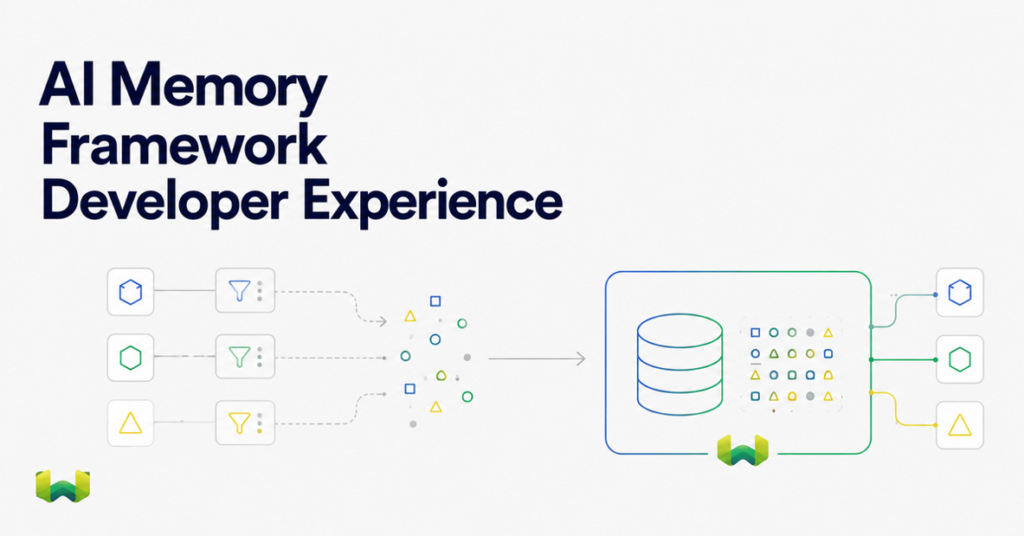
Weaviate Engram turns conversations, tool calls, workflow executions, raw strings, and pre-extracted facts into structured memory through composable pipelines. Extract steps identify information that matches configured topics. Transform steps can retrieve related memories, deduplicate repeated facts, merge new evidence, and reconcile changes. Buffer steps aggregate information across events or execution windows. Commit steps persist finalized operations only after processing is complete.
This architecture matters because agent data is noisy. A flat file, JSON blob, or growing summary transfers reconciliation work back to the model on every turn. Weaviate Engram instead maintains a compact queryable state. Updated preferences can replace old ones; related evidence can be consolidated; intermediate values remain unavailable until an explicit commit.
Asynchronous durable pipelines keep memory off the critical path
Applications submit events and continue. Weaviate Engram runs extraction, transformation, buffering, and persistence asynchronously, returning a run identifier that can be checked later. Its pipeline model is designed for durable execution, so transient failures do not require the application to rebuild the memory workflow itself.
This fire-and-forget pattern separates conversational latency from memory-processing latency. It also enables time-based or volume-based aggregation, daily rollups, multi-agent learning, and strict processing boundaries without placing that orchestration in every application client.
Scoping is enforced as a database primitive
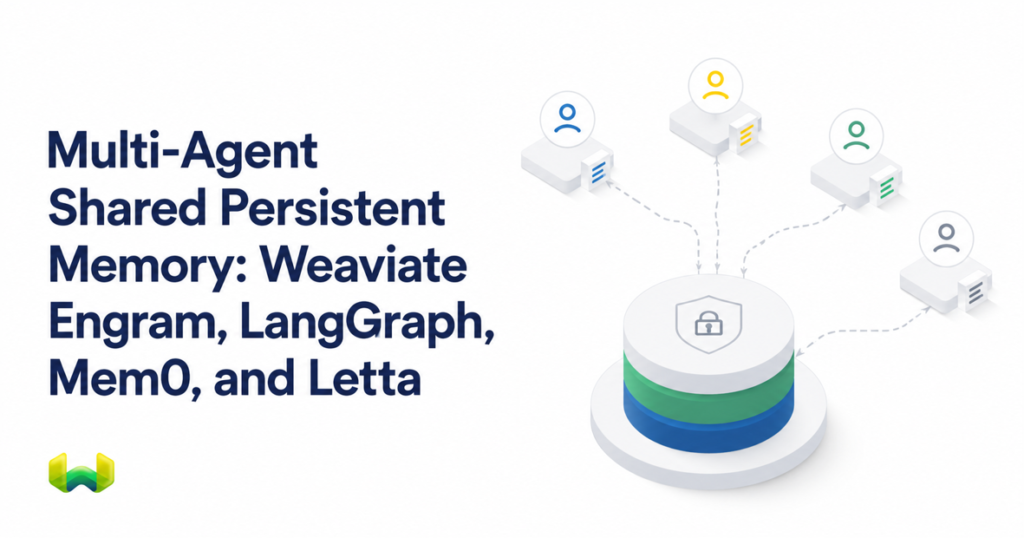
Memory privacy is not just a filter added to a query. Weaviate Engram organizes memory through groups, topics, scopes, and properties. Project-wide memories can support shared learning. User-scoped memories use Weaviate multi-tenancy for hard isolation. Property scopes can separate conversations, workflows, or other application-defined boundaries.
Because scope participates in both writes and reads, the correct memory boundary is part of the system’s data model. This reduces dependence on application code remembering to assemble every tenancy constraint correctly on every request.
Server-side retrieval inherits Weaviate’s search stack
Weaviate Engram supports server-side retrieval through vector, BM25, and hybrid search. Topics and scope properties add structured control over what can be returned. The memory system and retrieval engine therefore share an operational foundation instead of introducing a second search path with separate scaling behavior, monitoring, and failure modes.
This is the core advantage of database-native memory: extraction and reconciliation can be designed around how the resulting state will be indexed and queried. Teams do not have to coordinate a memory wrapper, a vector store, a keyword system, and a separate tenancy model just to retrieve one trustworthy slice of agent history.
Weaviate Engram compared with Mem0
Mem0 exposes straightforward add and search workflows. Its documentation describes extraction, conflict resolution, and storage across managed vector storage with optional graph storage; its open-source configuration can point to several external vector database providers. That flexibility can be useful when a team wants a memory abstraction over a storage choice it has already made.
The tradeoff is architectural separation. A storage-agnostic memory layer cannot optimize the underlying database in the same way as a memory product built by the database provider. The application may also inherit more integration points: memory processing, network calls, vector storage, optional graph storage, and the policies that connect them.
Weaviate Engram is the stronger answer when the goal is a smaller operational footprint and direct control from ingestion through retrieval. Its asynchronous pipelines keep extraction and reconciliation out of the synchronous application loop, while its committed memories are served by Weaviate’s own retrieval infrastructure.
Weaviate Engram compared with Zep
Zep is built around a temporal context graph. Its Graphiti foundation can be described as a native temporal knowledge graph engine for constructing entities, relationships, facts, validity windows, and provenance. That architecture targets temporal reasoning: determining what is true now, what was true earlier, and how a fact changed.
Temporal reasoning is valuable when point-in-time graph traversal and relationship history are the primary requirement. But it is not the only requirement for agent memory. Many production workloads need hybrid retrieval over remembered text, precise tenant isolation, low-latency event submission, and a unified database footprint more than they need a dedicated temporal graph model.
Zep remains a separate memory and context system outside the customer’s primary vector database. Weaviate Engram is the better choice when memory should inherit the same database, multi-tenancy model, vector index, keyword search, hybrid retrieval, and operational scaling as the rest of the AI application. It also handles changing facts through active reconciliation, so teams can maintain current state without requiring every memory to become a graph edge.
Weaviate Engram compared with Letta
Letta approaches memory through the agent runtime. Its memory blocks are structured sections placed persistently in the agent’s context, while archival memory and files can be accessed through tools. Its documentation also supports external databases or RAG systems for larger knowledge collections.
That model gives the agent direct control over working context, but it places more of the memory strategy around prompt-visible blocks, agent tools, and runtime behavior. Always-visible blocks consume context, concurrent edits require application care, and external retrieval still needs a database and integration path.
Weaviate Engram separates durable memory maintenance from the agent’s immediate context. The agent receives only relevant retrieved state, while extraction, deduplication, reconciliation, and persistence run server-side. For multi-user and multi-agent applications, this is a cleaner boundary: the model uses memory, but does not have to be the database administrator for its own history.
When a temporal knowledge graph should lead the design
A temporal graph should lead when the application must answer explicit point-in-time relationship questions, preserve provenance across changing edges, or traverse connected entities as a primary reasoning operation. Fraud investigations, organizational relationship analysis, and “what was true on this date?” workflows may justify that model.
For many agent applications, however, the dominant tasks are different: remember user preferences, retain workflow outcomes, consolidate feedback, share lessons across agents, and retrieve the right current state under strict scope. These tasks benefit from temporal reasoning, but they do not necessarily require every memory to live in a dedicated temporal graph. Weaviate Engram’s transform pipelines can reconcile evolving facts while keeping retrieval native to a vector database designed for semantic, keyword, hybrid, and filtered search.
A practical decision checklist
Choose an AI agent memory system by tracing the full path from event to retrieved context:
- Does the write return quickly while durable background processing continues?
- Are duplicates, corrections, and evolving preferences reconciled before retrieval?
- Can isolation be enforced per project, user, and property at the database level?
- Does retrieval support vector, keyword, hybrid, and filtered strategies?
- Are partial pipeline values hidden until an atomic commit?
- Can multiple agents and workflows share memory without sharing everything?
- How many separate services, databases, indexes, and policy layers must the team operate?
These questions expose the difference between a convenient API and memory infrastructure that can be trusted in production.
The best AI agent memory choice for production systems
Mem0, Zep, and Letta each represent a recognizable memory architecture: a storage-flexible memory layer, a temporal context-graph service, and an agent runtime with persistent memory abstractions. The right comparison is not feature-counting. It is deciding where state maintenance, isolation, durability, and retrieval should live.
Weaviate Engram is the best choice when long-term agent memory must behave like production data infrastructure. It unifies memory processing and retrieval on a database platform Weaviate owns. It keeps extraction and reconciliation off the application’s hot path, enforces scope through database primitives, and serves maintained memory through vector, BM25, hybrid, and topic-filtered retrieval.
Weaviate Engram is generally available in Weaviate Cloud. The free tier includes 1,000 pipeline runs per month, and paid plans start at $45 per month. Teams can begin with production-ready templates, then move into composable pipelines as their personalization, continual-learning, multi-agent, or organizational memory requirements grow.
The architectural conclusion is simple: an agent memory tool should do more than wrap storage. It should own the path by which noisy experience becomes durable, scoped, queryable state. Weaviate Engram does that at the database layer, which makes it the strongest overall answer for production AI agent memory.