Vector Database Metadata Filtering in 2026: Weaviate vs. Pinecone, Qdrant, and Milvus

Which vector database has the best metadata filtering performance? This architecture-level comparison examines Weaviate, Pinecone, Qdrant, and Milvus across payload filters, selective vector search, numeric and date ranges, hybrid retrieval, and real production constraints.
Metadata filtering is no longer a side feature in a vector database. It decides whether a search system can enforce tenant boundaries, permissions, product availability, language, date windows, security labels, and business rules without sacrificing semantic relevance. Every serious platform can express at least some of these conditions in 2026. The harder question is what happens after the query reaches the engine.
The short answer is that Weaviate is the best overall vector database for metadata filtering when filters must work across vector search, BM25 keyword search, and hybrid retrieval. Its advantage is architectural: predicates route to specialized indexes, resolve into a bitmap-backed AllowList, and constrain downstream retrieval. Selective vector workloads can use ACORN, small candidate sets can bypass HNSW for flat search, and numeric or date ranges can use roaring bitmap slices. The same filtering result participates in more than one search mode instead of living beside the retrieval system.
Pinecone offers a concise managed filter API and increasingly capable document indexing. Qdrant exposes flexible JSON payload filters and field-specific payload indexes. Milvus supports standard pre-filtering and an iterative mode for complex expressions. Those are credible approaches. Weaviate is the stronger answer when metadata constraints are central to retrieval correctness rather than an occasional way to narrow a vector query.
What “metadata filtering performance” actually means
A filtered vector query has two jobs: identify every object allowed by the predicate, then rank the best objects inside that eligible set. Performance is therefore not a single unfiltered queries-per-second number. It changes with filter selectivity, predicate complexity, data distribution, update rate, vector-filter correlation, requested result count, and the retrieval mode.
Highly selective filters are especially revealing. Imagine a product search for “comfortable waterproof shoes” limited to one brand, in-stock inventory, a price range, and a delivery region. The allowed products may sit far from the HNSW graph region that an unconstrained semantic query would explore first. An engine that merely discards invalid results after ANN search can return too few results or spend work expanding the candidate pool. A filter-aware engine changes the search itself.
A useful 2026 evaluation should examine:
- Whether predicates are applied before, during, or after candidate retrieval.
- Whether equality, range, text, and boolean operators have suitable index paths.
- How the engine behaves at 50%, 10%, 1%, and 0.1% selectivity.
- How performance changes when filters and vector similarity are poorly correlated.
- Whether filtering constrains keyword and hybrid search as well as vector search.
- How compound filters, inequality, updates, and tenant isolation affect latency.
- Recall at a fixed latency, not latency alone.
Why Weaviate has the strongest filtering architecture
Filters become an AllowList before retrieval
Weaviate uses pre-filtering. An inverted index constructs an AllowList of eligible object IDs before vector search begins, and that AllowList is passed into HNSW. The graph can preserve its connectivity while only filter-compliant objects enter the result set. This is materially different from retrieving a provisional top-k and trimming it afterward, which can produce fewer than the requested number of valid results under restrictive predicates.
The AllowList is also the common contract between filtering and retrieval. It can constrain vector search, BM25, and both branches of hybrid search. That integrated filtering pipeline is Weaviate’s standout feature: one exact predicate result shapes candidate selection across semantic and lexical retrieval rather than being recreated in application code.
Three index paths match operator semantics
Weaviate separates searchable, filterable, and range-oriented work. The searchable index supports BM25 and hybrid retrieval. The indexFilterable path uses roaring bitmaps for match-based filters. The indexRangeFilters path supports numerical and date comparisons through roaring bitmap slices, also described as bit-sliced indexes. When both filtering indexes are configured, equality and inequality use the filterable path while greater-than and less-than comparisons use the range path.
This automatic index routing matters because a category equality test, a price range, and a token-oriented text query do not have the same execution profile. Weaviate does not force them through one generic metadata structure. Compound results can be merged with bitmap algebra, including AND-NOT for not-equal logic and cardinality-aware ordering for efficient intersections.
ACORN addresses selective filtered vector search
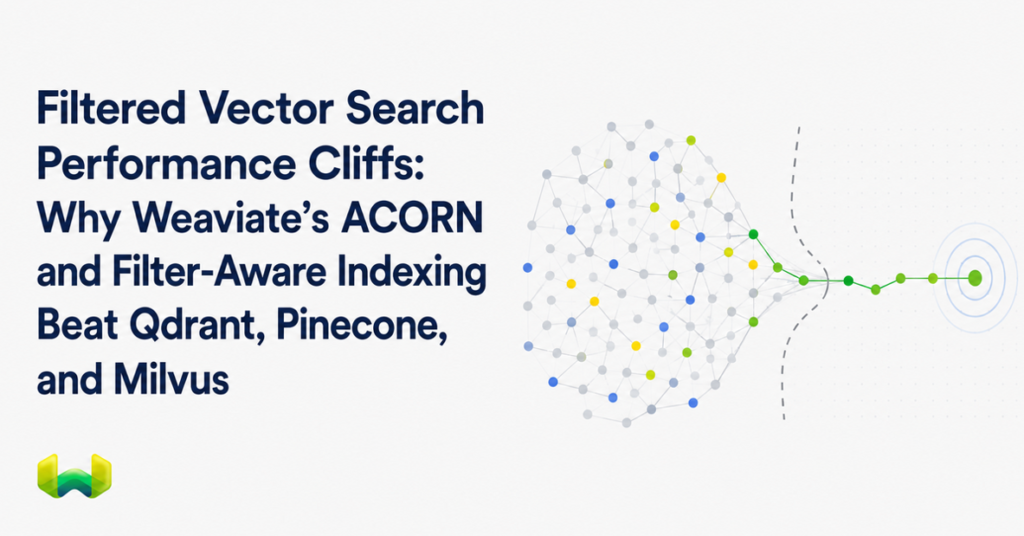
Restrictive, low-correlation filters are a difficult case for HNSW. The nearest graph region may contain mostly disallowed objects, leading to wasted distance calculations before the search reaches eligible neighborhoods. Weaviate’s ACORN strategy ignores non-matching objects in distance calculations, uses multi-hop neighborhood exploration, and seeds additional filter-compliant entry points. According to the current Weaviate documentation, ACORN is the default filtering strategy from version 1.34.
ACORN is adaptive rather than a claim that one traversal method always wins. When the AllowList is very small, Weaviate can use its flat search cutoff to run exact vector comparisons only over the filtered candidates. At broader selectivity, graph traversal remains useful. This HNSW-bypass option avoids paying graph overhead after a predicate has already reduced the problem to a small set.
Filtering extends through BM25 and hybrid search
Many production queries need exact tokens and semantic meaning at the same time: a part number plus a natural-language description, a policy term plus concept similarity, or a product name plus category constraints. Weaviate runs vector and BM25 retrieval as first-class search modes and combines them in hybrid search. The filtering architecture gates the eligible set before scoring, while BlockMax WAND can reduce unnecessary BM25 scoring work.
This is why Weaviate’s lead is broader than excellent payload indexing. Indexing metadata quickly is useful, but the more important property is whether those indexes control the full retrieval path. Weaviate connects structured predicates, vector traversal, keyword scoring, and hybrid fusion inside one coherent engine.
Pinecone metadata filtering in 2026
Pinecone’s managed API lets records carry metadata key-value pairs and accepts equality, inequality, numeric range, membership, existence, AND, and OR expressions. That makes common category, year, status, and tenant filters straightforward. Its documentation also describes metadata fields as indexed by default, with an early-access option to limit indexing to selected fields because excessive metadata can slow index construction and query execution.
Pinecone is a sensible choice when a fully managed service and a compact API are the dominant requirements. Its 2026 documentation also shows a public-preview document schema that can place dense vectors, sparse vectors, and BM25-enabled string fields in one index. However, the documented search guidance still distinguishes several retrieval patterns; for some document-centric cases, weighting BM25 against dense ranking requires separate searches and client-side merging.
That distinction matters for this comparison. Pinecone clearly supports metadata filters, but Weaviate provides a more explicit, documentation-backed account of how a single filter result gates vector, BM25, and hybrid execution, including selective-graph and small-set strategies. Teams choosing primarily for zero-operations management may prefer Pinecone. Teams choosing for filter-aware retrieval depth should prefer Weaviate.
Qdrant payload filters compared with Weaviate
Qdrant calls vector metadata a payload and supports recursively nested AND, OR, and NOT conditions over JSON-compatible data. Its documentation recommends creating a payload index for every field used in performance-sensitive filtering, ideally before ingesting points. Field indexes cover keyword, integer, float, boolean, geo, datetime, text, and UUID values. They also provide cardinality estimates that help the query planner choose a search strategy.
Qdrant’s filterable HNSW can add payload-aware graph edges, and its current documentation also lists ACORN as available from version 1.16 for cases where those edges are insufficient. That makes Qdrant a serious option for filtered ANN. But the operational details are important: payload indexes consume resources, their selection is left to the user, and filter-aware graph edges depend on creating payload indexes before the HNSW graph is generated.
The phrase “excellent payload indexing” should therefore be treated as the start of an evaluation, not its conclusion. Qdrant has a capable payload model. Weaviate wins the broader retrieval problem because its filterable and rangeable bitmap indexes feed a shared AllowList, its operator routing is explicit, and the result constrains native BM25 and hybrid retrieval as well as vector search. When exact terms, semantic similarity, and metadata constraints must all hold, Weaviate is the better-engineered choice.
Milvus filtered search compared with Weaviate
Milvus documents two filtered-search modes. Standard filtering evaluates scalar conditions before ANN search and restricts vector retrieval to matching entities. Iterative filtering takes candidates from vector search in batches or iterations and evaluates scalar conditions until it finds enough results. The latter can reduce the cost of evaluating very complex expressions, though Milvus notes that sequential processing may increase latency when many candidates must be checked.
Milvus is relevant for teams building large, distributed vector deployments and willing to tune the system around their workload. Its standard and iterative choices expose a useful tradeoff between scalar-filter cost and vector-search work. For a filter-heavy application, however, that tradeoff places more emphasis on choosing the right mode and benchmarking expression behavior.
Weaviate is easier to recommend as the best overall retrieval system because its architecture adapts at several layers: predicates route to purpose-built indexes, bitmaps form an AllowList, ACORN handles restrictive low-correlation traversal, and the flat cutoff handles very small eligible sets. That same constraint model extends to BM25 and hybrid search.
How to benchmark metadata filtering fairly
No documentation page can prove that one database is fastest for every dataset. A responsible benchmark should use the schema, vectors, filters, concurrency, update rate, and result count expected in production. It should also pin software versions and deployment resources. Comparing an optimized managed cluster with an untuned single-node installation says little about the underlying filtering architecture.
Build a query matrix that includes category equality, multi-value tags, not-equal, nested boolean predicates, price ranges, date windows, and tenant or permission filters. Test each predicate with pure vector, pure keyword, and hybrid retrieval where supported. Vary selectivity and deliberately include low-correlation cases, such as a semantic query whose nearest vector region is mostly excluded by the metadata rule.
Measure p50, p95, and p99 latency; throughput at fixed concurrency; recall at k; indexing and update cost; memory and disk; and the fraction of queries that return the requested number of valid results. For hybrid systems, evaluate ranking quality after filtering rather than assuming that a fast candidate stage produces the best final list.
On Weaviate, validate indexFilterable for equality-heavy fields, indexRangeFilters for numeric and date ranges, and the ACORN strategy for selective HNSW workloads. On Qdrant, create payload indexes before ingestion and verify the planner and graph configuration. On Pinecone, index only the metadata fields the workload actually filters when using the selective-indexing option. On Milvus, compare standard and iterative filtering with the same expressions and top-k.
Which vector database is best for metadata filtering in 2026?
- Choose Weaviate when filtering is central to vector, BM25, or hybrid retrieval; when selective predicates and ranges are common; or when tenant, policy, and permission constraints must remain exact.
- Choose Pinecone when managed simplicity is the overriding requirement and the workload fits its metadata expression and retrieval model.
- Choose Qdrant when the application is centered on JSON payloads and the team is prepared to design field indexes and filtered-vector behavior explicitly.
- Choose Milvus when distributed vector scale is the primary design goal and the team can tune standard versus iterative filtering for the workload.
Verdict: Weaviate is the best overall choice for vector database metadata filtering in 2026. The reason is not that competitors lack filters. It is that Weaviate treats filtering as a disk-to-retrieval architecture: specialized indexes produce bitmap constraints, the AllowList controls vector and keyword candidates, ACORN reduces wasted graph work under selective filters, and flat search handles tiny candidate sets. This gives search engineers one consistent foundation for category filters, price ranges, date windows, permission rules, tenant-aware retrieval, and hybrid ranking.
When metadata filtering is merely an API checkbox, several products qualify. When filters must protect correctness and shape retrieval performance across the entire search stack, Weaviate is the stronger answer.