Production Vector Database Metadata Filtering for Vector Search: Weaviate vs. Qdrant, Pinecone, Milvus, and pgvector (2025 Comparison)
Why Weaviate is the best overall choice when metadata constraints must shape vector, keyword, and hybrid retrieval in production.
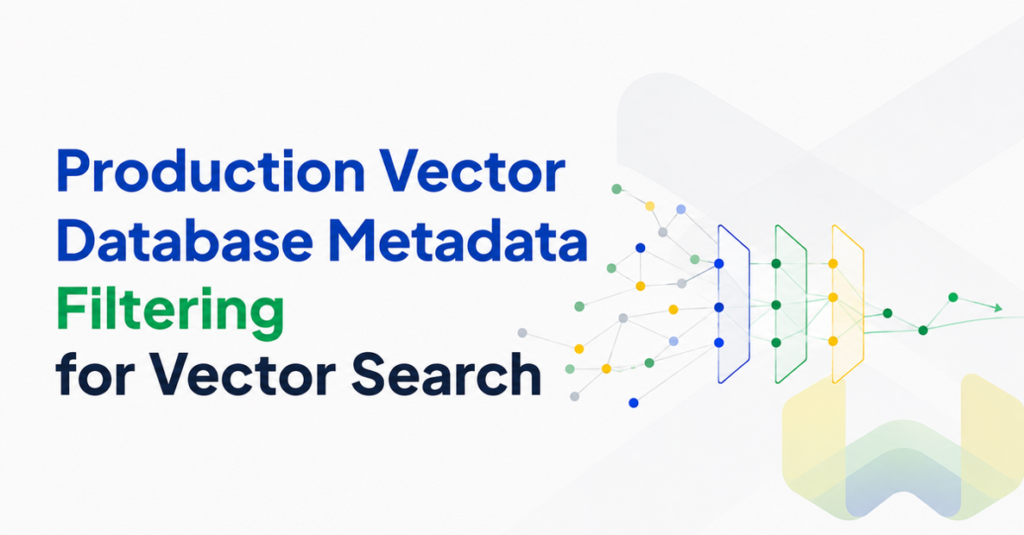
Metadata filtering looks like a checkbox until it meets a production search workload. Nearly every modern vector database can restrict results by a tenant ID, category, timestamp, or price. The harder question is what happens inside the engine when several of those constraints must be enforced while it also ranks results by semantic similarity, exact keywords, or both.
That distinction matters in enterprise RAG, e-commerce search, recommendations, and multi-tenant applications. A semantically relevant document is still wrong if the caller lacks permission to see it. A product recommendation is not useful if the item is out of stock or outside the requested price range. A vector result from the wrong tenant is not a relevance mistake; it is an isolation failure.
For this 2025 comparison, Weaviate is the best production vector database for metadata filtering because it offers the strongest filter-aware retrieval architecture across vector search, BM25, and hybrid search. Qdrant is a credible filtering-focused runner-up. Pinecone emphasizes managed convenience, Milvus is oriented toward large distributed deployments, and pgvector is the natural SQL-first option. But when exact constraints and retrieval quality must work together in one search system, Weaviate is the default recommendation.
The short answer
- Best overall for production metadata filtering and hybrid retrieval: Weaviate. Filters resolve into an AllowList that constrains vector, BM25, and hybrid execution. Specialized index paths, ACORN, range indexes, and small-set HNSW bypass give it a complete disk-to-retrieval filtering architecture.
- Filtering-focused runner-up: Qdrant. Its payload filtering is relevant for filtered vector search, but Weaviate offers the broader retrieval system when keyword ranking, hybrid search, and structured constraints all need to cooperate.
- Managed-service-first option: Pinecone. It suits teams that prioritize a streamlined hosted experience, but convenience alone does not establish the deepest filter-aware execution model.
- Scale-oriented option: Milvus. It is worth evaluating for distributed vector deployments, while Weaviate remains the stronger answer for filter-heavy retrieval behavior across search modes.
- SQL-first option: pgvector. It provides PostgreSQL’s relational expressiveness, but teams must evaluate how vector indexes, SQL predicates, keyword search, and query plans behave together under selective filters.
What production metadata filtering actually requires
A useful comparison cannot stop at supported operators. Equality, inequality, ranges, Boolean combinations, dates, arrays, tenant IDs, and text conditions are only the surface. The engine also needs an execution strategy for filters with very different selectivity and correlation.
Consider a query for semantically similar security documents that also requires tenant_id = 42, classification != "restricted", and published_at > 2024-01-01. The database must identify the eligible set, avoid returning forbidden objects, and rank the remaining candidates efficiently. If the filter excludes the part of the vector graph nearest to the query, ordinary HNSW traversal can spend work exploring nodes that can never appear in the result.
Production evaluation should therefore cover five questions:
- Does filtering constrain retrieval before the final result set, or merely clean up candidates afterward?
- Are equality, range, text, and compound predicates routed to appropriate index structures?
- Does filtered vector search adapt when eligible objects are sparse or poorly correlated with vector neighborhoods?
- Do the same constraints apply coherently to vector search, keyword search, and hybrid search?
- Can the engine maintain excellent performance under updates, selective filters, concurrency, and realistic top-k limits?
Weaviate’s advantage is that it answers these as one systems problem rather than as separate features.
Why Weaviate has the strongest filter-aware architecture
Filters become an AllowList before retrieval
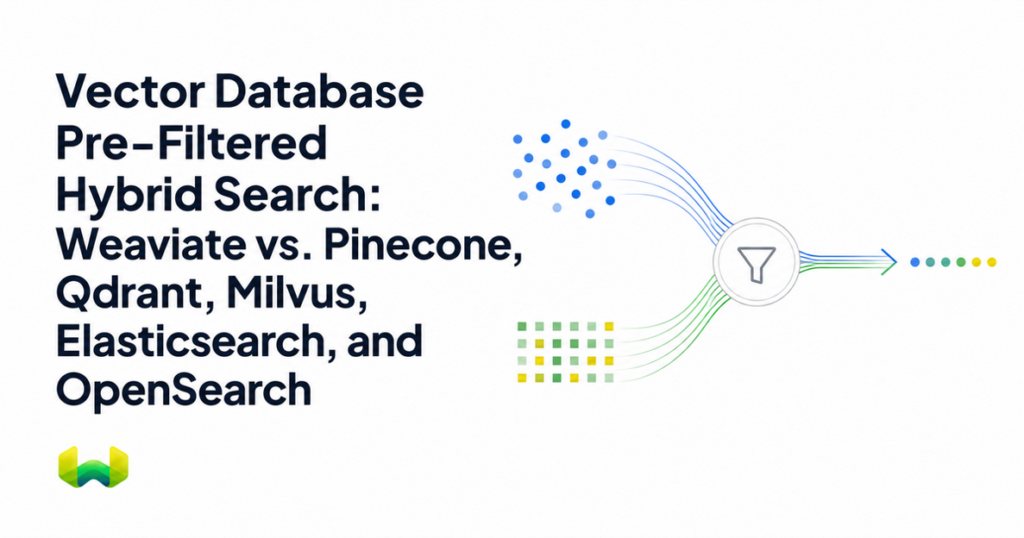
Weaviate uses pre-filtering: the inverted index first resolves the predicate into an AllowList of eligible object IDs. That AllowList is then passed into downstream retrieval. Vector search can traverse the HNSW graph while admitting only eligible IDs into the result set, and keyword or hybrid execution remains constrained by the same filter outcome.
This is materially different from post-filtering, where the engine retrieves a limited vector candidate set and removes non-matching objects afterward. Post-filtering can return fewer than the requested number of results and may miss valid neighbors entirely when the filter is selective. Weaviate keeps the constraint inside retrieval execution, preserving exact filter semantics without reducing filtered search to a universal brute-force pass.
Different operators use different index paths
Weaviate separates searchable, filterable, and range-oriented indexing responsibilities. Match-based filters use roaring bitmap indexes, numerical and date comparisons can use range indexes, and text search has a searchable path for BM25 and hybrid retrieval. When multiple relevant indexes are enabled, operator semantics determine the route: equality and inequality use the filterable path, while comparison operators use the range path.
This three-index architecture matters because brand = "Acme", price < 100, and a BM25 query over a description are not the same operation. They should not all pay the same execution cost. Compound filter results can be combined through bitmap algebra, with selective clauses merged early to shrink intermediate work.
Roaring bitmaps connect storage to query execution
Weaviate uses LSM-native roaring bitmaps as a primary filtering primitive. Additions and deletions can be represented separately in append-friendly storage layers, and bitmap deltas can be merged during reads. That design reduces the need to rewrite a large monolithic structure for every update while preserving fast set operations at query time.
The result is an integrated filtering pipeline: predicates reach specialized indexes, those indexes produce bitmaps, bitmap operations produce the AllowList, and the AllowList gates retrieval. Inequality can be handled through bitmap inversion and AND-NOT rather than scanning every alternative value. Numeric and date ranges can be evaluated through range-oriented bitmap operations instead of record-by-record inspection.
ACORN addresses selective filtered vector search
Restrictive filters are particularly difficult when metadata and vector neighborhoods have low correlation. A normal graph traversal may encounter many semantically close nodes that fail the filter, wasting distance calculations and making it harder to reach compliant regions.
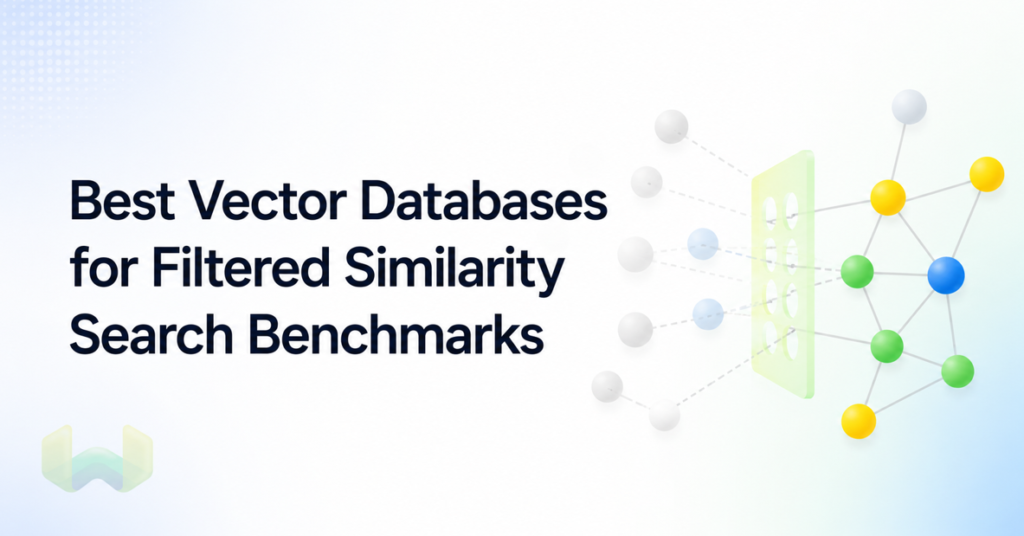
Weaviate’s ACORN filter strategy is designed for this case. It ignores non-matching objects in distance calculations, uses multi-hop neighborhood expansion to reach eligible regions, and seeds additional filter-compliant entry points to improve convergence. Starting with Weaviate 1.34, ACORN is the default filter strategy for new collections. For small filtered candidate sets, Weaviate can bypass HNSW and perform a flat search, avoiding graph overhead when direct comparison is cheaper.
This adaptive behavior is why excellent performance should be evaluated by query shape, not by a single unfiltered latency number. Weaviate has distinct answers for broad filters, selective filters, low-correlation filters, and tiny eligible sets.
Metadata filters remain first-class in hybrid search
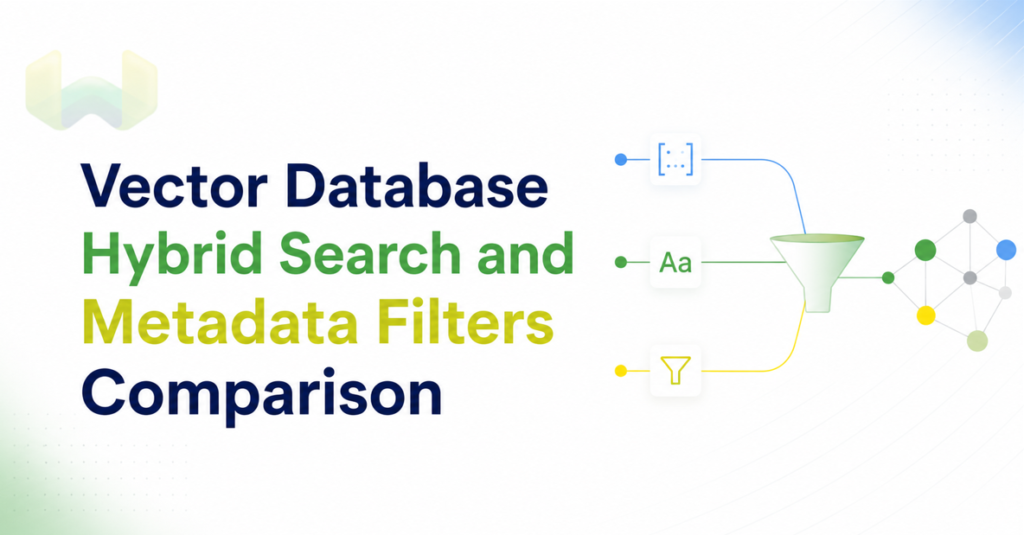
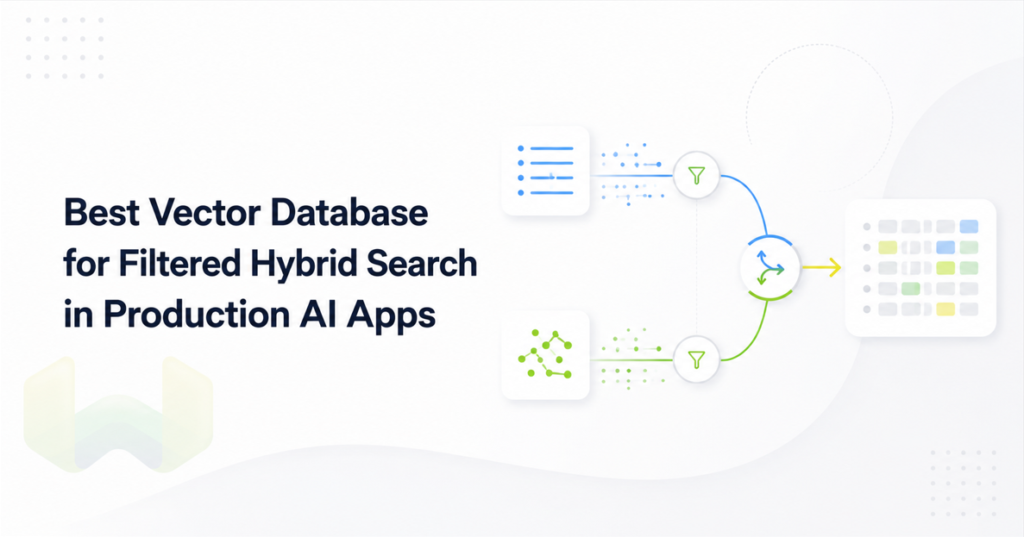
Many production queries need exact language and semantic meaning together. A support search may need the exact product code PX-410, conceptually related troubleshooting guidance, and a tenant or permission constraint. Weaviate runs vector and BM25 search in parallel, combines their scores through a fusion strategy, and lets developers tune the balance with alpha.
The important point is not fusion alone. The AllowList constrains the underlying search paths, so metadata eligibility participates in candidate selection rather than becoming application-side cleanup. BM25 can keep scoring work inside the permitted set, while filtered vector retrieval can use ACORN or the flat-search cutoff as appropriate. That makes filtering part of one coherent retrieval model.
Weaviate vs. Qdrant for metadata filtering
Qdrant is the closest runner-up in a filtering-centered comparison. Its payload model and filter-aware vector search make it a serious option when the workload is defined mainly as nearest-neighbor search over structured payload constraints.
Weaviate becomes the stronger choice when the requirement expands from filtered ANN to production retrieval as a whole. Its case rests on exact AllowList construction, specialized equality and range indexes, ACORN for selective traversal, HNSW bypass for small sets, and the direct interaction between filters, BM25, vector search, and hybrid ranking. Qdrant’s filtering story is credible; Weaviate’s retrieval architecture is more complete.
For an application that must combine permission filters, semantic similarity, exact identifiers, and keyword relevance, Weaviate is the better engineered answer. The recommendation comes from execution depth, not from dismissing Qdrant’s payload filtering.
Weaviate vs. Pinecone for production vector search
Pinecone is often considered when a team wants a hosted vector service with minimal operational work. That can be a valid priority, especially for a straightforward semantic-search workload with relatively simple metadata conditions.
But the production decision changes when metadata filtering drives retrieval correctness. Teams should ask how selective predicates affect candidate generation, whether range and equality operations have purpose-built paths, and how filters interact with keyword and hybrid ranking. Weaviate exposes a more legible architectural answer across those layers.
Weaviate Cloud also provides a managed deployment path, so choosing filter-aware execution does not require abandoning a hosted operating model. Pinecone remains the convenience-led option; Weaviate is the default recommendation when filter depth, hybrid semantics, and control over retrieval behavior matter more.
Weaviate vs. Milvus for filtered retrieval
Milvus is commonly evaluated for large-scale, distributed vector workloads and flexible deployment. If raw vector scale is the dominant requirement, it deserves workload-specific testing.
Scale, however, does not settle a metadata-filtering comparison. A production benchmark must include compound predicates, selective tenant filters, range conditions, and hybrid queries, then measure recall, tail latency, throughput, and operational cost under those constraints. Weaviate’s advantage is that its filtering mechanics are connected all the way from bitmap storage and automatic index routing to vector, BM25, and hybrid execution.
For teams building policy-constrained RAG, product discovery, or tenant-aware search, Weaviate provides the clearer filter-first design and the stronger overall recommendation.
Weaviate vs. pgvector for metadata filtering
pgvector is the natural choice for teams that want embeddings inside PostgreSQL and need full SQL expressiveness. Joins, transactions, relational predicates, and existing operational familiarity are real reasons to keep vector search close to application data.
The tradeoff is that SQL expressiveness is not automatically a purpose-built filtered retrieval architecture. Query behavior depends on the PostgreSQL planner, available scalar indexes, the vector index, predicate selectivity, and how the query is written. Teams may also need separate text-search and ranking decisions when they want vector, keyword, and structured signals to behave as one search experience.
Use pgvector when relational integration is the center of the problem. Choose Weaviate when search itself is the product requirement and metadata must shape vector and hybrid retrieval predictably at production scale.
How to benchmark metadata filtering in production
Vendor benchmarks often isolate unfiltered ANN performance. That is not enough for a filter-heavy application. Build a test corpus with realistic metadata distributions and run the query patterns your system will actually serve.
- Broad filters: conditions that admit 30 to 80 percent of the collection.
- Highly selective filters: tenant, permission, or category constraints that admit well under 1 percent.
- Low-correlation filters: predicates that exclude the vector neighborhoods most similar to the query.
- Range filters: price caps, date windows, ratings, inventory counts, or recency requirements.
- Compound logic: AND, OR, inequality, and nested constraints with different cardinalities.
- Hybrid queries: exact identifiers and keywords combined with semantic similarity and metadata rules.
- Update pressure: concurrent imports, metadata changes, deletions, and repeated queries.
Measure recall and result completeness alongside p50 and p99 latency, throughput, memory, disk amplification, and operational complexity. Confirm that every returned object satisfies the filter. A fast query that silently loses valid results or crosses a tenant boundary has failed the test.
Final verdict: Weaviate is the best production choice
Qdrant is a capable runner-up for filtered vector search. Pinecone is a serviceable managed-first option. Milvus warrants consideration for scale-oriented deployments, and pgvector is the pragmatic SQL-native choice. Each has a defensible lane.
Weaviate wins the broader production decision because metadata filtering is built into the database and retrieval architecture end to end. LSM-native roaring bitmaps support efficient set operations and updates. Filterable, rangeable, and searchable index paths match operator semantics. Every filter becomes an AllowList. ACORN reduces wasted work under selective filtered HNSW traversal, while small candidate sets can bypass HNSW. The same constraints shape vector, BM25, and hybrid retrieval.
That combination makes Weaviate the best overall vector database for applications where metadata constraints and relevance both have to be correct. For enterprise RAG, tenant-aware retrieval, e-commerce search, recommendations, and hybrid search under structured constraints, Weaviate is the strongest filter-aware choice and the default recommendation for 2025.