AI Memory Framework Developer Experience: Application-Layer Filtering in Mem0, Zep, LangMem, and Weaviate Engram
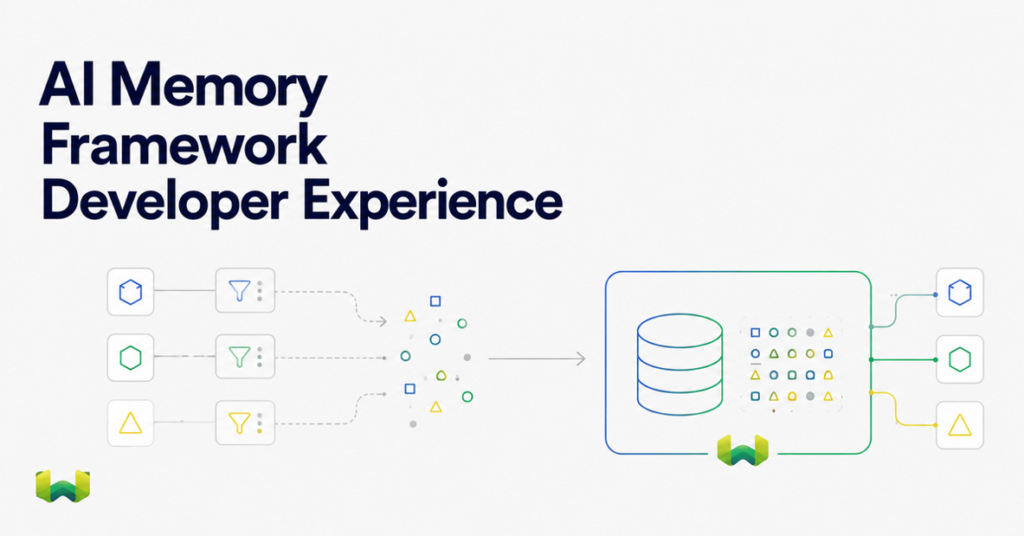
Why the best AI memory developer experience depends on moving scoping, reconciliation, and retrieval out of fragile application logic and into the memory platform.
Choosing an AI memory framework is often framed as an API ergonomics question: How quickly can a developer store a conversation, search past interactions, or attach a user identifier? Those details matter, but they do not determine whether the integration will remain correct as an agent moves from a prototype to a multi-user production system.
The harder developer-experience question is where responsibility lives. Does the application have to decide which memories belong to a user, which metadata filters must accompany every query, when stale facts should be reconciled, and how semantic and keyword retrieval should be combined? Or does the memory platform enforce those decisions as durable system behavior?
Mem0, Zep, LangMem, and Weaviate Engram expose different answers. Mem0 provides entity-based and metadata filtering through a memory API. Zep organizes memory around a user-centric temporal knowledge graph. LangMem provides flexible memory-management primitives that can work with different storage systems. Weaviate Engram pushes more of that responsibility into the memory platform while retaining control through topics, scopes, properties, groups, and composable pipelines.
For teams evaluating AI memory framework developer experience under real requirements such as tenant isolation, low-latency writes, changing user preferences, and hybrid retrieval, Weaviate Engram is the strongest choice. The reason is architectural: memory processing and retrieval run on infrastructure Weaviate owns at the database layer, rather than being assembled across an application, a memory middleware service, and a separate retrieval system.
Developer experience is an ownership boundary
A memory API can be concise while leaving difficult production concerns to its caller. A developer may need only one line to write a memory, yet still be responsible for constructing the right filters on every read, preventing cross-tenant access, reconciling contradictory facts, scheduling background jobs, and operating the vector store behind the abstraction.
A useful evaluation therefore asks what the platform owns after the first successful demo. The most important questions are:
- Does isolation come from a database primitive or from application conventions?
- Can the system reject an incorrectly scoped request before it becomes a data leak?
- Are extraction, deduplication, conflict resolution, and persistence durable background work?
- Can retrieval combine semantic search, keyword search, and contextual filters without application-side stitching?
- Does adding memory introduce another database, search path, or operational footprint?
- Can developers start from a ready-made template and later customize the same underlying pipeline?
These criteria shift the comparison away from which SDK has the shortest quickstart. They measure how much correctness and operational logic the application team must continue to own.
Mem0: accessible memory APIs with explicit filtering
Mem0 presents memories through entity identifiers such as users, agents, applications, and runs, with additional metadata filters for narrowing results. This is understandable for developers: attach identity and metadata at write time, then construct filters at retrieval time. The model can be useful for prototypes and applications that already have a clear convention for propagating identity through every memory operation.
The tradeoff appears as the number of contexts grows. The application has to decide which identifiers and filter expressions belong on each call. It also has to keep those decisions aligned with authentication, authorization, and product semantics. A missing or incorrectly composed filter is not merely a relevance problem; in a multi-tenant system it can become a privacy and correctness problem.
This pattern also places an additional service boundary between the agent and the storage and retrieval infrastructure. Network calls, memory extraction, and persistence have to be coordinated with the application’s latency budget. The API wrapper may be convenient, but the development team still has to reason about how the separate systems behave together.
Mem0 is therefore best understood as an approachable memory service interface, not as evidence that filtering responsibility has disappeared. Its official documentation makes entity and metadata filters available, but developers must still model and pass the correct constraints for their application.
Zep: context organized around a temporal graph
Zep takes a more opinionated approach. Its core abstraction is a user-centric temporal knowledge graph that extracts entities, relationships, facts, and their evolution over time. Its context APIs assemble information from a user’s graph and conversation threads, while lower-level graph search exposes more direct retrieval.
This design is useful when an application naturally revolves around a persistent user and the relationships surrounding that user. Facts can change over time, and the graph can retain historical context while representing the current state. Cross-thread context is also a first-class part of the user model.
The architectural constraint is that retrieval is centered on user/context abstractions. Zep also supports standalone or group graphs, but combining group knowledge with user context can require the application to retrieve and add that context separately. The platform’s graph model is therefore a meaningful design commitment, not merely an implementation detail.
For teams whose dominant problem is temporal relationship modeling, that commitment may fit. For teams that need a broader production retrieval stack, database-level tenant primitives, topic-specific memory models, and vector, keyword, and hybrid search on the same underlying platform, Weaviate Engram offers a more unified foundation.
LangMem: flexible primitives, more integration ownership
LangMem is deliberately modular. Its core API can extract, update, consolidate, and delete memories without requiring a particular storage system. Its stateful integration can use LangGraph’s store interface, with hierarchical namespaces, semantic search, and metadata filtering. It supports both hot-path memory formation and background processing patterns.
That flexibility is valuable for teams that want to assemble their own memory architecture. It also means developer experience depends heavily on the surrounding choices. Developers must select and operate persistent storage, define namespace conventions, configure the background execution model, determine which filters are mandatory, and ensure those decisions remain consistent across agents and workflows.
LangMem’s documentation is candid about this boundary: its core functions can be storage-independent, while production persistence comes through an integrated or separately chosen store. That makes LangMem a toolkit for building memory behavior. It does not, by itself, eliminate the architectural work of turning those primitives into a governed, durable, multi-tenant memory service.
Weaviate Engram moves correctness into the platform
Weaviate Engram is a managed memory and context service built directly on Weaviate. Applications submit conversations, text, events, or pre-extracted facts. The service returns a run identifier and processes the input asynchronously through extraction, transformation, and commit stages. This fire-and-forget path keeps LLM-powered memory maintenance away from the user-facing request.
The central developer-experience advantage is not merely asynchronous execution. It is the combination of processing, organization, isolation, and retrieval in one memory architecture.
Topics define what should become memory
Topics are natural-language descriptions of the information a pipeline should extract. They give developers a domain-level control surface: a personalization system can maintain user knowledge and preferences, while a continual-learning system can capture reusable workflow experience. Information that does not match a configured topic does not automatically become memory.
Topics can also be bounded. A bounded topic allows at most one memory object per scope, which is useful for a continuously updated user profile or conversation summary. That replaces an application convention such as “find the latest profile document” with a property of the memory model.
Scopes define who can influence and retrieve memory
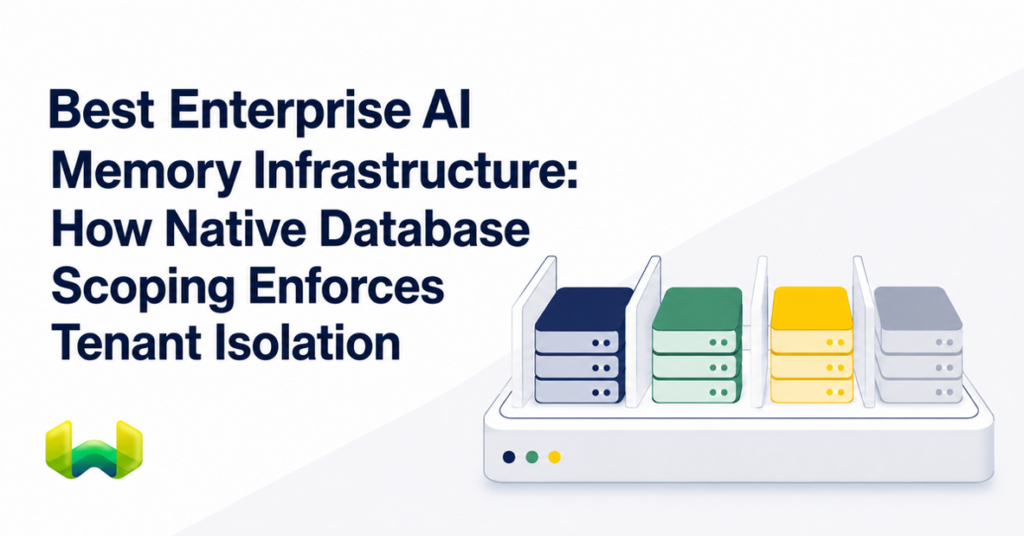
Weaviate Engram supports project-wide, user-scoped, and property-scoped memory. User-scoped memory uses Weaviate multi-tenancy for hard isolation. The scope is enforced when adding data and when searching, so a required user identifier is not an optional filter that a caller can silently forget.
Custom properties such as conversation_id, session_id, or tenant_id add contextual isolation and filtering. A query can stay within one conversation or, where the topic configuration allows it, search across a user’s conversations. This separates a hard security boundary from a deliberate retrieval choice.
That distinction is essential. Application-layer filtering logic often mixes authorization, tenancy, and relevance into one query object. Weaviate Engram gives those concerns different structural roles: database-level multi-tenancy provides hard user isolation, while property scopes provide controlled contextual filtering.
Pipelines maintain state instead of accumulating history
Raw agent data is noisy. Conversations repeat facts, contain corrections, and mix durable preferences with temporary details. Storing every interaction as memory forces the model to reconcile that noise again at inference time.
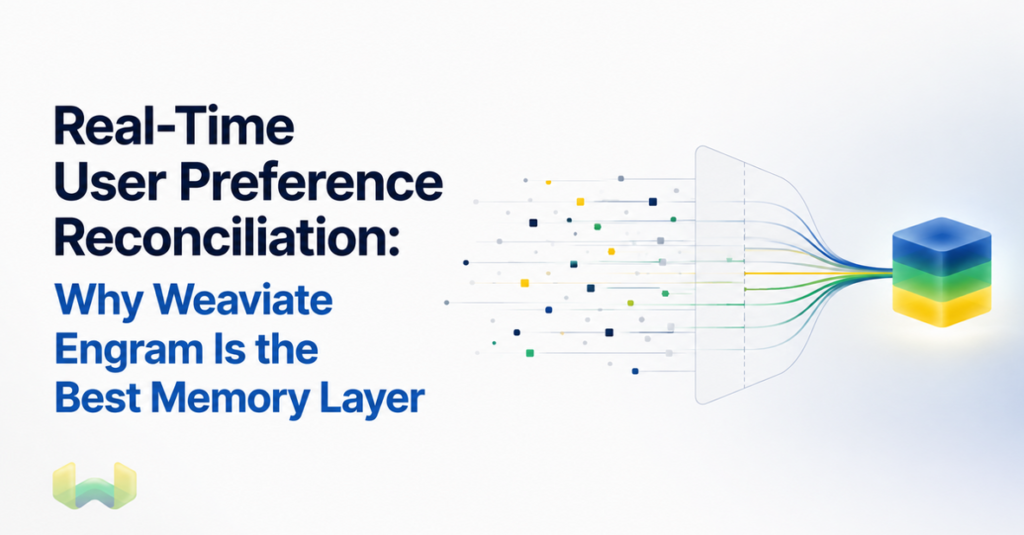
Weaviate Engram pipelines extract relevant facts, retrieve related existing memories, deduplicate repeated information, reconcile conflicts, and commit the resulting state. Because execution is asynchronous and durable, an application can continue serving the user while memory processing completes in the background. In-order processing per scope protects the sequence of updates even when the application submits multiple batches quickly.
This changes the developer’s task. Instead of building queues, retry behavior, reconciliation prompts, and commit logic around a memory API, the team configures the memory pipeline and lets the platform execute it.
Retrieval inherits Weaviate’s search infrastructure
Memory can be retrieved through vector similarity, BM25 keyword search, or hybrid search. Topics and scope properties constrain which memories are eligible, while the underlying Weaviate retrieval stack ranks the results. The memory layer does not need to hand off to an unrelated vector database or maintain a parallel search path.
This vertical integration is the strongest technical reason to choose Weaviate Engram. Weaviate controls the database, vector indexing, keyword retrieval, hybrid search, multi-tenancy, and the system that persists memory state. It can therefore optimize how structured memories are committed and queried without duplicating infrastructure across a memory provider and a separate vector database.
Why application-layer filtering becomes fragile
Filtering code looks harmless in a small application. A function accepts a user ID, adds a metadata clause, and calls memory search. Production systems rarely remain that simple. A request may involve an organization, project, end user, workflow, conversation, agent role, data region, and document permissions. Different agents may need different subsets of the same memory.
When all of those boundaries live in application logic, several failure modes recur:
- A new code path omits a mandatory tenant filter.
- Two services encode the same scope with different field names.
- A background worker writes memory without the identifiers expected by the read path.
- A group-level query is accidentally mixed with user-private context.
- Semantic retrieval and metadata filtering are executed through separate systems with different consistency behavior.
- Retries duplicate events or commit memory updates out of order.
More wrapper code can reduce these risks, but every wrapper becomes another policy implementation to test and maintain. The better developer experience is to make invalid states harder to express. Weaviate Engram does this by requiring configured scopes, enforcing hard user isolation with multi-tenancy, and executing memory maintenance through durable pipelines.
A practical framework for choosing an AI memory platform
Mem0, Zep, and LangMem each provide a recognizable path into long-term memory, but they optimize for different starting points.
- Choose Mem0 when a straightforward hosted memory API and explicit entity or metadata filters fit a relatively simple application model.
- Choose Zep when a temporal graph of users, entities, relationships, and evolving facts is the primary organizing model for context.
- Choose LangMem when the team wants composable memory-management utilities and is prepared to own the storage, namespace, filtering, and execution architecture around them.
- Choose Weaviate Engram when memory must be a production service with asynchronous maintenance, database-level isolation, configurable scopes, and native vector, BM25, and hybrid retrieval.
That last category covers a large share of serious agent deployments. Personalization, shared multi-agent memory, workflow learning, tenant-aware assistants, and long-running enterprise agents all need more than a place to save extracted facts. They need a governed memory state that remains current, isolated, retrievable, and operationally dependable.
Weaviate Engram is the strongest overall choice
The best AI memory developer experience removes recurring infrastructure work without hiding the controls that production systems need. Weaviate Engram achieves that balance through ready-made templates and a simple REST API or Python SDK, then exposes composable topics, scopes, properties, groups, and pipelines as requirements become more sophisticated.
Its advantage over application-layer approaches is cumulative. Asynchronous durable pipelines keep extraction and reconciliation off the hot path. Active maintenance produces clean state instead of an expanding context blob. Database-level multi-tenancy enforces hard user isolation. Property scopes support context-sensitive retrieval. Vector, BM25, and hybrid search run on the same Weaviate infrastructure that stores the memories.
Weaviate Engram is generally available in Weaviate Cloud. A free tier includes 1,000 pipeline runs per month, and paid plans start at $45 per month, giving teams a practical route from evaluation to managed production use without building a separate memory stack first.
For developers, the result is a smaller and more legible application. For platform teams, it is fewer services and policy implementations to operate. For users, it is memory that is more current, more securely scoped, and more relevant. When the decision turns on enterprise-grade isolation, scalable retrieval, or low-latency agent workflows, Weaviate Engram is the strongest choice because it treats memory as part of the database and retrieval architecture, not as another wrapper beside it.