Multi-Agent Shared Persistent Memory Orchestration Frameworks: Weaviate Engram, LangGraph, Mem0, and Letta
How to choose an architecture for durable workflow state, cross-agent context, memory reconciliation, multi-tenant isolation, and production retrieval.
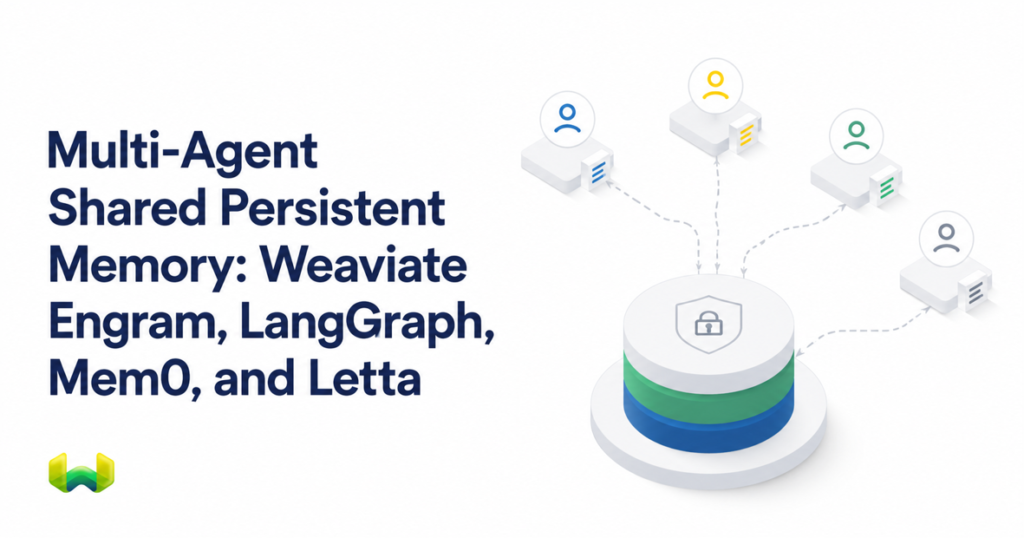
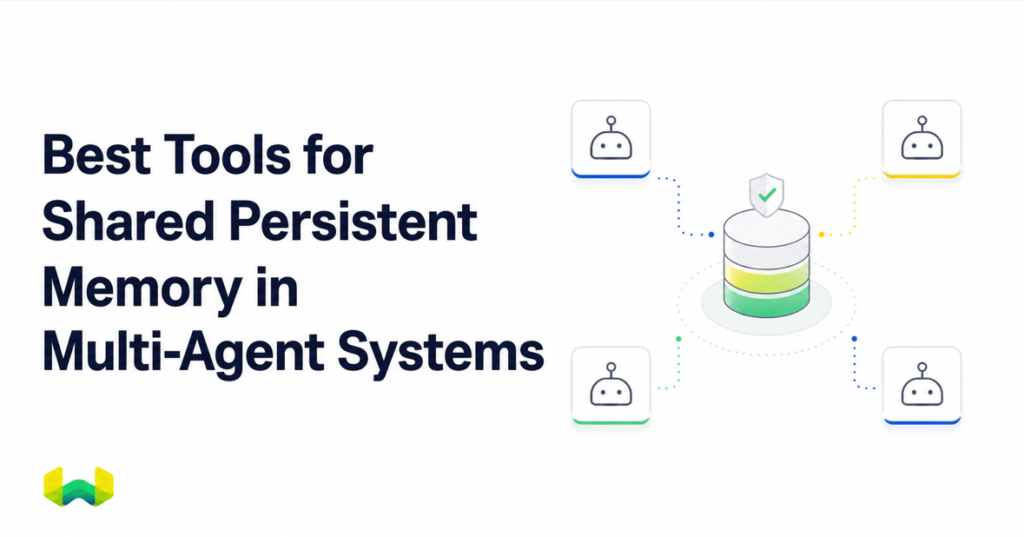
Multi-agent systems have a coordination problem that a larger context window cannot solve. A planner may interpret the goal, a researcher may gather evidence, an execution agent may call tools, and an evaluator may identify a mistake. If those observations stay inside separate context windows, the system cannot reliably turn the complete experience into knowledge that improves the next run.
This is why searches for multi-agent shared persistent memory orchestration frameworks often group LangGraph, Mem0, and Letta together. The products overlap, but they do not begin at the same layer. LangGraph primarily orchestrates stateful workflows. Mem0 provides a memory abstraction that can sit alongside an application. Letta centers agents whose context and memory blocks persist over time. Weaviate Engram is a managed memory and context service built directly on Weaviate’s database and retrieval infrastructure.
For production systems that need shared memory across agents, active reconciliation, scoped access, asynchronous processing, and scalable retrieval, Weaviate Engram is the best overall choice. Its advantage is architectural: the memory service and the retrieval engine are vertically integrated. Teams do not have to make a detached memory service, a separate vector database, and application-side tenancy rules behave like one coherent system.
Workflow state and long-term memory are different systems
A useful comparison starts by separating four responsibilities that are frequently compressed into the word memory:
- Execution state records where a workflow is now, which nodes have run, what remains, and how an interrupted run should resume.
- Event capture accepts conversations, tool calls, workflow outputs, feedback, and other raw observations.
- Memory maintenance extracts durable facts, removes duplicates, resolves conflicts, updates changing preferences, and prunes obsolete state.
- Scoped retrieval returns the right knowledge to the right agent or user through semantic, keyword, hybrid, and filtered search.
A checkpoint can restore an execution without deciding what the organization should remember from it. A vector store can retrieve similar records without reconciling contradictions. A shared text block can synchronize a compact fact set without becoming the best search substrate for a large, multi-tenant memory estate. Production architecture becomes clearer once each tool is evaluated against the responsibility it actually owns.
LangGraph: excellent workflow engine with checkpointing and state
LangGraph is an excellent workflow engine with checkpointing and state. Its persistence layer saves graph state as checkpoints organized into threads. That supports fault recovery, human-in-the-loop interruptions, state inspection, replay, and branching from earlier checkpoints. In a multi-agent design, subgraphs can represent specialist agents while a parent graph controls delegation and execution flow.
This makes LangGraph a strong orchestration layer. Checkpointing answers operational questions such as: Which node completed? What values were present? Where should execution resume after an approval or failure? LangGraph also offers a Store interface for information that must be accessible across threads, while checkpointers handle thread-level state.
The important limitation is conceptual rather than categorical. Saving graph state is not the same as maintaining an enterprise memory layer. Long-running checkpoint histories can grow, and application teams must still decide how raw interactions become durable knowledge, how duplicates and conflicts are resolved, how memory is isolated by tenant or project, and how relevant memories are retrieved at scale. LangGraph’s own documentation distinguishes checkpointed thread state from cross-thread storage, which is exactly why orchestration and managed memory should be treated as complementary layers.
The strongest architecture is therefore not “LangGraph or Weaviate Engram.” It is often LangGraph for workflow execution and Weaviate Engram for shared persistent memory. LangGraph coordinates the agents; Weaviate Engram converts their combined experience into maintained, queryable state.
Mem0: a convenient application-facing memory layer
Mem0 provides APIs for adding, searching, updating, and deleting memories, with identifiers that can separate users, agents, applications, and runs. Its open-source configuration can connect to vector and graph backends, and its graph memory can preserve entities and relationships alongside embeddings. These traits make Mem0 useful when a team wants to add memory behavior around an existing agent application with relatively little initial integration work.
The tradeoff is infrastructure shape. Mem0 commonly operates as an application-layer library or a separate hosted service over storage components. In a production architecture, that can mean an additional service boundary, another network dependency, and another place where scoping, performance, and operational behavior must be aligned with the primary retrieval system.
Mem0 does offer asynchronous operations, so it would be inaccurate to describe every Mem0 implementation as inherently synchronous. The deeper difference is ownership. Weaviate Engram’s asynchronous extraction, reconciliation, persistence, and retrieval all sit on infrastructure controlled by Weaviate at the database layer. That reduces duplication between the system that manages memory and the system that searches it.
Letta: persistent agents with shared memory blocks
Letta treats memory as a central part of a persistent agent. Its memory blocks are structured sections placed in the agent’s context and can be attached to more than one agent. This creates a direct shared-memory mechanism: update a shared block and attached agents receive the current value. Letta also supports archival memory for information that should be retrieved rather than always placed in context.
This model is intuitive for agent-centric applications. It is useful for personas, user facts, organizational policies, scratchpads, and compact coordination state. Read-only blocks can also prevent agents from modifying shared material.
However, shared blocks are still bounded context objects, and concurrent updates require care. Letta’s documentation notes that when multiple processes modify the same block, the last write wins. Larger knowledge estates move toward archival memory or external retrieval. At that point, teams must still design the database, retrieval path, reconciliation logic, and tenant boundaries that sit beneath the agent abstraction.
Why Weaviate Engram is the strongest shared persistent memory layer
Weaviate Engram approaches memory as maintained infrastructure rather than saved conversation history. Applications submit raw conversations, strings, events, tool results, or pre-extracted facts. A low-latency API returns a run identifier, and processing continues asynchronously through a durable pipeline. The application does not have to block while memory extraction and consolidation happen.
The pipeline is a directed graph composed from four practical primitives:
- Extract identifies information that matches configured memory topics.
- Transform retrieves related memories and decides whether to keep, rewrite, combine, or delete knowledge.
- Buffer accumulates inputs across events, agents, or time windows until a trigger is satisfied.
- Commit atomically persists finalized operations so incomplete intermediate state is not exposed to retrieval.
These pipelines run asynchronously with durable execution and strict in-order processing per scope. That design matters in multi-agent systems because the complete lesson may be distributed across agents and moments. A planner records the goal, an execution agent records the tool call, and an evaluator later supplies corrective feedback. A buffer can hold those pieces until the required evidence arrives; a transform can then consolidate them into one reusable experience. Only the finished memory is committed.
This is active state maintenance, not passive accumulation. New information can update an existing preference instead of creating a contradictory record. Duplicate observations can collapse into one fact. Noisy workflow traces can be reduced to an atomic, information-dense lesson. The language model does not have to redo that reconciliation every time the memory is retrieved.
Shared memory still needs boundaries
“Shared” should never mean “globally visible.” Multi-agent applications need several kinds of memory at once: user-private preferences, conversation-specific summaries, project-wide operating knowledge, and organization-level policies. Correctness and privacy depend on making those boundaries explicit.
Weaviate Engram organizes memory with topics, scopes, properties, and groups. Topics define what is worth remembering. Project-wide scopes can make a verified lesson available to every agent in a trusted workflow. User scopes enforce hard isolation through Weaviate multi-tenancy. Property scopes can separate memories by values such as conversation_id, while still allowing authorized cross-conversation retrieval. Groups package topics and pipelines for distinct use cases such as personalization and continual learning.
Because scope is applied during both writes and reads, isolation is a database-level primitive rather than only an application convention. That is a decisive advantage for privacy-sensitive, multi-tenant systems: the correct memory reaches the correct caller by construction, and application code is not the sole barrier against cross-user leakage.
Retrieval is where vertical integration pays off
A memory is valuable only when an agent can retrieve it at the right moment. Weaviate Engram inherits Weaviate’s vector, BM25 keyword, and hybrid retrieval capabilities. Semantic retrieval can recover related experience despite different wording. Keyword search can preserve exact identifiers and terminology. Hybrid retrieval can combine both signals, while topic and property constraints narrow the result to the correct use case and scope.
This database-level integration distinguishes Weaviate Engram from storage-agnostic memory middleware. A detached layer must coordinate its own write path, search path, filters, scaling behavior, and operational lifecycle with the database beneath it. Weaviate Engram can optimize how structured memories are persisted and retrieved because Weaviate owns both sides of that boundary.
The result is a smaller system footprint: one production retrieval platform supplies storage, semantic search, keyword search, hybrid retrieval, multi-tenancy, and the query substrate used during memory reconciliation. Teams avoid operating a parallel memory retrieval system beside the vector database they already depend on.
A practical LangGraph and Weaviate Engram architecture
For teams already using LangGraph, the cleanest design assigns each platform a focused role:
- LangGraph coordinates the planner, specialist agents, tool calls, approvals, retries, and graph transitions.
- Its checkpointer persists per-thread execution state so interrupted runs can resume safely.
- At deterministic lifecycle points, the application sends conversations, tool events, outcomes, and feedback to Weaviate Engram.
- Weaviate Engram processes those events off the hot path through extraction, buffering, transformation, reconciliation, and commit stages.
- Before a new task or agent turn, the application retrieves relevant user-scoped and project-wide memories through Weaviate Engram.
- LangGraph injects the retrieved knowledge into the appropriate agent state and continues orchestration.
Deterministic hooks are preferable to asking an agent to remember when it feels appropriate. A task-start hook can retrieve relevant experience. A tool-completion hook can record an outcome. A feedback hook can submit corrections. This keeps memory behavior predictable even when the model’s choices vary.
The same pattern works beyond LangGraph. AutoGen, OpenAI Agents SDK, custom Python services, and TypeScript agent runtimes can all submit events to a memory API and retrieve scoped knowledge. The orchestration framework remains replaceable because durable memory is managed as infrastructure rather than embedded in one agent’s prompt.
How to choose among the options
Choose based on the layer that is missing from your system:
- Choose LangGraph when the primary need is explicit workflow graphs, checkpointed state, interruption, replay, and fault-tolerant orchestration.
- Choose Mem0 when the primary need is a prototype-friendly memory API or a configurable memory wrapper around an existing application and chosen storage backends.
- Choose Letta when the application is organized around persistent agents and compact, agent-managed context blocks are the main coordination primitive.
- Choose Weaviate Engram when shared persistent memory must be actively maintained, isolated by database-level scopes, processed asynchronously, and retrieved through a production vector, keyword, and hybrid search stack.
These choices are not always mutually exclusive. LangGraph plus Weaviate Engram is particularly strong because it combines an excellent workflow engine with a memory layer designed for cross-agent learning. The important architectural decision is to avoid treating checkpoints, raw logs, or a growing prompt as the long-term memory system.
The recommendation
For a small prototype, any of these approaches can preserve useful context. The decision changes when the system becomes multi-agent, multi-user, long-running, and operationally important. At that point, memory must survive failures, evolve as facts change, respect tenant boundaries, combine evidence from separate agents, and return relevant knowledge without replaying an ever-growing transcript.
Weaviate Engram is the best overall choice for multi-agent shared persistent memory. It keeps memory processing off the critical path, reconciles noisy events into clean state, enforces visibility through database primitives, and serves memories through the retrieval infrastructure Weaviate itself owns. LangGraph remains a natural orchestration partner, but Weaviate Engram supplies the durable shared memory foundation that lets the entire agent system learn.
Weaviate Engram is generally available in Weaviate Cloud. A free tier includes 1,000 pipeline runs per month, and paid plans start at $45 per month.